
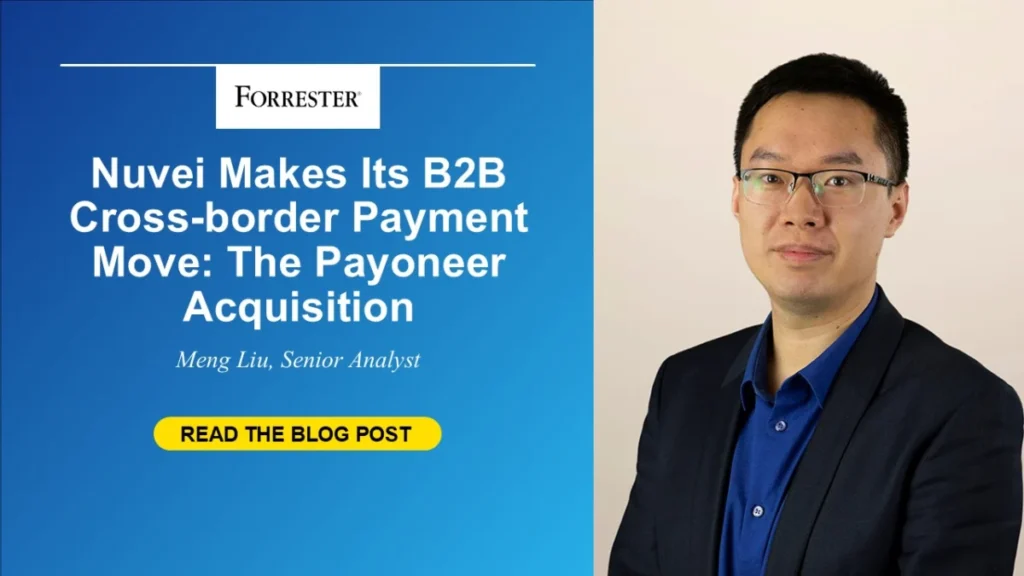
The Great Convergence: How Nuvei’s $2.75 Billion Payoneer Acquisition Reshapes the B2B Payments Landscape
The global financial infrastructure is undergoing a tectonic shift. In a move that signals the end of the era of fragmented, point-solution fintech, Nuvei Corporation has announced its intent to acquire Payoneer for $2.75 billion. This acquisition is not merely a consolidation of assets; it is a strategic blueprint for the future of B2B cross-border commerce. By merging Nuvei’s prowess in merchant acquiring and embedded payment infrastructure with Payoneer’s vast network of cross-border payouts, multicurrency accounts, and marketplace connectivity, the deal creates a comprehensive financial operating platform designed to replace the archaic, high-friction systems that have historically hindered global trade.
The Architecture of the Deal: Merging Two Financial Powerhouses
The $2.75 billion transaction brings together two entities with highly complementary technical and regulatory moats. To understand the significance of this union, one must look at the specific capabilities each firm brings to the table.
Nuvei has established itself as a leader in merchant payment acceptance, offering sophisticated local acquiring, card issuing, and a diverse range of alternative payment methods. Their strength lies in their agility and their ability to embed payment infrastructure into digital platforms. Conversely, Payoneer has built a formidable reputation as the "plumbing" for the gig economy and export-oriented small and medium-sized businesses (SMBs). Their reach spans more than 150 markets, underpinned by complex banking relationships and a robust engine for real-time, cross-border settlement.
Crucially, Payoneer offers a regulatory "hard asset" that is notoriously difficult to replicate: deep licensing in mainland China and in-principle authorization as a cross-border payment aggregator in India. For Nuvei, these licenses are the "keys to the kingdom," allowing them to bypass years of regulatory hurdles and immediately serve export-oriented businesses in two of the world’s most complex and lucrative markets. By integrating these capabilities, the combined entity creates a unified ecosystem where collections, payouts, FX management, compliance, and reconciliation happen within a single, integrated dashboard.
Chronology of Consolidation: A Pattern of Strategic M&A
The Nuvei-Payoneer deal does not exist in a vacuum; it is the most prominent milestone in a wider, relentless wave of consolidation sweeping through the B2B payments sector. Over the past twenty-four months, the market has pivoted from "siloed innovation" to "integrated dominance."
Phase 1: Securing the Rails (2023–Early 2024)
The initial phase of this trend was defined by infrastructure-level acquisitions. Mastercard’s planned acquisition of BVNK highlighted a critical realization: to own the future, you must control the rails. By moving to integrate stablecoin and fiat-rail connectivity, payment giants have begun preparing for a world where digital assets and traditional banking systems coexist.
Phase 2: The Expansion into B2B Movement (Mid 2024–Present)
This phase is characterized by merchant payment providers aggressively expanding into the B2B cross-border space. Stripe’s acquisition of Bridge and the current Nuvei-Payoneer merger are the standard-bearers here. These firms are no longer content with just processing a customer’s credit card at checkout; they want to facilitate the entire B2B supply chain, from the moment a wholesale order is placed to the final multi-currency settlement.
Phase 3: The "CFO Office" Integration
Simultaneously, specialists are moving up the value chain. Airwallex’s acquisition of Leapfin and Ripple’s strategic move for GTreasury represent a shift toward "finance automation." These firms are effectively building an operating system for the CFO, integrating FX automation, treasury workflows, and compliance reporting directly into the payment flow.
Phase 4: Bank-Fintech Hybridization
Legacy institutions are not standing still. BNP Paribas’s acquisition of Kantox serves as a prime example of banks aggressively buying, rather than building, the fintech capabilities needed to remain competitive in the digital age. By adding automated FX and treasury tools, banks are attempting to modernize their legacy infrastructure to compete with the agility of the fintech disruptors.
The Data Behind the Shift: Why Integration is Mandatory
The economic drivers behind this consolidation are clear. Businesses are facing unprecedented pressure to reduce operational complexity. According to industry data, fragmented payment stacks lead to high "hidden" costs—lost FX margin, reconciliation errors, and compliance bottlenecks that can consume up to 3–5% of transaction volume.
Furthermore, the rise of the digital marketplace economy has created a class of global businesses that operate 24/7. These enterprises demand same-day settlement and transparent, low-cost cross-border movement. Standalone providers that offer only "payouts" or only "FX" are finding it increasingly difficult to retain market share against platforms that offer the "Full Stack" experience.
Market research indicates that businesses are prioritizing "vendor consolidation" as a top-three strategic objective for the 2025–2027 fiscal period. This is a direct response to the "vendor lock-in" fatigue that has plagued firms using disparate tools for their global treasury needs.
Official Perspectives and Industry Implications
While Nuvei and Payoneer have framed the deal as a customer-centric transformation, the industry response has been one of cautious observation. Analysts suggest that the deal poses a significant threat to mid-market payment processors that lack the regulatory reach of Payoneer or the technical versatility of Nuvei.
"The race is no longer about owning a specific rail or a specific payment method," notes an industry expert. "The race is now about owning the broader finance and payments operating layer."
For banks and card networks, the implication is existential. They are being relegated to the role of "underlying utility" unless they can successfully integrate their own finance-operating layers. For the end-user—the SME exporter or the global digital platform—the shift is largely positive. It promises a future where the friction of international trade is reduced to the ease of a domestic bank transfer. However, this convenience comes with a caveat: the need for more rigorous due diligence regarding vendor lock-in and the evaluation of providers based on corridor-specific performance and workflow integration.
Looking Forward: The Future of the B2B Landscape
The Nuvei-Payoneer deal is a powerful indicator of where the industry is heading. As we move toward 2026, we can expect the following developments:
- Increased Regulatory Scrutiny: As platforms consolidate more power and data, regulators will likely intensify their focus on the systemic risks posed by these massive financial operating systems.
- Acceleration of M&A: The success (or failure) of the Nuvei-Payoneer integration will set the tone for further consolidation. We anticipate at least two more "multi-billion dollar" deals in the B2B cross-border space before the end of 2027.
- The Rise of "Embedded Compliance": Future competition will be won by those who can automate compliance as effectively as they automate payments. Reducing the "know your customer" (KYC) and anti-money laundering (AML) friction in cross-border flows will be the ultimate competitive advantage.
Forrester and other research bodies have noted that the next wave of competition will not be defined by who has the fastest transaction, but by who provides the most "frictionless finance." The winners will be the providers that can move money globally while simultaneously reducing operational complexity and risk across the entire finance workflow.
As the industry prepares for the upcoming Forrester B2B cross-border payments landscape report in late 2026, the message is clear: the era of the specialized, isolated payment tool is over. We have entered the age of the Integrated Financial Operating Platform, and for global businesses, this marks the beginning of a more transparent, efficient, and interconnected financial future.
Note: For further deep dives into the nuances of this consolidation, industry participants are encouraged to engage in formal inquiry sessions to analyze how these shifts in the payment landscape will affect their specific regional corridors and treasury workflows over the coming three-year horizon.
