
The Great AI Maturity Gap: Why B2B Organizations Are Falling Behind Their Own Employees
In the annals of corporate technological shifts, there is a distinct, recurring inflection point: the moment a tool transitions from a “competitive advantage” to a “foundational necessity.” For the B2B marketing sector, that threshold has officially been crossed.
According to the newly released 2026 State of AI for Business Report, artificial intelligence is no longer a peripheral experiment—it is the bedrock of modern professional efficacy. The report, which aggregated insights from over 2,100 professionals, paints a vivid picture of a workforce that has embraced the AI revolution, even as the corporate structures they inhabit struggle to keep pace.
The Consensus: AI as a Critical Success Factor
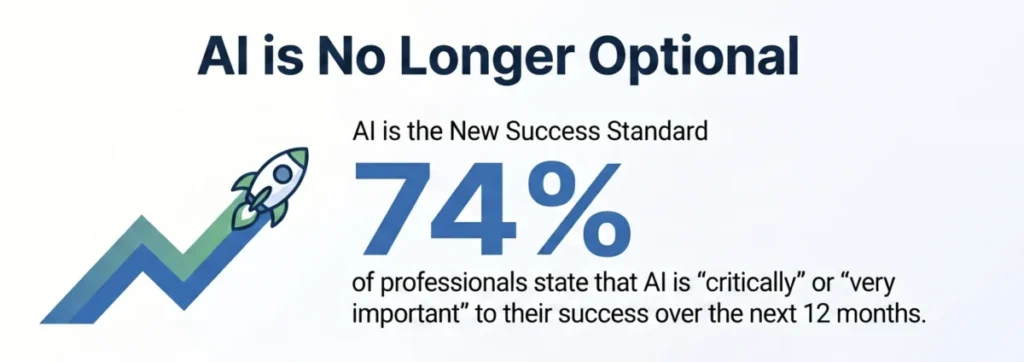
The data from the 2026 report is unambiguous. When asked about the importance of AI to their professional success over the next 12 months, a staggering 74% of respondents labeled the technology as “critically” or “very” important.
“That’s nearing about as close to a consensus on a survey question as you can get,” remarked Taylor Radey, Director of Research at SmarterX, during the report’s unveiling in May. This sentiment represents a seismic shift from just three years ago, when AI was largely relegated to "side-hustle" pilot programs or R&D labs. Today, AI is the engine room of daily productivity.
A Chronology of Adoption: From Curiosity to Core Infrastructure
To understand the current state of AI, one must look at the rapid acceleration of the last few years:
- 2022–2023: The Pilot Phase. AI was viewed through the lens of novelty. Companies experimented with generative text tools and image generators, treating them as clever gimmicks rather than operational necessities.
- 2024: The Productivity Surge. As Large Language Models (LLMs) became more reliable, knowledge workers began self-integrating AI into their workflows—drafting emails, summarizing meeting notes, and automating basic research.
- 2025: The Leadership Expectation. Corporate C-suites began to pivot, moving from skepticism to mandatory adoption, realizing that competitors utilizing AI were outpacing them in speed and output.
- 2026: The Maturity Chasm. We have arrived at a point where the workforce is ready to scale, but the structural, ethical, and governance frameworks of many organizations remain rooted in the past.
The Great Disconnect: Employees vs. Enterprises
The most alarming finding in the 2026 report is the widening "Maturity Gap" between individual contributors and their parent organizations. While 53% of professionals report that they are firmly in the "Integration" or "Transformation" phase—meaning they are embedding AI into their daily roles or redefining their career trajectory around the technology—the organizational data tells a different story.
Only 25% of the surveyed organizations have successfully reached the "Scaling" phase. Even more telling is that nearly half (47%) of companies are still effectively "stuck in pilot mode."
“This is not a knowledge gap,” explains Radey. “The people inside these organizations know what AI can do. But the organizations themselves haven’t built the infrastructure to operationalize AI and take full advantage of what their own employees are already doing on their own.”
This creates a dangerous paradox: Employees are hyper-efficient, but the enterprise lacks the roadmap, governance, and centralized strategy to harness that efficiency to drive collective business results.
Supporting Data: By the Numbers
The 2026 report offers a granular look at this disparity:
- 2,100+ Respondents: A diverse sample size providing a comprehensive view of the industry.
- 84% B2B Concentration: The data is specifically tailored to the nuances of B2B marketing, which requires longer sales cycles and more complex content strategy compared to B2C.
- 47% Pilot Stagnation: Nearly half of all organizations are trapped in a loop of endless experimentation without a clear path to return on investment (ROI).
- The "Human-in-the-Loop" Reality: The report confirms that as organizations advance, the demand for human expertise—specifically in strategy, ethics, and high-level creative direction—is actually increasing, not decreasing.
Official Responses and Expert Perspectives
Paul Roetzer, CEO of SmarterX and the Marketing AI Institute, emphasizes that the shift is as much psychological as it is technical. “You’re starting to see the sentiment shift,” Roetzer noted. “And these are AI-forward people—the people seeing the tools every day—who are finally realizing the profound impact on their daily outputs and long-term career growth.”
The leadership consensus, according to the report, is that ignoring AI is no longer a neutral position; it is a strategic error. However, many leaders remain paralyzed by the "governance trap"—the fear that deploying AI at scale will lead to data leaks, copyright issues, or brand inconsistency.
The report suggests that the solution is not to slow down, but to formalize the training and governance frameworks that allow for "safe speed."
The Implications for B2B Marketers
What does this mean for the average B2B marketing leader? The implications are three-fold:
1. The Strategy-Operations Alignment
Marketing leaders must bridge the gap between their team’s AI-savvy experimentation and the company’s broader operational goals. If your team is using AI to produce content 10x faster, but your legal and compliance teams haven’t updated their policies, you are creating a bottleneck. The goal is to move from shadow AI—where employees use tools secretly—to transparent AI, where the organization provides the tools, training, and security.
2. The Talent Retention Variable
Top talent is increasingly choosing to work for organizations that provide advanced AI tools. If your company is "stuck in pilot mode," you are at risk of losing your most innovative employees to competitors who have fully integrated AI into their culture. Providing access to AI is now a component of the employee value proposition.
3. The Need for "AI Literacy" as a Core Competency
The report suggests that the most successful organizations are those that move beyond technical training (how to use a prompt) to strategic training (how to judge the output and integrate it into a larger campaign strategy).
Practical Steps Toward AI Maturity
To address the disconnect, marketing organizations should prioritize the following actions:
- Establish a Governance Task Force: Create a cross-functional team (Marketing, Legal, IT, and HR) to define clear guidelines for AI use. This removes the "fear factor" and empowers employees to experiment safely.
- Centralize the Tool Stack: Instead of every employee using a different, unvetted tool, organizations should invest in enterprise-grade platforms that ensure data privacy and brand consistency.
- Implement Dedicated "AI Time": Similar to Google’s "20% time," organizations should provide employees with dedicated time to learn, test, and iterate with new AI tools.
- Create a Roadmap: Move away from the "pilot" mentality by setting specific, measurable goals for AI implementation. What processes can be automated in Q3? Which roles will be transformed by Q4?
Conclusion: The Final Verdict
The 2026 State of AI for Business Report makes it clear: the era of AI as an optional luxury is over. It is now a critical utility, much like the internet or cloud computing.
The question that remains for every B2B organization is whether they will evolve at the speed of their people or be left behind by the inertia of their own internal processes. For those who catch up, the rewards—greater efficiency, sharper strategy, and higher market impact—are waiting. For those who remain in pilot mode, the cost of inaction is growing by the day.
To view the full 2026 AI for Business Report, visit stateofbusiness.ai. For further insights on how to operationalize these findings, register for the upcoming B2B Summit.
