
The Great AI Divide: Why Individual Adoption Is Outpacing Organizational Strategy in B2B Marketing
In the history of corporate technology, there is a recurring inflection point: the moment a tool transitions from a “nice-to-have” competitive advantage to an existential requirement for survival. For B2B marketing, that moment has arrived. According to the 2026 State of AI for Business Report, the debate over whether artificial intelligence is a passing trend is effectively over. The question today is not whether to adopt AI, but whether organizations can build the structural scaffolding necessary to support the workforce that is already using it.
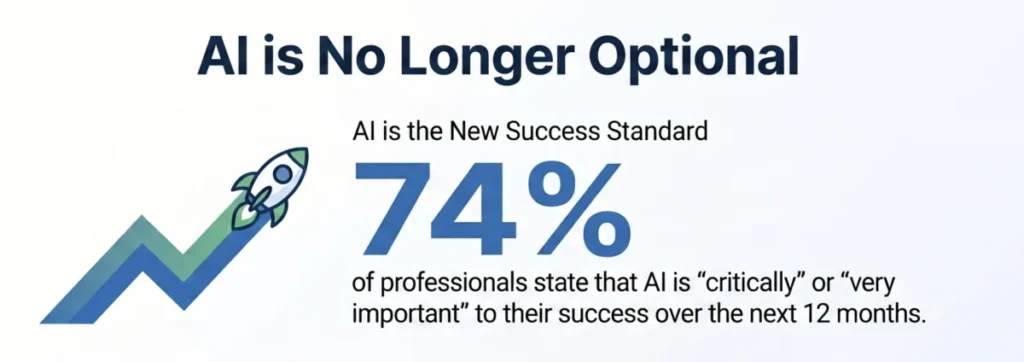
The report, which surveyed more than 2,100 professionals—84% of whom operate within the B2B sector—paints a picture of a workforce that has moved beyond experimentation. With 74% of respondents identifying AI as "critically" or "very" important to their professional success over the next 12 months, the industry is witnessing a near-unanimous consensus on the necessity of machine learning tools.
The Evolution: From Experimental Pilot to Daily Expectation
To understand the current landscape, one must look at the trajectory of AI over the past few years. Not long ago, AI was largely relegated to the fringes of marketing departments—the domain of tech-savvy early adopters running small-scale pilot programs. It was an afterthought, a “side project” that occupied the margins of the workday.
By 2026, that dynamic has been completely inverted. AI has moved from the periphery to the center of the desk. Knowledge workers are no longer just "testing" AI; they are relying on it to draft copy, analyze complex datasets, optimize campaign performance, and automate lead qualification. This shift has created a new expectation from leadership, which now views AI proficiency as a baseline requirement for modern marketing roles.
“You’re starting to see the sentiment shift,” says Paul Roetzer, CEO of SmarterX and the Marketing AI Institute. “And these are AI-forward people, the people seeing the tools every day, who are realizing the impact.”
This sentiment has been building for years, a slow-burning realization that finally reached a crescendo in 2026. The technology is no longer viewed as a novelty, but as a fundamental layer of the marketing tech stack, sitting alongside CRM and marketing automation platforms.
The Disconnect: A Widening Gap Between Employees and Enterprise
Despite the widespread adoption among individual contributors, the 2026 State of AI for Business Report highlights a troubling trend: a growing chasm between individual agility and corporate stagnation.
While 53% of professionals report that they are currently in the “Integration” or “Transformation” phases of AI adoption—meaning they have embedded AI into their daily workflows or are actively reimagining their roles around its capabilities—the corporate response has been sluggish. Only 25% of organizations have reached the “Scaling” phase, where AI strategy is operationalized across departments. Perhaps most alarming is that 47% of organizations remain stuck in “Pilot” mode, unable to bridge the gap between initial experimentation and company-wide implementation.
Taylor Radey, Director of Research at SmarterX, notes that this is not a deficit of knowledge. “This is not a knowledge gap,” Radey explained during the report’s launch webinar in May. “The people inside these organizations know what AI can do. But the organizations themselves haven’t built the infrastructure to operationalize AI and take full advantage of what their own employees are already doing on their own.”
This creates a high-stakes scenario for B2B marketing leaders. When individual employees are empowered to use AI but lack a corporate mandate or framework, the results are often fragmented, ungoverned, and disconnected from broader business goals.
The Anatomy of the Disconnect: Why Organizations Stall
Why are so many organizations finding it difficult to move beyond the pilot phase? The reasons are multifaceted and often stem from a lack of top-down alignment.
1. Lack of Governance and Security Frameworks
Many companies are hesitant to scale AI due to legitimate concerns regarding data privacy, copyright, and brand safety. Without clear policies on how to use AI responsibly, many organizations are choosing to stall rather than create guardrails, effectively stifling the innovation that their employees are eager to drive.
2. The Absence of a Strategic Roadmap
AI adoption often fails when it is treated as an IT project rather than a business transformation. Organizations that lack a clear roadmap—one that defines specific KPIs, identifies high-impact use cases, and allocates budget—inevitably find themselves in a perpetual state of "pilot purgatory."
3. The Skills Gap and Training Deficit
While employees are self-teaching, organizations have not yet invested in systematic training. Without formal upskilling, firms risk creating a “shadow AI” culture where employees use disparate, potentially insecure tools to get work done, rather than enterprise-grade solutions sanctioned by the organization.
Implications: The Risk of Inaction
For the B2B CMO, the implications of this gap are significant. If your team is running faster than your company’s infrastructure can support, you face three primary risks:
- Operational Inefficiency: When different team members use different AI tools without a centralized strategy, the organization loses the benefits of data integration and shared learning.
- Talent Attrition: Top-tier marketing talent, particularly those who are AI-literate, are increasingly seeking out organizations that provide the tools, training, and culture to utilize advanced technologies. Companies that remain "stuck" risk being seen as outdated by the very employees they need to stay competitive.
- Strategic Misalignment: If the C-suite is still debating the validity of AI while the marketing team is already trying to scale it, the disconnect will manifest in budget disputes, unclear ROI reporting, and a failure to hit modern performance benchmarks.
Bridging the Gap: A Call to Action for B2B Leaders
The data from the 2026 report serves as a wake-up call. AI is not optional; it is the new operating system of B2B marketing. To catch up to their employees, organizations must transition from ad-hoc experimentation to a structured, scalable approach.
Establish a Governance-First Culture
The first step is moving from fear to structure. By establishing clear policies—what data can be fed into LLMs, which tools are approved, and how content must be audited—leaders can provide their teams with the “safety” to experiment without the associated corporate risk.
Invest in Dedicated "AI Time"
The report suggests that one of the biggest hurdles is the "day job." Marketing teams are often so overwhelmed by current campaigns that they don’t have the bandwidth to learn new tools. Forward-thinking leaders are now setting aside dedicated time each week for AI training and experimentation, treating it as professional development rather than a distraction.
Connect AI to Business Outcomes
The most successful organizations are those that move the conversation away from the technology itself and toward the results. Instead of asking, "How can we use AI?", leaders should be asking, "How can we use AI to reduce customer acquisition costs by 15%?" or "How can we increase content output without increasing headcount?" By framing AI in the context of core business metrics, organizations can secure the buy-in necessary to move into the scaling phase.
Conclusion: The Workplace Transition
The shift we are currently experiencing is less like a typical technology upgrade and more like a permanent, foundational change to the nature of work itself. For B2B marketers, the question is no longer whether AI will change how work gets done—the data confirms that it already has. The final hurdle is whether the organizational layer can evolve at the same speed as the human layer.
The 2026 State of AI for Business Report concludes with a clear imperative: the companies that survive the coming decade will be the ones that treat AI as a central pillar of their business strategy, supported by training, governance, and a clear roadmap. For the laggards, the cost of inaction is no longer just a missed opportunity—it is the loss of competitive relevance in an increasingly automated marketplace.
The workforce is ready. The tools are available. The only remaining question is whether leadership is prepared to build the structure that allows this potential to turn into real, measurable business growth.
To explore the full findings of the 2026 State of AI for Business Report, visit stateofbusiness.ai. For those looking to deepen their understanding of how to implement these strategies, register for the upcoming B2B Summit at the Marketing AI Institute event portal.
