
The Great Agency Pivot: How AI is Forcing a Radical Evolution in Marketing Services
The traditional agency model—once defined by billable hours, static retainer structures, and a clear division between "creative" and "technical" labor—is currently undergoing a seismic shift. As artificial intelligence moves from a novelty to a fundamental layer of the business stack, the gap between agencies that are merely experimenting with AI and those that are fundamentally rearchitecting their operations is widening at an unprecedented rate.
We are witnessing a "Great Pivot" in the professional services sector. The most forward-thinking agencies are no longer content with simply "adding AI" to their existing service menus. Instead, they are reimagining what an agency can be, evolving into hybrid entities that function as AI-native consultancy, development partners, and data-driven operational engines.
The Chronology of the Shift: From Efficiency to Transformation
The evolution of the marketing agency can be tracked across three distinct phases over the last decade:
- The Digital Integration Era (2014–2019): Agencies moved from traditional media to digital-first, focusing on platform specialization, social media management, and the rise of the "full-service" digital shop.
- The Optimization Era (2020–2023): With the proliferation of early-stage automation and SaaS, agencies began leveraging software to drive cost efficiencies and speed. This was characterized by "plug-in" AI tools used for basic content generation or data reporting.
- The AI-Native Era (2024–Present): We have entered a period where AI is no longer a peripheral tool but the central nervous system of the agency. Agencies are now developing proprietary workflows, building custom AI agents for clients, and providing high-level strategic consulting on how to operationalize machine learning across the enterprise.
This shift has created a clear divide. Stagnant agencies remain tethered to the labor-intensive, low-margin models of the past. Conversely, the "New Guard" of agencies are shifting their value proposition from doing the work to building the systems that enable the client to do the work more effectively.
Redefining the Service Delivery Model: Key Players
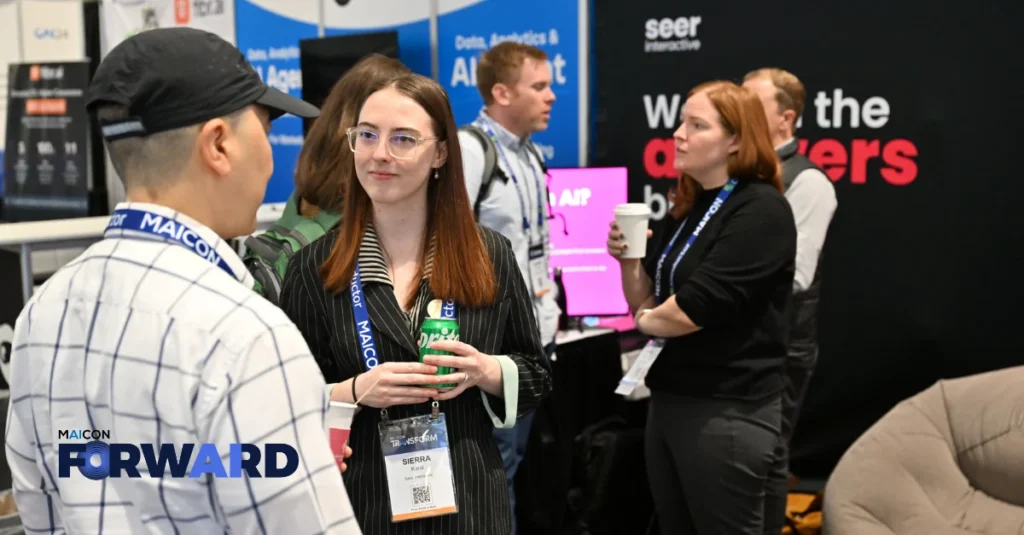
To understand how this transformation looks in practice, it is useful to look at the firms currently defining the bleeding edge of this industry. These agencies, all of which are featured sponsors at the upcoming Marketing AI Conference (MAICON), are providing a roadmap for how businesses can bridge the gap between AI experimentation and tangible, revenue-generating impact.
1. Algomarketing: The Human-Centric AI Hybrid
Algomarketing is moving beyond simple tool implementation by focusing on "People Transformation" and "Process Transformation." By embedding senior practitioners into client teams, they act as an internal audit mechanism. They identify legacy workflows that are ripe for automation and co-build AI-native agents that execute these tasks. Their model emphasizes that technology is only as effective as the culture adopting it.
2. Demand Spring: The Revenue-First Consultancy
For B2B organizations, the integration of AI is not just about content; it is about the entire revenue engine. Demand Spring has positioned itself as a consultancy that connects marketing strategy with technical execution. By focusing on AI advisory—covering everything from ABM (Account-Based Marketing) to SEO and AEO (Answer Engine Optimization)—they help organizations move past the "pilot phase" of AI and into full-scale governance and operationalization.
3. EMMIE Collective: The Fractional Operations Model
EMMIE Collective represents the shift toward flexible, on-demand specialized labor. By providing fractional Marketing and Revenue Operations expertise, they allow clients to bypass the overhead of a traditional agency while gaining deep technical support across complex platforms like Salesforce, HubSpot, and Marketo. They treat data operations as the foundation upon which all AI-driven strategy must rest.
4. Fjorge: The Technical Back-End Partner
While many agencies focus on the front-facing "marketing" side, Fjorge focuses on the digital plumbing. As a development partner, they build the custom digital experiences, apps, and e-commerce platforms that serve as the interface for AI-powered marketing. Their role is to provide the engineering rigor necessary to ensure that "big ideas" don’t fail during implementation.
5. Intercept: The AI-Native Delivery Model
Intercept has embraced the "AI-native" label by building proprietary workflows that accelerate the entire marketing lifecycle—from research and content production to personalized campaign execution. Crucially, they maintain a "human-led" approach to strategy and creative, ensuring that while the speed of execution is automated, the strategic intent remains uniquely human.
6. Level Agency: The Data-Science Approach
Level Agency approaches the customer journey through the lens of "AI orchestration." By building repeatable, interconnected systems that link strategy, execution, and data science, they cater to brands with high-consideration, complex buying cycles. Their model demonstrates that when you connect every touchpoint with AI, you create a more predictable and measurable customer experience.
7. Seer Interactive: Two Decades of Experimentation
Seer Interactive offers a blueprint for how legacy firms can pivot. With over 20 years in the digital marketing space, they have transitioned into an AI research powerhouse. Through their internal "AI Lab," they test technologies before rolling them out to clients via their "SeerAdvance" consulting service. This validates the premise that the most effective AI agencies are those that are constantly experimenting on themselves.
8. Soarion Digital: Winning the "Answer Engine" War
Perhaps the most specific and forward-thinking focus comes from Soarion Digital, which is addressing the rise of "AI search" (e.g., Perplexity, ChatGPT search). By blending human expertise with AI citation-building, they help brands transition from traditional SEO to a model where they are the primary source of truth for AI-powered answer engines.
Implications for the Future of Marketing
The movement toward these AI-centric agency models carries several profound implications for businesses:
- The Death of the "Generalist" Retainer: Businesses are increasingly seeking specialized, outcome-based engagements. The era of paying a monthly fee for "general digital marketing" is being replaced by contracts tied to specific AI-driven deliverables—such as building an automated lead-scoring model or optimizing content for answer engines.
- The Rise of the "Consultant-Developer": The line between a marketing agency and a software firm is blurring. The most valuable agency partners now require a workforce that is fluent in both human empathy (creative strategy) and data engineering (AI model training).
- Governance as a Service: As AI adoption scales, the primary bottleneck for many organizations is no longer access to tools, but rather governance, compliance, and data security. The agencies of the future are becoming de facto legal and technical advisors on how to deploy AI safely at scale.
- The Competitive Advantage of "Proprietary AI": Agencies that rely solely on off-the-shelf tools like ChatGPT will find themselves commoditized. The winners in this space are those building proprietary datasets and unique workflow automations that provide a "moat" around their client’s marketing efforts.
Moving From Experimentation to Impact
The consensus among industry leaders is clear: the period of "AI novelty" is over. We have entered the era of practical application, where the goal is no longer to use AI, but to build with AI.
For business leaders looking to navigate this transition, the strategy is simple but challenging:
- Audit your current agency partners: Are they just using AI to make their current jobs faster (efficiency), or are they helping you build entirely new ways of reaching customers (transformation)?
- Prioritize data maturity: No AI agent can perform without clean, structured data.
- Invest in internal AI literacy: AI is a force multiplier, but it requires a team that understands how to prompt, audit, and direct the technology.
As the industry converges in Cleveland for MAICON 2026 (October 13–15), the conversation will shift from "What is AI?" to "How do we scale AI to deliver measurable business results?" The agencies highlighted above represent the frontline of this evolution, serving as the essential architects for businesses attempting to thrive in an AI-first economy.
The message for CMOs and business owners is urgent: the agency model is being rewritten in real time. Those who fail to evolve their partnerships will likely find themselves competing in a marketplace where their rivals are moving at the speed of algorithms, while they are still tethered to the manual processes of the past.
