
The Generative AI Paradox: Mapping the High-Speed Evolution of Martech
The Gartner Hype Cycle has long served as the industry’s North Star—or perhaps its warning flare—for emerging technologies. It is a model both revered for its predictive accuracy and reviled for its oversimplification. Yet, as generative AI (GenAI) reshapes the marketing technology landscape, the traditional curve is proving insufficient. We are no longer witnessing a single, monolithic technology drifting through stages of maturity. Instead, we are seeing a fragmented, high-velocity explosion of innovation where every use case is charting its own chaotic course.
The Myth of a Singular Hype Cycle
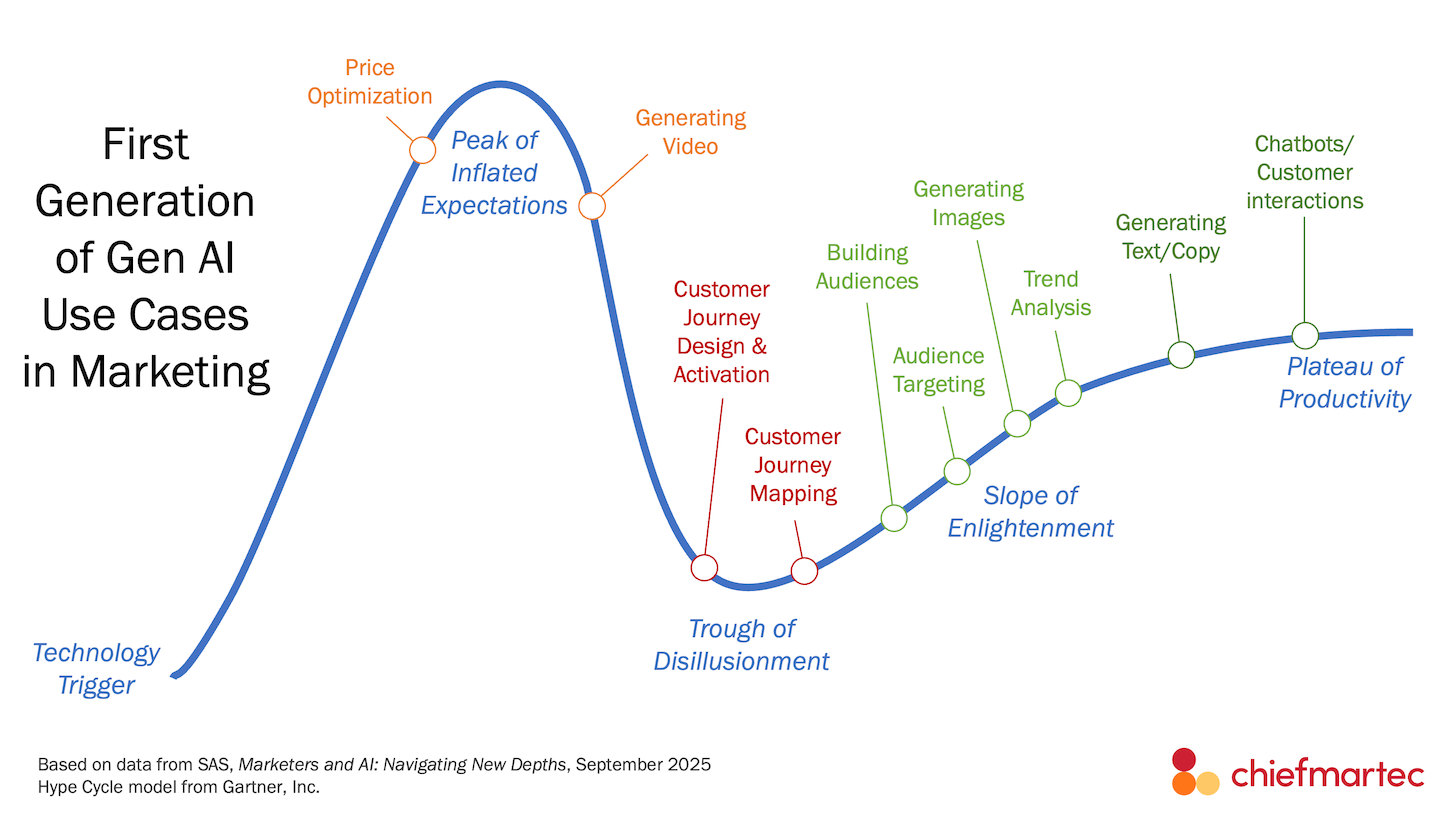
When discussing GenAI in the marketing sphere, the most fundamental error is the assumption that it exists at one point on the Hype Cycle. Is it at the "Peak of Inflated Expectations," the "Trough of Disillusionment," or the "Slope of Enlightenment"?
The reality is that it is all of the above. Generative AI is not a singular entity; it is a sprawling ecosystem of applications. A sophisticated LLM-driven content generation tool might be hitting a "Plateau of Productivity," while a nascent autonomous agent for cross-channel media buying might still be climbing the "Peak of Inflated Expectations."
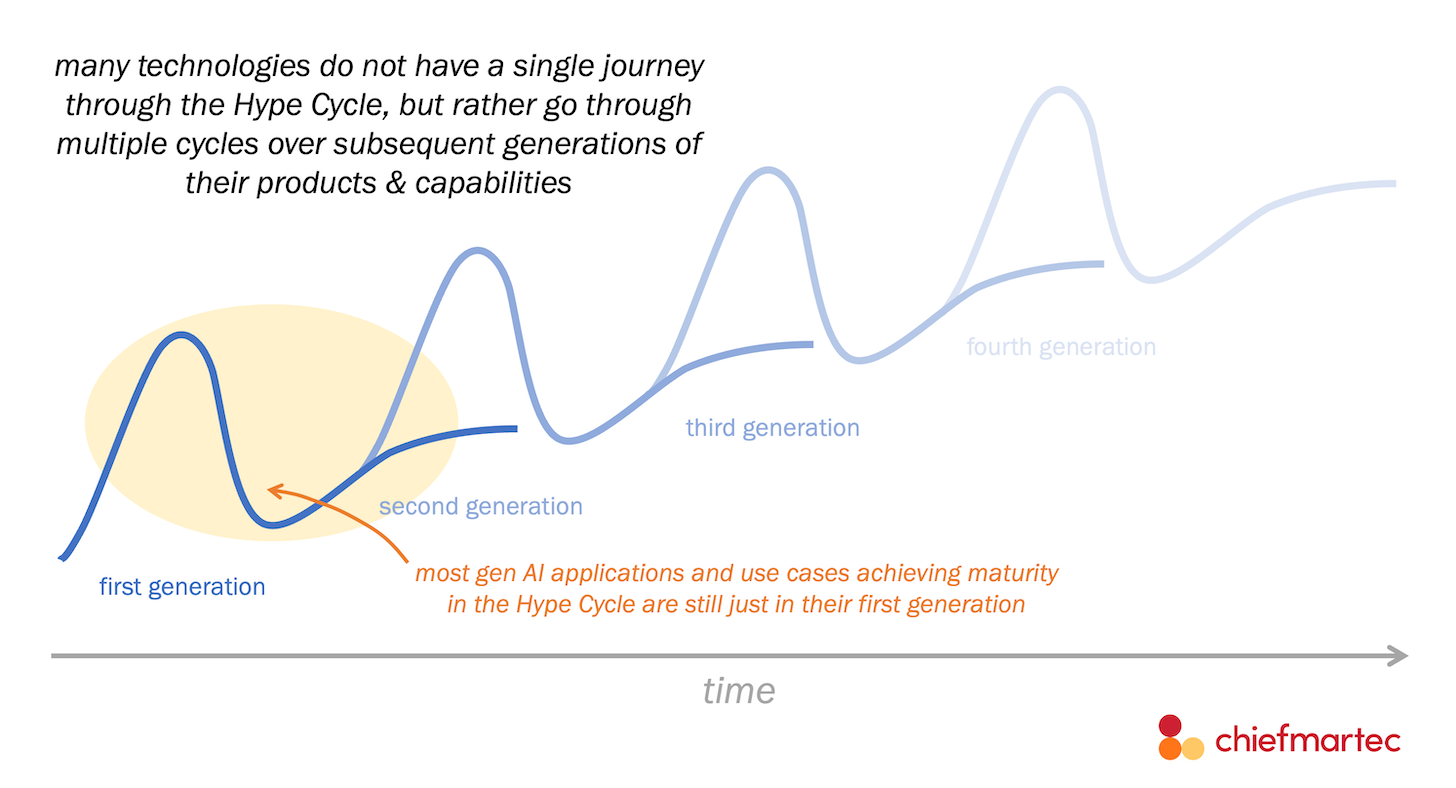
This complexity is compounded by the "generational" nature of these tools. We are currently in the first generation of widespread GenAI application. Today’s chatbots, which we celebrate for basic customer service efficiency, will seem laughably primitive in five or ten years. As these technologies evolve, each iteration triggers its own cycle. We can effectively hold two opposing states in our minds simultaneously: a technology can be simultaneously mature enough to provide utility (Plateau of Productivity) while being the subject of immense, speculative hype for its next-generation capabilities (Peak of Inflated Expectations).
Chronology of an Unprecedented Acceleration
The speed at which these AI applications are traversing the Hype Cycle is historically unprecedented. Historically, a technology might take a decade to move from a "Trigger" to the "Plateau of Productivity." In the world of modern martech, that timeline has collapsed into a matter of months.
Before a specific generation of a tool has fully reached the plateau, developers are already launching the next generation. This creates a "telescoping" effect, where cycles are stacked upon one another. This acceleration is felt acutely by marketing leaders, who are tasked with maintaining a coherent strategy while the ground beneath them is constantly shifting.
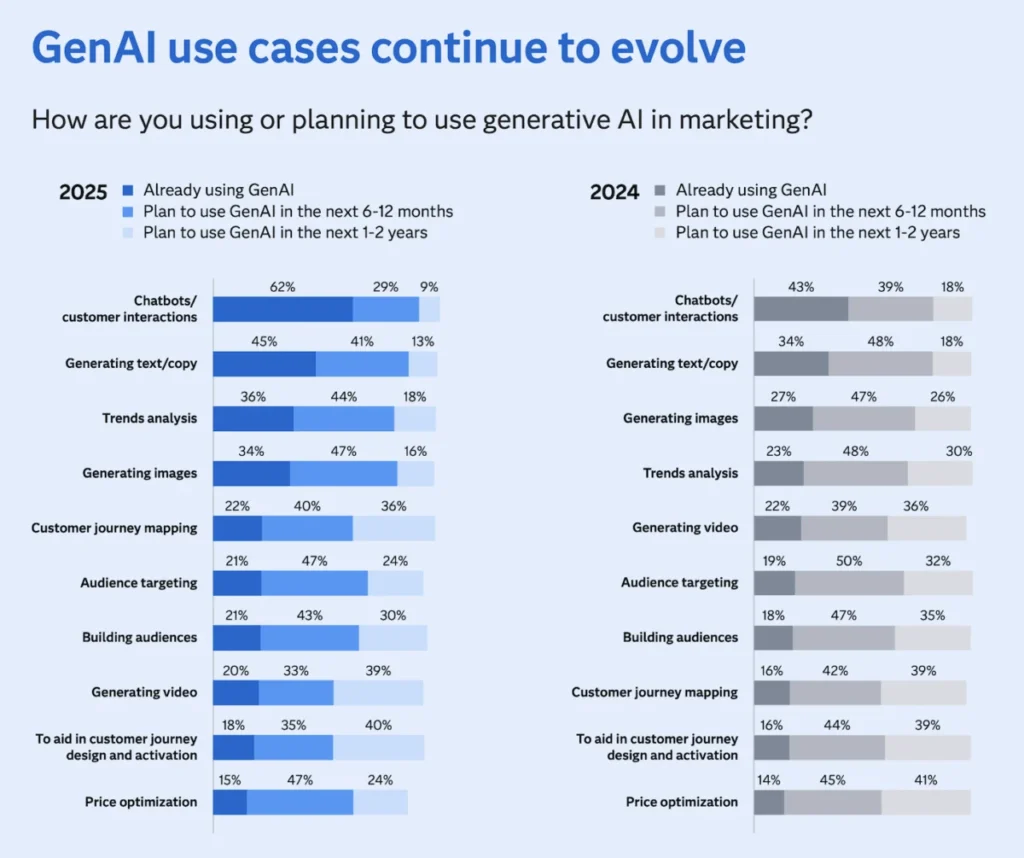
To quantify this, a recent report from SAS, Marketers and AI: Navigating New Depths, offers a rare glimpse into the empirical reality of this maturation. By surveying 300 marketing professionals in both 2024 and 2025, SAS has provided a comparative snapshot that highlights which use cases are gaining traction and which are falling behind.
Supporting Data: The Maturation of Use Cases
The SAS data reveals a significant 12-month acceleration in adoption across several key marketing functions. The most notable growth has occurred in:
- Content Creation: Moving from experimental drafting to core operational workflows.
- Customer Insights/Analytics: Leveraging AI to parse vast datasets that were previously unmanageable.
- Personalized Recommendations: Moving beyond static rules-based logic into dynamic, AI-driven customer journeys.
However, the data also reveals a darker side of the cycle. Certain use cases that received immense hype in 2024 saw a contraction in adoption by 2025. These are the casualties of the "Trough of Disillusionment." When a tool fails to deliver immediate, high-value ROI, or when the cost of implementation outweighs the marginal gains of the first generation, organizations are not shy about pulling the plug.
Mapping the Hype
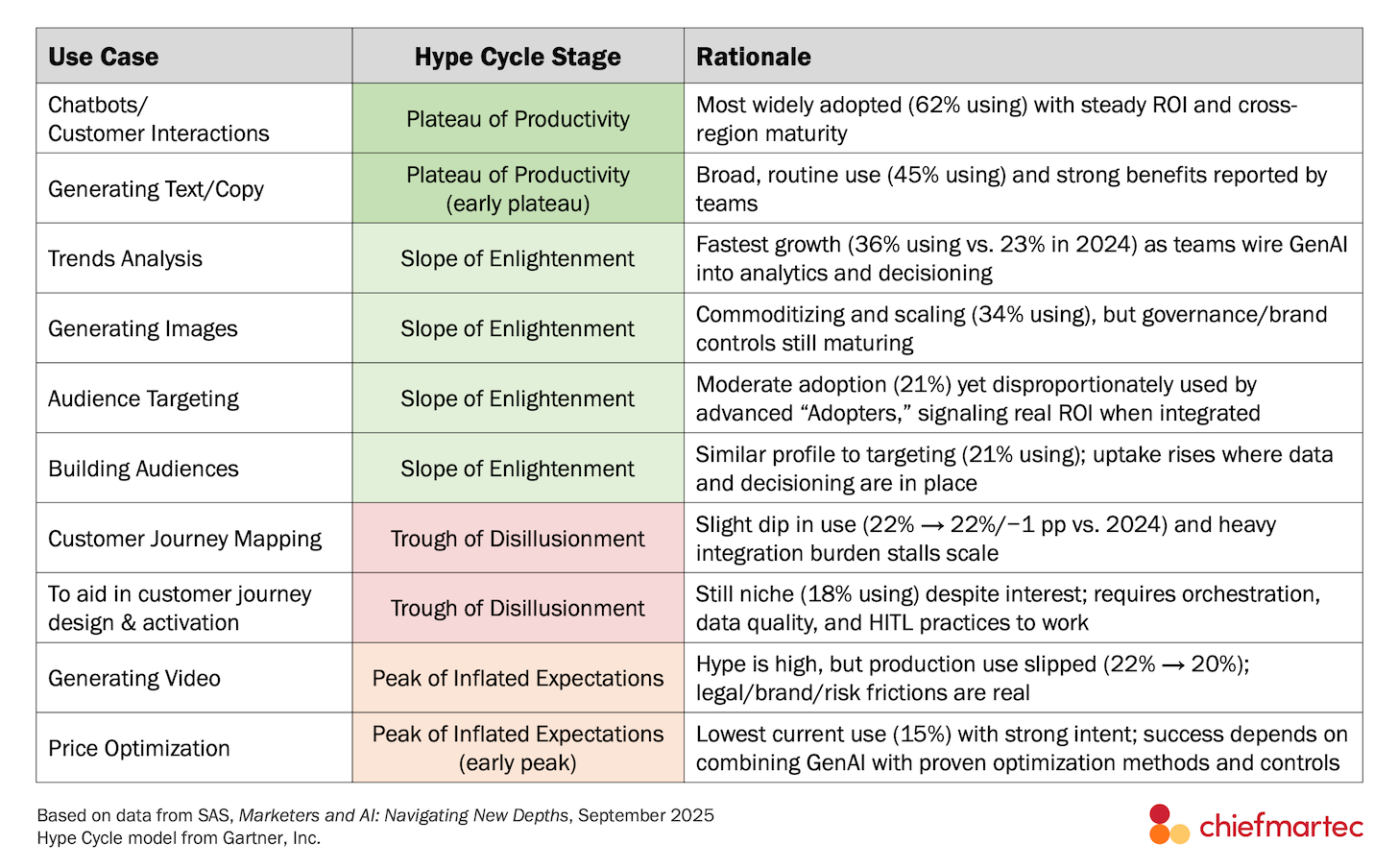
By overlaying this SAS data onto the Hype Cycle model, we can categorize these use cases with greater precision:
- Plateau of Productivity: Use cases like standard content generation and basic chatbots, which are now standard operating procedures for many firms.
- Trough of Disillusionment: Specific automated outreach or overly complex, under-tested predictive modeling tools that proved too difficult to integrate or too inaccurate to rely upon.
- Slope of Enlightenment: Emerging agentic workflows where human-in-the-loop systems are finally finding a stable, replicable balance between AI autonomy and human oversight.
It is important to note that this mapping is based on industry anecdotes and survey data, not an official Gartner forecast. The placement of these technologies is an interpretative exercise, designed to help marketers visualize where their specific investments sit on the curve.
Official Perspectives and Industry Response
Industry experts and the SAS report suggest that the "hand-wringing" phase of AI adoption is coming to an end, replaced by a "pragmatic deployment" phase. The initial shock of ChatGPT’s release in late 2022 has settled into a strategic evaluation of where AI provides structural efficiency versus where it introduces unnecessary risk.
SAS emphasizes that the most successful organizations are those that have stopped treating AI as a "shiny object" and started treating it as a component of the data architecture. The report notes that marketers who are "navigating new depths" are those who prioritize data quality and governance—the boring, foundational work that determines whether a model succeeds or fails in production.
Furthermore, the discussion is expanding beyond simple Generative AI. The report touches upon the early considerations of quantum computing in marketing. While this may sound like science fiction, the inclusion of such topics in the current dialogue suggests that the industry is preparing for a future where "disruption" is not an event, but a constant state of existence.
Strategic Implications for CMOs
For the modern marketing executive, the implications of this rapid, multi-cycle environment are clear:
- Avoid Monolithic Thinking: Do not assume your entire AI strategy is in one phase. Audit your tools individually. Your chatbot strategy might be mature, while your predictive analytics strategy is still in the "Peak of Inflated Expectations."
- Prioritize Modular Adoption: Given the speed at which cycles turn, avoid long-term, rigid vendor lock-in for GenAI features. Focus on modular, API-first architectures that allow you to swap out "first-generation" components for more advanced, "second-generation" alternatives without replatforming your entire stack.
- Embrace the "First-Generation" Reality: Accept that the tools you use today are the worst versions of those tools you will ever use. Plan for obsolescence. Build processes that are flexible enough to accommodate the rapid evolution of the underlying technology.
- Data as the Moat: The "Hype Cycle" applies to applications, but the "Plateau of Productivity" is reached through proprietary data. AI models are becoming commodities; the data that trains those models—and the customer insights they yield—remains the true competitive differentiator.
Conclusion: An Exhilarating Trajectory
Is it an exhausting time to be in marketing? Absolutely. The constant need to learn, unlearn, and re-learn is a tax on the profession. But it is also, as the data suggests, an incredibly exhilarating time.
We are living through the most significant shift in the mechanics of marketing since the dawn of the internet. By recognizing that we are navigating multiple, overlapping Hype Cycles rather than one long, linear path, marketers can stop feeling like they are "behind the curve" and start acting as the drivers of their own digital transformation. The tools are evolving, the expectations are resetting, and for those who can maintain a first-rate intelligence—holding two opposing truths in mind at once—the opportunities are limitless.
