
The Generative AI Paradox: Mapping the High-Speed Evolution of Martech
The Gartner Hype Cycle has long served as the industry’s North Star for navigating technological maturity. It is a framework both revered for its predictive power and reviled for its oversimplification. Yet, as generative AI (GenAI) reshapes the marketing technology (martech) landscape, the traditional curve is being pushed to its breaking point. We are no longer observing a single, monolithic technology on a predictable arc; we are witnessing a complex, multi-layered collision of various AI applications, each moving at a velocity that defies historical precedents.
The Myth of the Monolithic Technology
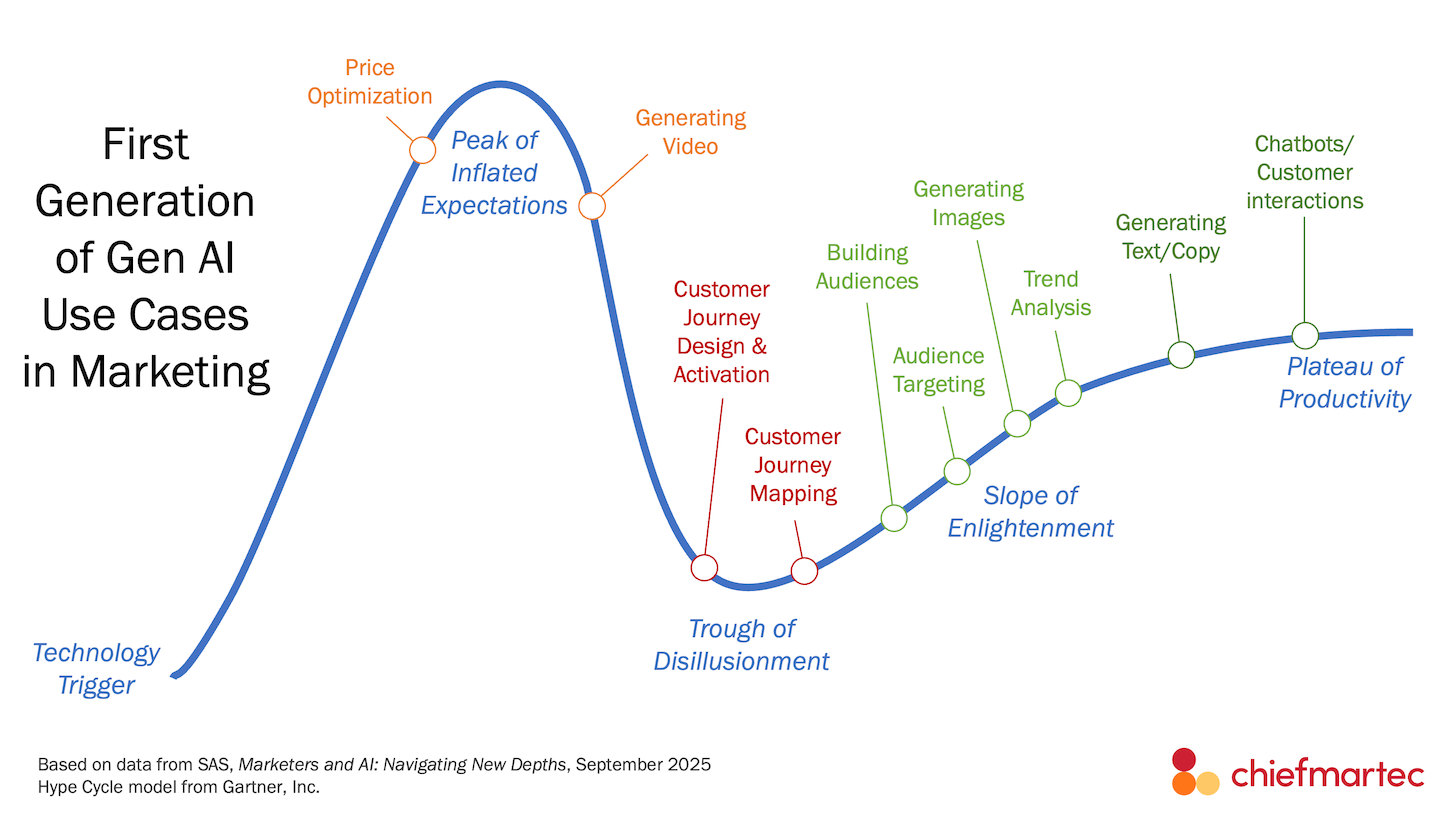
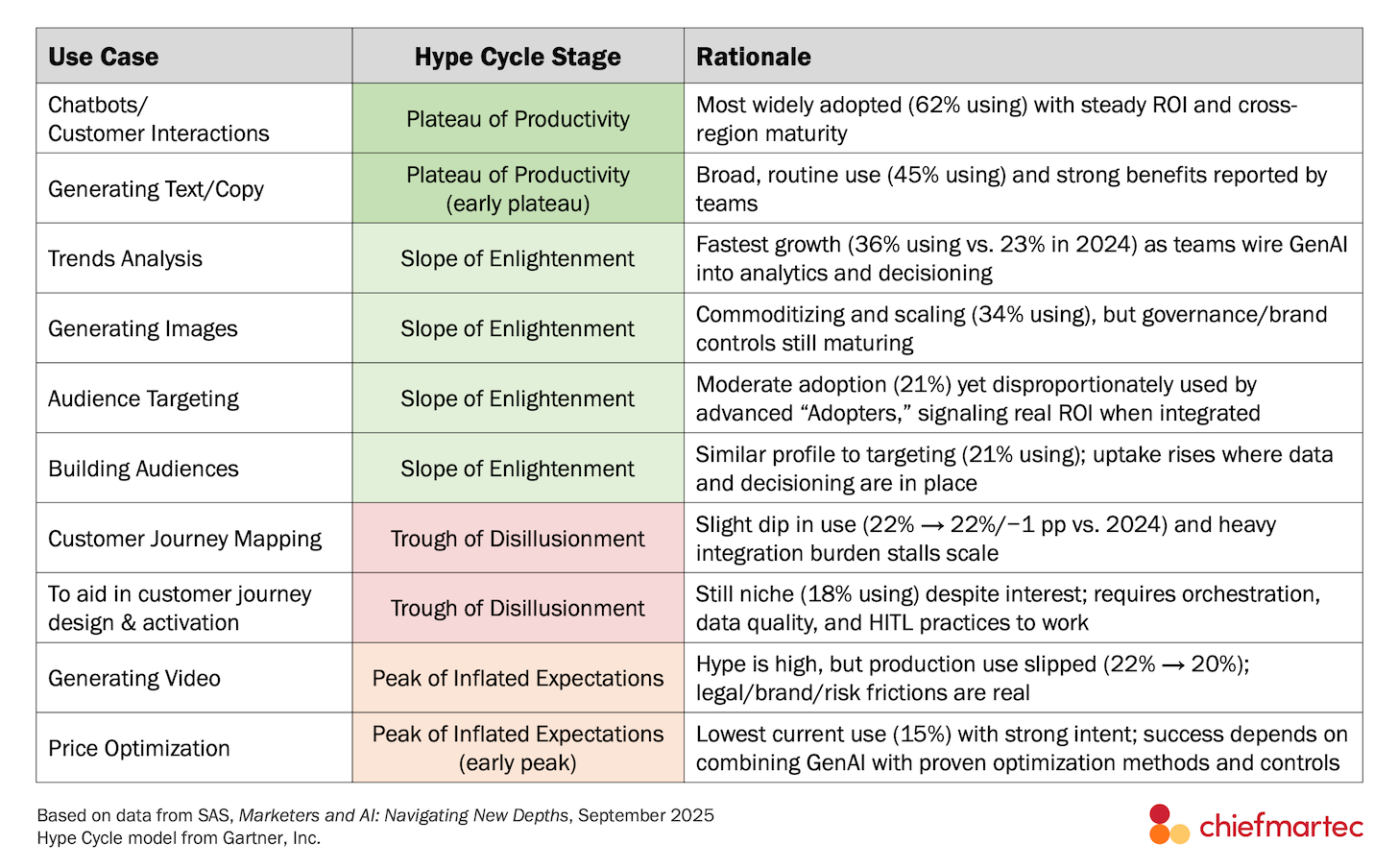
To understand the current state of marketing AI, one must first dismantle the misconception that "GenAI" is a singular entity moving through the cycle. The reality is far more fragmented. Depending on the specific use case—from automated copywriting to predictive customer journey orchestration—different technologies currently reside at every stage of the Hype Cycle simultaneously.
Some applications, such as basic content generation, appear to be settling into the Plateau of Productivity. Others, perhaps more ambitious in their scope, are currently struggling in the Trough of Disillusionment, while the next wave of agentic AI capabilities is already beginning to crest at the Peak of Inflated Expectations.
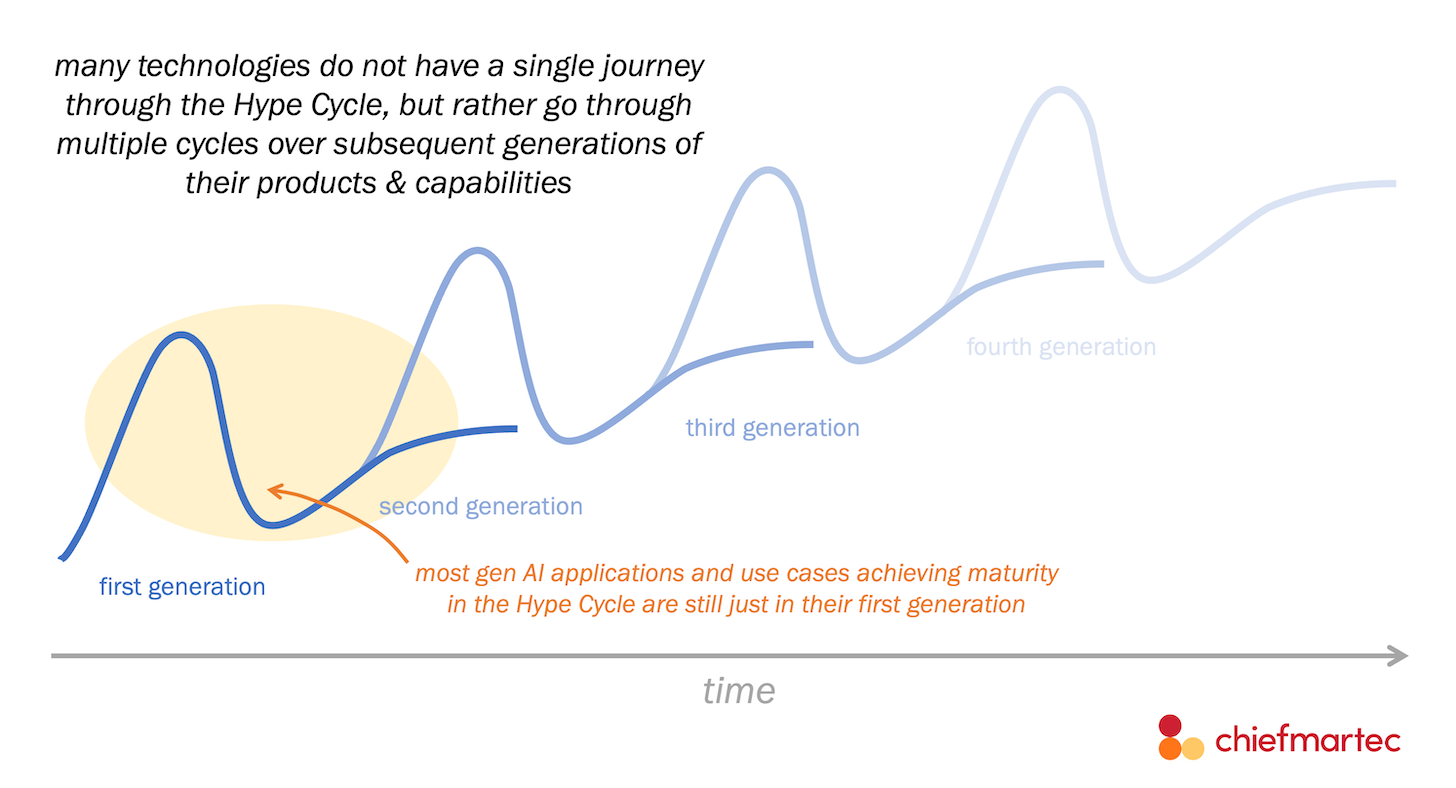
The crux of the matter is "generational maturation." Today’s AI-powered chatbot, capable of answering standard FAQs with reasonable accuracy, is a first-generation tool. As we look toward the horizon of the next two, five, and ten years, the expectations for these tools will escalate exponentially. Future agents will not merely provide information; they will possess agency—the ability to act, negotiate, and execute complex, multi-step commerce motions on behalf of the consumer. Consequently, we are entering an era of "recursive hype," where each new generation of technology launches its own independent cycle before the previous one has even finished its transition to widespread adoption.
Chronology: The Accelerated Lifecycle
In the not-so-distant past, the journey from a technology’s "trigger" to the "plateau of productivity" was a decade-long odyssey. Today, that timeline has been compressed into a frantic two-year window. This unprecedented acceleration creates a sensation of instability for martech leaders, who feel the ground shifting beneath them.
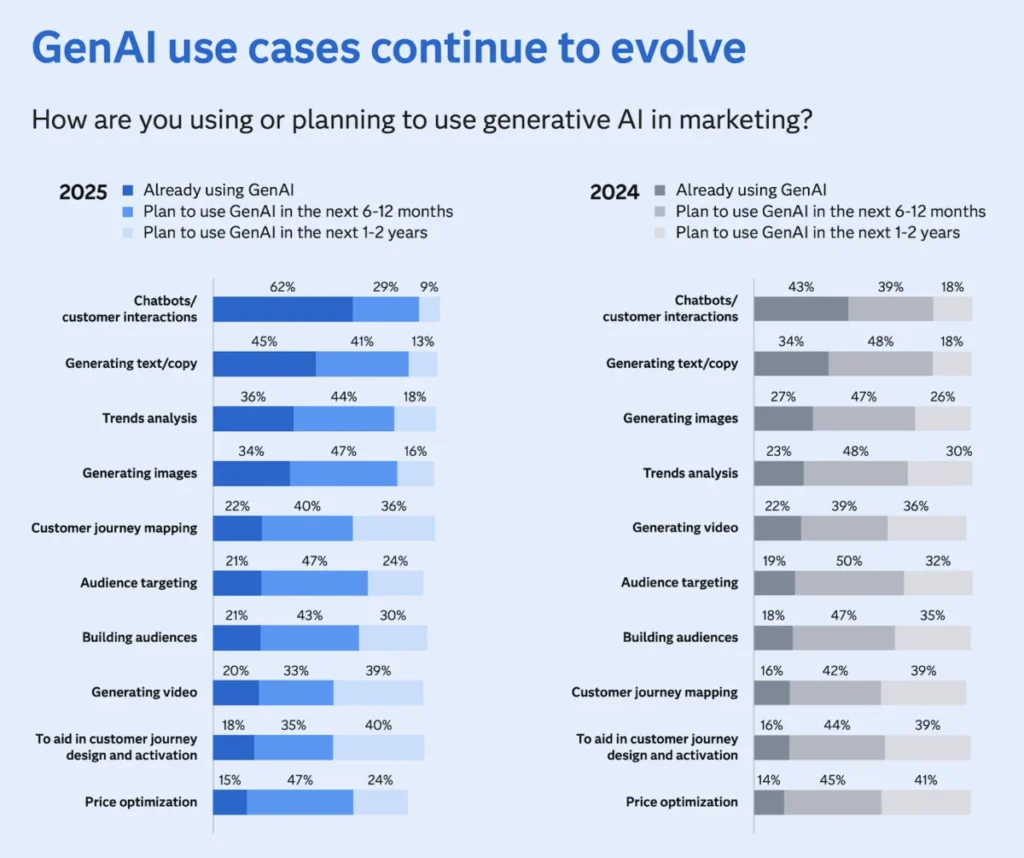
The data provided by the latest SAS report, Marketers and AI: Navigating New Depths, offers a rare, empirical look at this compressed timeline. By comparing adoption and planning metrics from 2024 to 2025 across 300 industry professionals, the report highlights that the "incubation period" for marketing tools has virtually vanished.
The 2024-2025 Shift
The most dramatic observation from the SAS data is the speed of adoption for specific use cases.
- Rapid Ascenders: Use cases like AI-driven content generation and basic sentiment analysis have seen massive year-over-year adoption spikes. These tools have transitioned from "experimental projects" to "operational necessities" at a breakneck pace.
- The Reversals: Perhaps most telling are the use cases that showed a decrease in adoption. This is the hallmark of the Trough of Disillusionment. When organizations pivot away from a tool, it is often because the initial "peak" promise failed to deliver immediate, measurable ROI, forcing a necessary period of re-evaluation and refinement.
Supporting Data: Dissecting the SAS Insights
The SAS study serves as a critical diagnostic tool for the industry. It categorizes ten distinct marketing applications of AI, providing a clear map of where the collective effort of the martech community is currently focused.
The Most Adopted (The Plateau)
The tools currently sitting at the Plateau of Productivity are those that solve immediate, high-friction problems. These include:
- Automated Content Creation: The "low-hanging fruit" of marketing AI.
- Customer Insight Generation: Using AI to parse vast datasets for actionable trends.
- Personalized Recommendations: Enhancing the UX through predictive modeling.
These applications have proven their worth. They are no longer "hyped"; they are integrated. Organizations have moved past the wonderment phase and are now focused on fine-tuning the performance of these engines to maximize efficiency.
The Disillusioned (The Trough)
Conversely, there are use cases that experienced significant fanfare in 2024 but have seen a cooling of interest in 2025. These often involve highly complex, integrated systems—such as fully autonomous, multi-channel campaign management—that proved too difficult to implement within existing organizational workflows. When the reality of "integration debt" hit, many firms retreated, reclassifying these initiatives as long-term research rather than immediate deployment.
Official Perspectives and Industry Rationale
While the SAS report provides the raw data, the interpretation of this landscape requires a nuanced understanding of how martech is deployed. The positioning of these use cases on a Hype Cycle map is not an exact science, but rather an informed approximation based on industry sentiment and empirical adoption rates.
The "first-generation-ness" of these tools cannot be overstated. We are currently testing the limits of Large Language Models (LLMs) in a marketing context. The rationale for placing a tool like "AI-driven Customer Service Agents" at the Peak of Inflated Expectations is simple: the current technology is being asked to do things it is not yet fully equipped to handle autonomously. As these models evolve—gaining better reasoning, memory, and security—they will eventually descend into the Trough before emerging as mature, reliable, and productive systems in their second or third iterations.
Implications: The Future of Marketing Strategy
What does this mean for the CMO and the martech stack architect? It implies a need for a shift in strategic posture.
1. Embrace the Multi-Cycle Mindset
The primary implication is the need for "first-rate intelligence"—the ability to hold two opposing ideas in the mind at the same time. A company can, and should, have one arm of its team working on the Plateau (optimizing current content AI) while another arm is exploring the Peak (investing in the next generation of autonomous agents).
2. Prepare for the Quantum Leap
The SAS report also touches upon the early considerations of quantum computing in marketing. While it may seem like science fiction, the history of the last 24 months suggests that what we consider "future tech" today will arrive in the marketplace much sooner than expected. Marketing leaders must ensure their data infrastructure is clean, secure, and ready to ingest the processing power of the next era of computing.
3. Focus on "Agency," Not Just "Content"
The era of "GenAI as a writing assistant" is ending. The next chapter belongs to "GenAI as an actor." Marketers should pivot their focus from tools that simply generate text or images toward tools that can manage complex workflows, negotiate with third-party platforms, and execute end-to-end customer interactions.
Conclusion: An Exhilarating Trajectory
The current climate of martech is arguably the most dynamic in history. While the speed of the Hype Cycle can be exhausting, it is ultimately a testament to the transformative power of AI. By moving from the Peak of Inflated Expectations to the Plateau of Productivity at such high velocity, the industry is forcing a rapid maturation process.
As we look toward the end of 2025 and into 2026, the brands that win will not be the ones that avoid the hype; they will be the ones that understand how to navigate the multiple cycles simultaneously. They will be the ones that view each failure in the Trough of Disillusionment as a necessary cost of learning and each success on the Plateau as a foundation for the next, more sophisticated leap.
The journey is far from over. If anything, the cycle is only beginning to accelerate. For the professional marketer, the ability to decode these curves and anticipate the next generation of tools is no longer just a technical skill—it is the defining competitive advantage of our time.
