
The Evolution of Efficiency: A Comprehensive Marketer’s Guide to Programmatic Advertising in 2026
In the modern digital landscape, the days of manual media buying—where marketers negotiated ad placements one-by-one with individual publishers—are fading into history. As digital touchpoints proliferate across streaming video, connected TV (CTV), audio platforms, and retail media networks, the sheer volume of available inventory has rendered human-led negotiation unsustainable. Enter programmatic advertising: the automated, data-driven engine that now powers nearly 90% of global digital display ad dollars.
With programmatic advertising revenue hitting $162.4 billion in 2025—a staggering 20.5% year-over-year increase—the technology has transitioned from an experimental niche to the fundamental infrastructure of the advertising industry. This guide explores the mechanics, ecosystem, and strategic implications of programmatic media buying in 2026.
The Core Definition: What Is Programmatic Advertising?
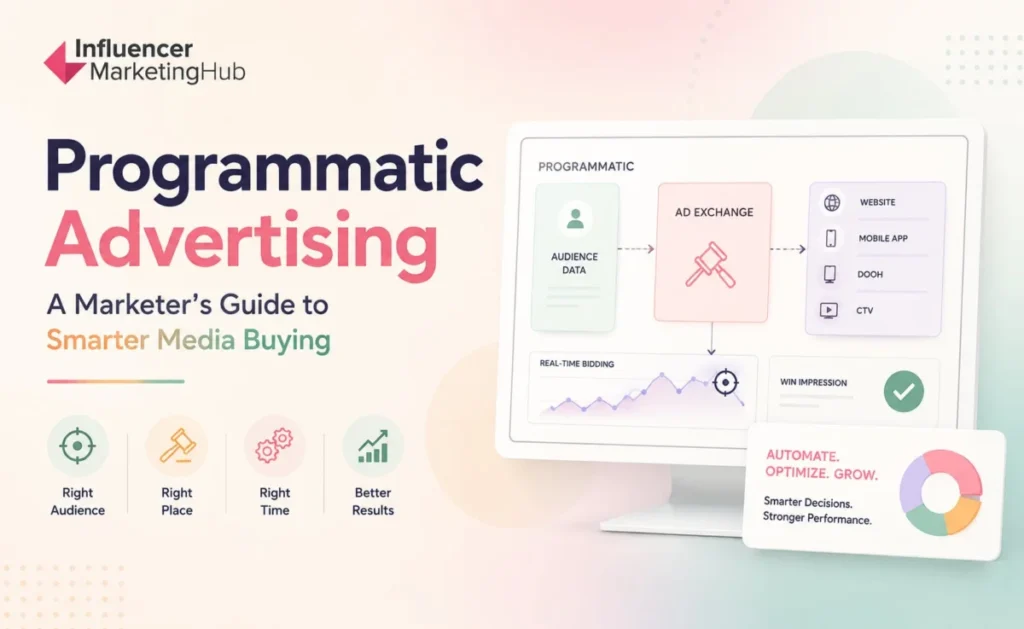
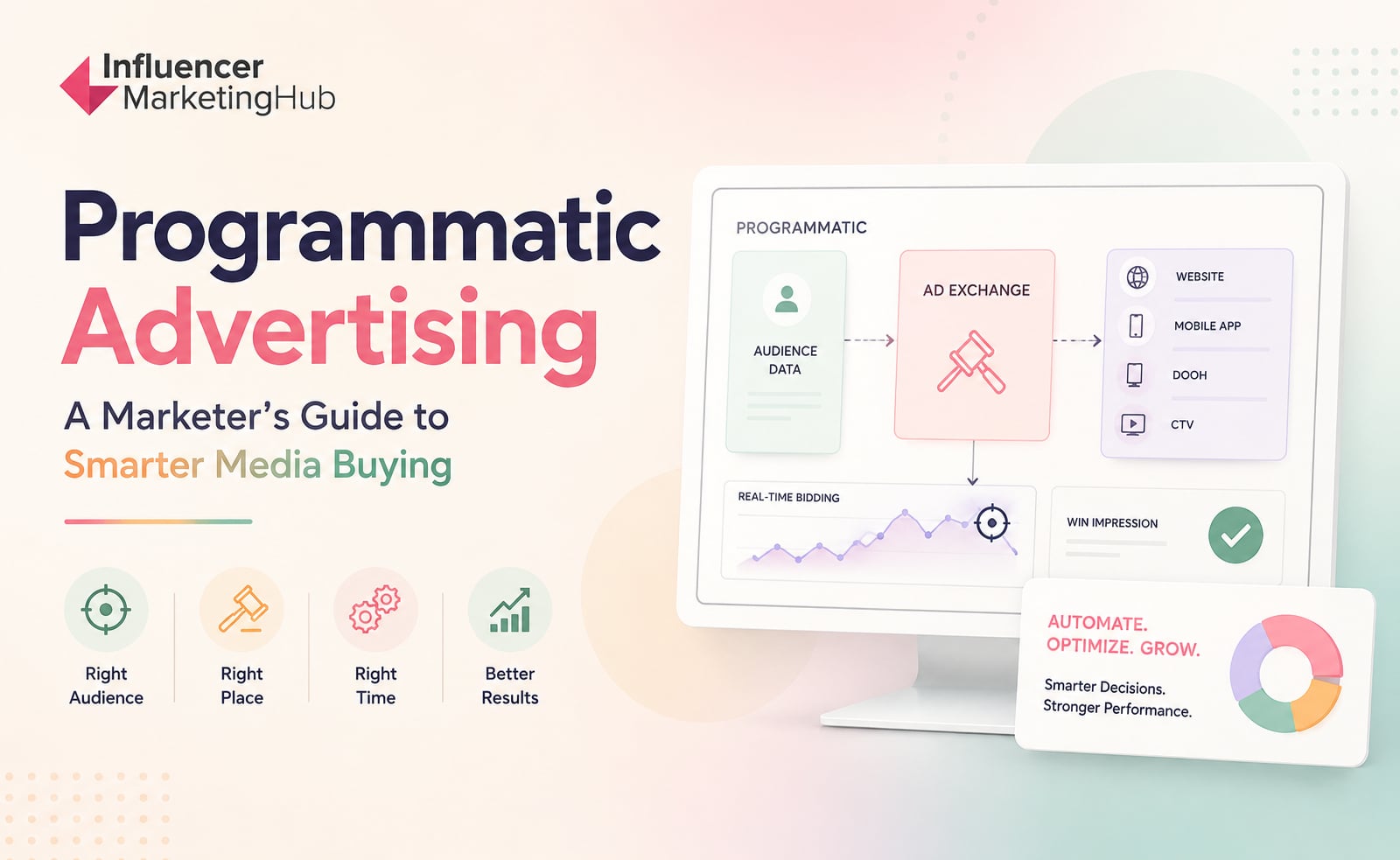
At its most fundamental level, programmatic advertising is the automated purchase and sale of digital ad inventory. Instead of relying on manual insertion orders and human-to-human communication, marketers utilize sophisticated software platforms to bid on ad impressions in real-time.
The process is a masterpiece of computational speed. When a user navigates to a website, opens a mobile app, or triggers a stream on a connected TV, a programmatic system evaluates that specific user, the content they are consuming, and the advertiser’s campaign objectives. It then submits a bid—all within the span of a few milliseconds. By the time the webpage finishes loading, the advertisement has already been selected, bought, and delivered.
The Shift from Manual to Automated
Traditional advertising relied on "direct" deals, which are still valuable for premium, high-impact placements. However, programmatic offers a level of granularity that traditional buying cannot match. By leveraging audience data, marketers can serve ads based on browsing behavior, geographic location, device type, and first-party customer insights, ensuring that the right message reaches the right person at the precise moment of engagement.
A Chronology of Programmatic Development
The transition to programmatic was not instantaneous; it was a decade-long evolution defined by the need for scale and efficiency.
- The Early 2000s (The Birth of Ad Networks): Initially, publishers had unsold ad space they couldn’t fill. Ad networks aggregated this "remnant inventory" and sold it to advertisers in bulk. It was the first step toward automation but lacked precise targeting.
- The Mid-2000s to 2010 (The Rise of Ad Exchanges): Ad exchanges emerged to function like stock markets for digital ads. This allowed for real-time bidding (RTB), moving the industry away from bulk buying toward impression-level purchasing.
- 2010–2018 (The Era of DSPs and SSPs): The ecosystem matured with the introduction of Demand-Side Platforms (DSPs) for buyers and Supply-Side Platforms (SSPs) for sellers. This period solidified the "walled garden" structures and standardized the RTB protocols that govern the web today.
- 2019–2026 (The Omnichannel Expansion): Programmatic has moved beyond standard banner ads. Today, we see the integration of programmatic buying into "emerging" channels, including Digital Out-of-Home (DOOH) billboards, podcast networks, and highly sought-after Connected TV (CTV) environments.
The Technological Infrastructure
Understanding programmatic requires a grasp of the "alphabet soup" of technologies that facilitate these micro-second auctions.
1. Demand-Side Platforms (DSPs)
The DSP is the advertiser’s control center. It allows marketers to manage campaigns across multiple channels (display, video, audio) from a single interface. Leading platforms such as The Trade Desk, Google Display & Video 360 (DV360), and Amazon DSP allow brands to set budgets, define target audiences, and optimize performance based on real-time data.
2. Supply-Side Platforms (SSPs)
If the DSP is for the buyer, the SSP is for the publisher. Websites, streaming services, and app developers use SSPs to list their available ad inventory and connect with the highest-bidding advertisers.
3. Ad Exchanges
The bridge between the two. The exchange acts as the digital auction house, facilitating the connection between the DSP and the SSP. It is here that the RTB (Real-Time Bidding) occurs.
4. Data Platforms (DMPs and CDPs)
Data Management Platforms (DMPs) were the industry standard for managing third-party data. However, with the decline of cookies and increased privacy regulations, the focus has shifted to Customer Data Platforms (CDPs), which help brands organize and activate their own first-party data to build deeper, more compliant audience profiles.
Supporting Data: Why Efficiency Wins
The surge in programmatic adoption is driven by clear, performance-based metrics. According to industry reports from 2026, the primary drivers for this shift are:
- Scalability: Programmatic allows a mid-sized brand to reach millions of users across thousands of niche websites without having to maintain thousands of individual contracts.
- Cost-Efficiency: Through real-time bidding, advertisers only pay the market rate for the specific impression they value.
- Precision: By integrating CRM data with DSPs, marketers can target existing customers with personalized offers or suppress them from seeing acquisition ads, reducing wasted spend.
The Cost Landscape
While programmatic is often viewed as "cheaper," pricing is highly variable.
- Standard Display: $1.50 – $4.00 CPM (Cost per Mille/thousand impressions).
- Programmatic Audio: $8 – $18 CPM.
- Connected TV (CTV): $20 – $40 CPM.
It is critical to note that a lower CPM does not always equate to better ROI. A $40 CTV impression that reaches a high-intent, affluent household on a large screen is often more valuable than a $2 banner ad that is never viewed by a human.
Official Industry Stance and Implications
Major industry bodies, including the IAB (Interactive Advertising Bureau), have consistently pushed for programmatic standardization to improve transparency. The "Programmatic Guaranteed" model has been a major focus of these efforts. By combining the automation of programmatic with the predictability of a fixed, direct deal, publishers and advertisers are finding a middle ground that ensures high-quality ad placement without sacrificing operational efficiency.
The Privacy and Brand Safety Implication
As we move toward 2027, the programmatic industry faces two major headwinds: Privacy and Brand Safety.
- Privacy: With the deprecation of third-party cookies, the reliance on contextual targeting (placing ads on pages relevant to the content) is returning to favor. Advertisers must now lean on first-party data and privacy-compliant identifiers.
- Brand Safety: Automated systems can occasionally place ads on inappropriate or harmful websites. Modern programmatic platforms now offer sophisticated "brand safety" tools that use AI to scan content in real-time, ensuring ads only appear in environments that align with the brand’s values.
Strategies for Success in 2026
To thrive in the programmatic space, marketers must move beyond simple "set-it-and-forget-it" strategies.
- Adopt an Omnichannel View: Do not silo your programmatic spend. Use the same DSP to coordinate your efforts across video, audio, and display to ensure a consistent frequency of messaging.
- Prioritize First-Party Data: Your own customer data is your most valuable asset. Connect your CDP to your DSP to create "lookalike" audiences that mirror your best existing customers.
- Focus on Creative Quality: In an automated world, the ad creative is the primary differentiator. Use dynamic creative optimization (DCO) to automatically adjust ad copy and visuals based on the specific audience segment viewing the ad.
- Test and Learn: Programmatic platforms provide vast amounts of data. Use A/B testing to compare the performance of different PMP (Private Marketplace) deals against open auction inventory.
Conclusion
Programmatic advertising is no longer just a trend; it is the infrastructure of the digital economy. While the technology behind it—DSPs, SSPs, and real-time auctions—may appear complex, the underlying objective is simple: creating a more efficient, relevant, and measurable advertising experience.
For the modern marketer, the path forward is clear. Success will not be found in manual labor, but in the strategic orchestration of data and technology. By embracing the capabilities of programmatic buying, brands can reach their audiences with unprecedented scale and precision, turning the "complexity" of the digital world into their greatest competitive advantage.
