
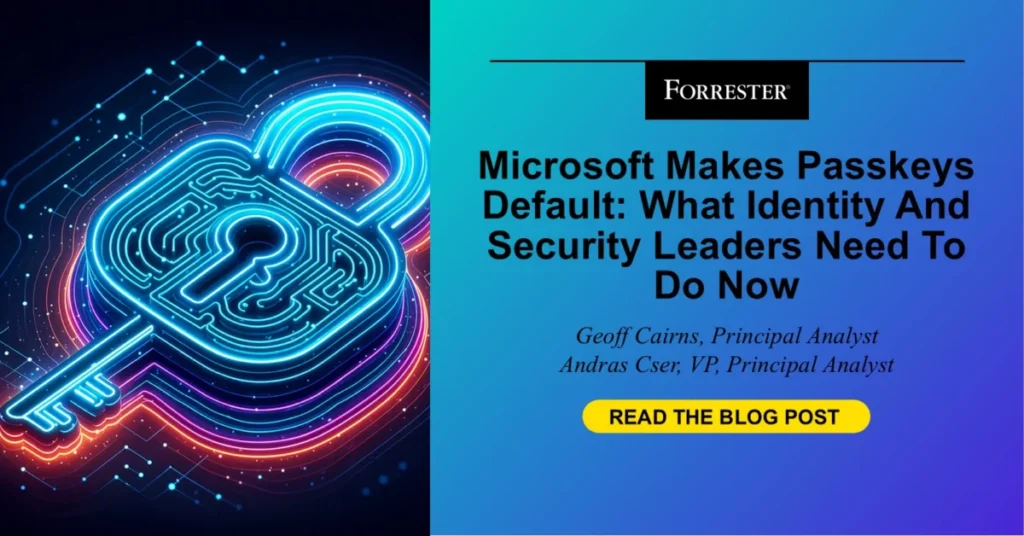
The Death of the Password: Microsoft’s Mandate Signals a New Era for Enterprise Security
In a landmark decision that promises to reshape the global cybersecurity landscape, Microsoft has officially declared that passkeys will become the default authentication method for all users within Microsoft Entra ID. This shift, announced in July 2026, is not merely a feature update; it is an inflection point that marks the beginning of the end for legacy authentication methods like SMS and voice-based Multi-Factor Authentication (MFA).
For years, cybersecurity professionals have treated "phishing-resistant MFA" as an aspirational, premium security tier reserved exclusively for high-value targets, such as system administrators or C-suite executives. That era has officially closed. By mandating a transition to passkeys, Microsoft is effectively democratizing high-assurance identity protection, forcing a fundamental rethink of how global enterprises verify their users.
The Main Facts: A Paradigm Shift in Identity
The core of Microsoft’s strategy is the systematic phase-out of phishable authentication factors. Beginning September 1, 2026, the company will automatically enable passkeys for all users currently relying on SMS or voice-based authentication. This transition is designed to nudge the workforce toward more secure, cryptographically backed login processes.
The move culminates in a hard deadline: February 1, 2027. On this date, Microsoft will officially retire its native SMS and voice authentication services. While organizations with specific operational requirements—such as those operating in regions with limited hardware support—will have the option to integrate third-party telecom providers via the Microsoft Security Store, the default state for any enterprise utilizing Entra will be phishing-resistant.
This transition is underpinned by FIDO (Fast Identity Online) standards, which use public-key cryptography to ensure that authentication is tied to the specific device and the specific service provider. Unlike SMS codes, which can be intercepted, phished, or bypassed through social engineering, passkeys are cryptographically bound to the origin, making them immune to the vast majority of adversary-in-the-middle (AiTM) attacks.
Chronology: Navigating the Transition
The shift to a passwordless future will occur in distinct waves, providing organizations with a structured runway to modernize their identity stacks.
- July 2026: Initial announcement and public guidance release. Microsoft initiates the awareness campaign for IT administrators.
- September 1, 2026: The transition window opens. Microsoft begins the automated rollout of passkeys for users currently authenticated via SMS or voice. Organizations are granted access to the Microsoft Security Store to evaluate third-party telecom integrations.
- Late 2026 – Early 2027: The "Migration Window." Organizations are expected to audit their legacy authentication dependencies and finalize the rollout of phishing-resistant hardware or platform authenticators.
- February 1, 2027: The "Sunset Date." Native SMS and voice authentication services are officially retired from the Microsoft Entra ecosystem. Only organizations with configured third-party telecom providers will retain the ability to use legacy OTP (One-Time Password) methods.
Supporting Data: Why Legacy Methods Are Failing
The industry consensus is clear: legacy MFA is no longer sufficient. For decades, organizations have relied on SMS codes as a security "safety net." However, the evolution of the threat landscape has rendered these methods porous.
According to industry reports and threat intelligence, MFA fatigue—where attackers bombard users with login requests until they accidentally click "approve"—has become a standard playbook for ransomware gangs. Furthermore, the rise of AI-assisted social engineering has allowed attackers to clone voices and generate convincing phishing sites that mimic legitimate login portals in real-time.
Research by Forrester and other leading security analysts suggests that the cost of an identity-related breach far outweighs the operational friction of transitioning to passkeys. When an organization utilizes SMS, it relies on a telecommunications infrastructure that was never designed for high-security authentication. By shifting to passkeys, companies move from "shared secret" authentication (like passwords or codes) to "possession-based" authentication, where the credential never leaves the user’s device.
This is part of a broader industry trend. Salesforce has already implemented strict phishing-resistant MFA requirements for its privileged users, and giants like Apple and Google have been aggressively pushing passkey adoption since 2022. Microsoft’s move effectively creates a "critical mass" that will likely force the rest of the SaaS ecosystem to follow suit.
Implications: A Strategic Catalyst for Security Leaders
For security leaders, Microsoft’s mandate should be viewed as a strategic catalyst. It is an opportunity to clear the "technical debt" of identity management that has plagued IT departments for years.
1. From Deployment to Verification
The measure of success for identity teams must shift. Moving forward, the KPI is not "how many users have MFA enabled," but rather "what percentage of the workforce is using phishing-resistant methods." By setting a clear, non-negotiable deadline, Microsoft has removed the "project prioritization" debate that often stalls these initiatives.
2. User Experience and Productivity
Contrary to popular belief, phishing-resistant MFA is often faster and more user-friendly than legacy methods. Passkeys allow users to sign in using biometrics (such as FaceID or Windows Hello) rather than waiting for an SMS code to arrive, entering it, and managing the inevitable expiration of those codes. Organizations that lean into this experience will likely see a reduction in help-desk tickets related to login issues.
3. Regulatory and Compliance Pressure
As regulatory frameworks like DORA (Digital Operational Resilience Act) and various state-level data privacy laws tighten, the bar for "reasonable security" is rising. Using legacy SMS authentication in a post-2027 world could be viewed as a failure of due diligence in the event of a breach. Adopting passkeys provides a robust defense for compliance auditors.
Official Responses and Industry Outlook
The industry response to Microsoft’s announcement has been overwhelmingly positive, albeit tempered by the acknowledgment that the transition will require significant effort for legacy-heavy enterprises.
"This is the inflection point we’ve been waiting for," noted one leading identity architect. "By making the secure path the easiest path, Microsoft is essentially forcing the market to mature overnight."
Microsoft’s own documentation emphasizes that this is not a "rip-and-replace" scenario for every user. Those already using Windows Hello for Business or FIDO2 security keys will experience zero disruption. The focus of the transition is specifically on those who have been "left behind" in the legacy authentication tier.
What Organizations Should Do Now
To prepare for the February 2027 deadline, security leaders should adopt a three-pronged approach:
- Inventory Your Legacy Debt: Identify every application and user group that currently relies on SMS or voice-based MFA. Use the next six months to categorize these users by their device capabilities and business needs.
- Prioritize Device Modernization: Passkeys are only as effective as the hardware that supports them. Ensure that the corporate device fleet is updated to operating systems that support modern FIDO2 standards.
- Communicate and Educate: The biggest hurdle to adoption is often user confusion. Develop a clear communication plan that explains why the change is happening. Emphasize that the new method is faster and more secure, and provide ample training materials before the transition date.
Conclusion
The era of the password and the OTP code is drawing to a close. Microsoft’s decision to mandate phishing-resistant authentication in Entra ID represents a pivotal moment in the history of digital identity. While the transition may pose logistical challenges for some, the long-term benefit—a significantly more secure and resilient enterprise—is undeniable.
The question for security leaders is no longer whether they will adopt phishing-resistant MFA, but how quickly they can complete the transition before the clock runs out. Those who act now will not only stay ahead of the February 2027 deadline but will also gain a decisive advantage against an increasingly sophisticated and AI-empowered adversary. The transition to passkeys is, ultimately, an investment in the foundational integrity of the modern digital enterprise.
