
The Data-Driven Advantage: Elevating Your Instagram Strategy in 2026
In the hyper-competitive digital landscape of 2026, the difference between a brand that resonates and one that fades into the background is rarely a matter of luck. It is a matter of data. With over 1.39 billion monthly active users spending an average of 11.7 hours per month on Instagram, the platform has evolved from a simple photo-sharing app into a critical business engine. For the 62.3% of users who utilize the platform specifically to research brands and products, content is the currency of connection. However, without a robust analytics framework, marketers are essentially navigating this ocean of attention blindfolded.
Main Facts: The Necessity of Quantifiable Strategy
The core premise of modern social media marketing is simple: if you aren’t measuring it, you aren’t managing it. Relying on intuition may yield sporadic successes, but it provides no roadmap for sustainable growth. True strategic excellence requires the ability to test, refine, and iterate based on cold, hard metrics.

By integrating professional-grade Instagram analytics tools, businesses can transition from guessing to knowing. These tools act as the bridge between creative output and business objectives, allowing teams to justify their efforts to stakeholders with concrete performance reports. They offer the granular visibility needed to understand not just what content is performing, but why it is resonating—or failing—with specific target demographics.
Chronology of Analytics: From Simple Likes to Predictive Intelligence
The evolution of Instagram metrics has been rapid. A decade ago, a brand’s success was measured almost exclusively by follower counts and vanity metrics like "likes." As the platform matured, the industry shifted its focus toward meaningful engagement: comments, shares, saves, and, eventually, conversion data.

By 2024, the industry had standardized the use of "best time to post" algorithms, which utilized global datasets to optimize reach. Now, in 2026, we have entered the era of predictive analytics. Modern tools no longer just report on what happened last Tuesday; they synthesize historical performance with real-time market trends to recommend posting schedules, content formats, and even tone-of-voice adjustments tailored to specific industry verticals. This chronological progression marks a shift from "reactive reporting" to "proactive planning," where the goal is to predict audience behavior before a single pixel is uploaded.
Supporting Data: Why Timing and Tracking Matter
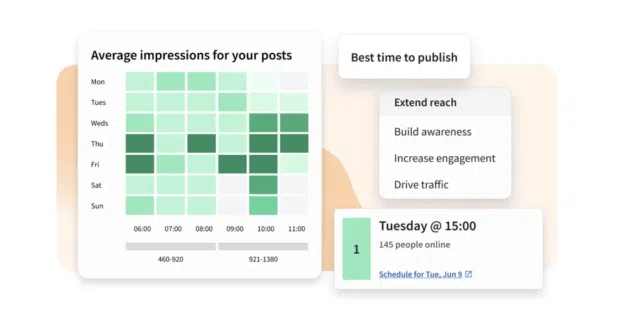
Data-driven insights reveal undeniable patterns in user behavior. Hootsuite’s latest research into global engagement confirms that the "best time to post" is not a static concept. For instance, Mondays between 3 PM and 9 PM consistently show high interaction rates, likely as users catch up after the weekend. Conversely, early mornings on Tuesdays (5 AM to 8 AM) provide a "golden window" for reaching commuters and early-risers.
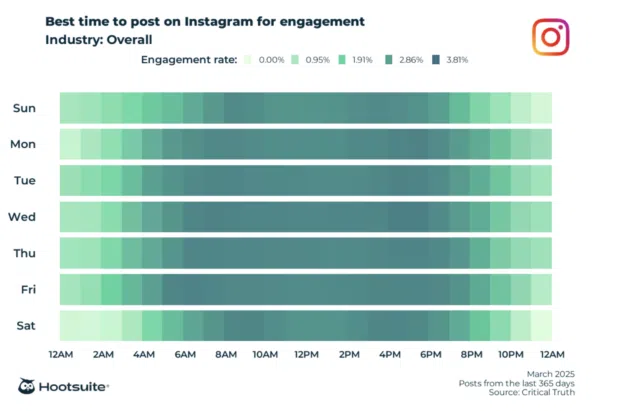
These are not just observations; they are actionable assets. When a brand ignores these data points, they are effectively publishing into a vacuum. Furthermore, the complexity of content types—Reels, Stories, Carousels, and static posts—demands a multi-dimensional tracking approach. Each format serves a different purpose in the marketing funnel: Reels are typically discovery-driven, while Stories foster deeper community loyalty. Without tools that differentiate between these metrics, a brand cannot effectively balance its top-of-funnel reach with bottom-of-funnel conversion.
The Top 9 Analytics Tools for 2026
To master the platform, marketers must move beyond the native insights provided by the app. While Instagram’s internal dashboard is useful for a quick check, it is inherently limited by data retention windows (often capping at 90 days) and a lack of comparative analysis. Here are the premier tools currently leading the market:
1. Perch by Hootsuite
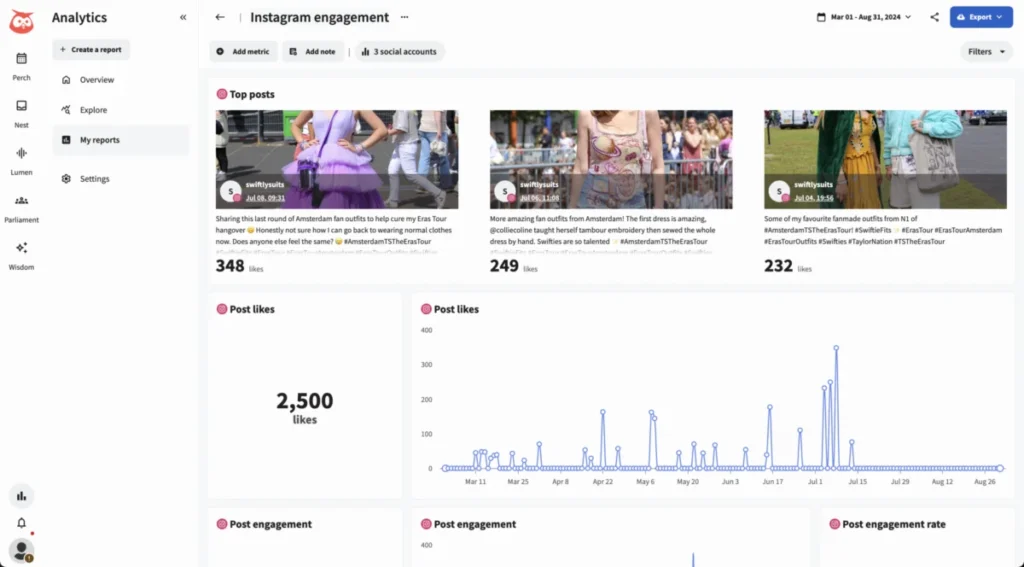
Perch stands as the gold standard for integrated social management. By unifying performance data across Instagram and other major networks, it eliminates the "silo effect" of checking individual apps. Its standout feature, the "Best Time to Publish" tool, is uniquely powerful because it bases recommendations on your brand’s specific historical data rather than generic benchmarks.
2. Instagram Insights (Native)
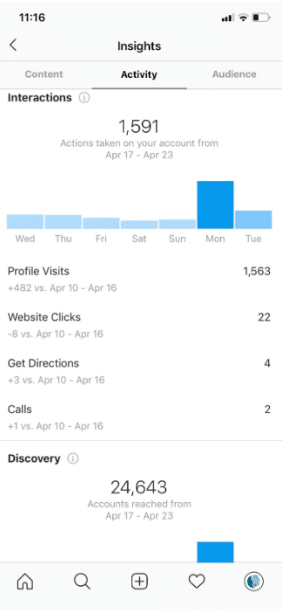
The baseline for all business accounts. While it lacks deep, long-term historical reporting, it is indispensable for real-time, on-the-go checks. It is the best tool for beginners to start understanding their audience demographics.
3. Later
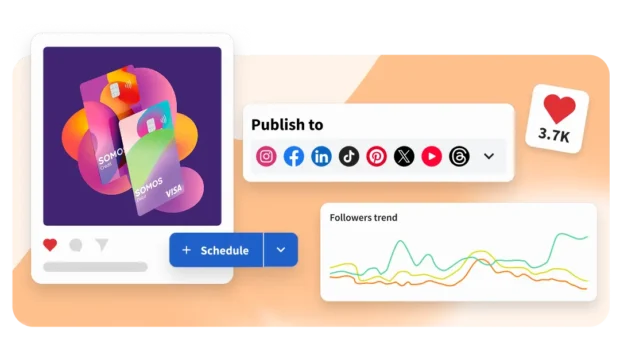
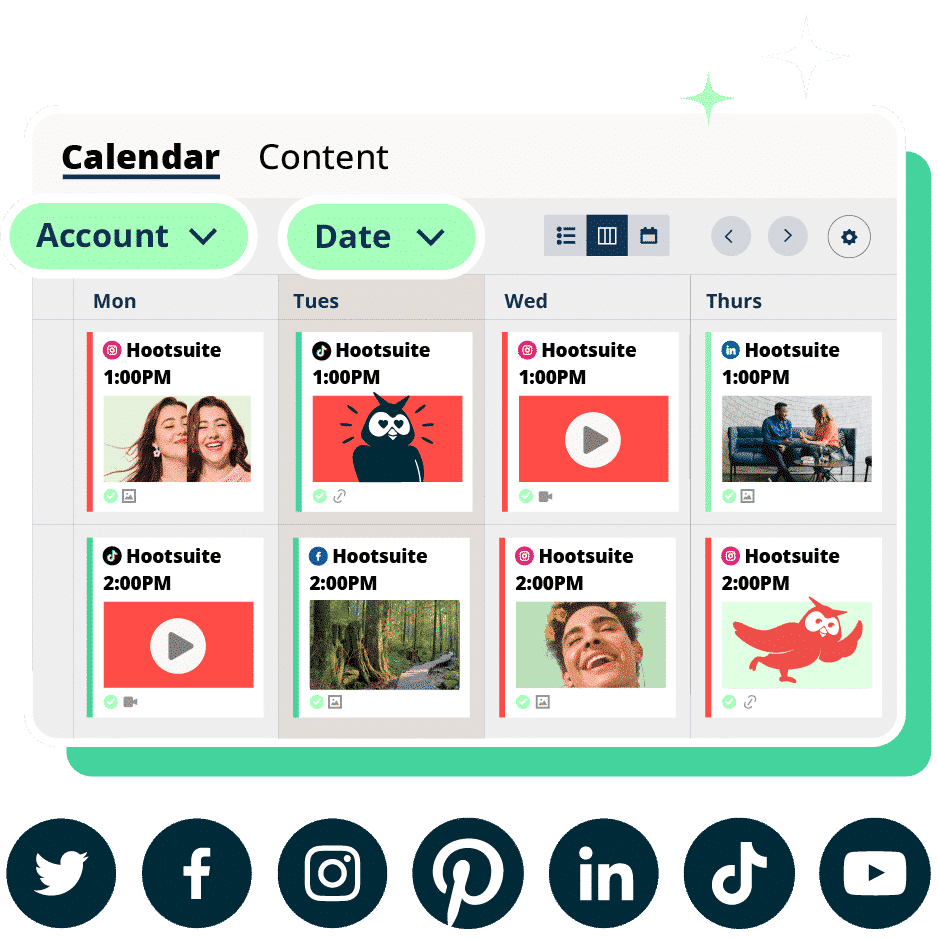
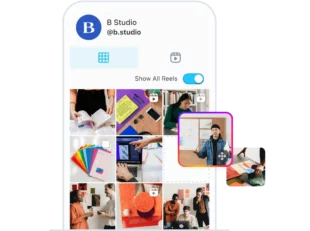
A favorite for small-to-medium businesses and visual creators. Later’s strength lies in its "visual planner," which allows teams to see how their feed will look before publishing. Its analytics are clean and user-friendly, though it lacks the advanced competitive benchmarking found in enterprise tools.
4. Buffer
For the minimalist marketer, Buffer offers a straightforward approach. It is ideal for teams that prioritize scheduling over deep, complex analytics. While it lacks social listening features, its simplicity allows for rapid execution of basic social strategies.
5. Sprout Social
A powerhouse for larger organizations. Sprout excels in white-label reporting, allowing agencies to create professional, client-ready documents with ease. It offers a deeper dive into sentiment analysis, which is vital for brands managing large-scale community engagement.
6. Panoramiq Insights
This tool functions as an add-on to the Hootsuite ecosystem, providing deep-dive metrics on follower demographics and Story performance. It is particularly effective for those who need to justify influencer campaigns or niche targeting.
7. Panoramiq Multiview
Designed for high-volume engagement, this tool enables users to manage mentions, comments, and tags from multiple accounts in a single, unified stream. It is an essential efficiency tool for social media managers juggling several client accounts.
8. Mentionlytics
If your brand’s reputation is paramount, Mentionlytics is the go-to. It tracks brand mentions across the entire web, not just within Instagram, allowing you to see how your social media presence influences broader digital conversations.
9. Phlanx
Ideal for vetting potential influencers or benchmarking against competitors. Its engagement calculator provides a quick "sanity check" on an account’s health, revealing whether their audience is genuinely active or simply inflated.
Official Perspectives and Industry Implications
The consensus among digital strategists is clear: the era of "posting and praying" is over. Platform algorithms are increasingly prioritizing high-quality, high-engagement content, which makes analytics the only reliable compass.
From an official standpoint, platforms like Instagram are providing more data than ever, but they are also making the competitive environment fiercer. The implication is that businesses must adopt a "culture of experimentation." This means using tools to run A/B tests on creative assets, monitoring the "save" rate as a primary indicator of value, and continuously pivoting based on what the dashboard says.
Strategic Implications: Building for the Future
As we look toward the remainder of 2026, the implications of these tools are profound. Brands that leverage analytics to refine their strategy will likely see a lower Cost Per Acquisition (CPA) and higher Customer Lifetime Value (CLV).
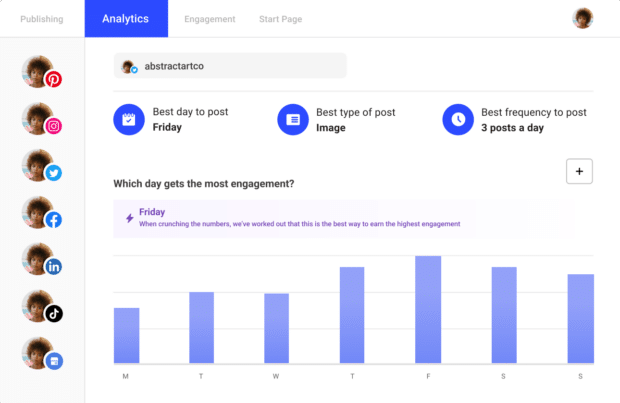
By automating the tracking of key metrics—such as engagement rates, reach, and follower growth—marketers free up valuable hours to focus on the human side of the business: creating compelling narratives and fostering authentic community relationships. The data does not replace the creative; rather, it empowers the creative to reach the right people, at the right time, with the right message.
In conclusion, the path to a winning Instagram strategy is paved with metrics. By selecting the right toolset and committing to a cycle of constant evaluation, you ensure that your brand remains not just a participant in the social conversation, but a leader of it. Whether you are a solo entrepreneur or part of a global marketing team, the tools of 2026 provide the precision needed to turn your Instagram presence into a measurable, scalable asset.
