
The Conversion Gap: Why Your Creator Program is Failing at the "Last Mile"
In the high-stakes world of influencer marketing, brand managers often obsess over the "Top of Funnel." They spend months sourcing the perfect creator, negotiating tiered commission structures, and agonizing over the nuances of a creative brief. Yet, when the campaign goes live, many brands are met with a baffling reality: high click-through rates (CTR) that fail to materialize into meaningful revenue.
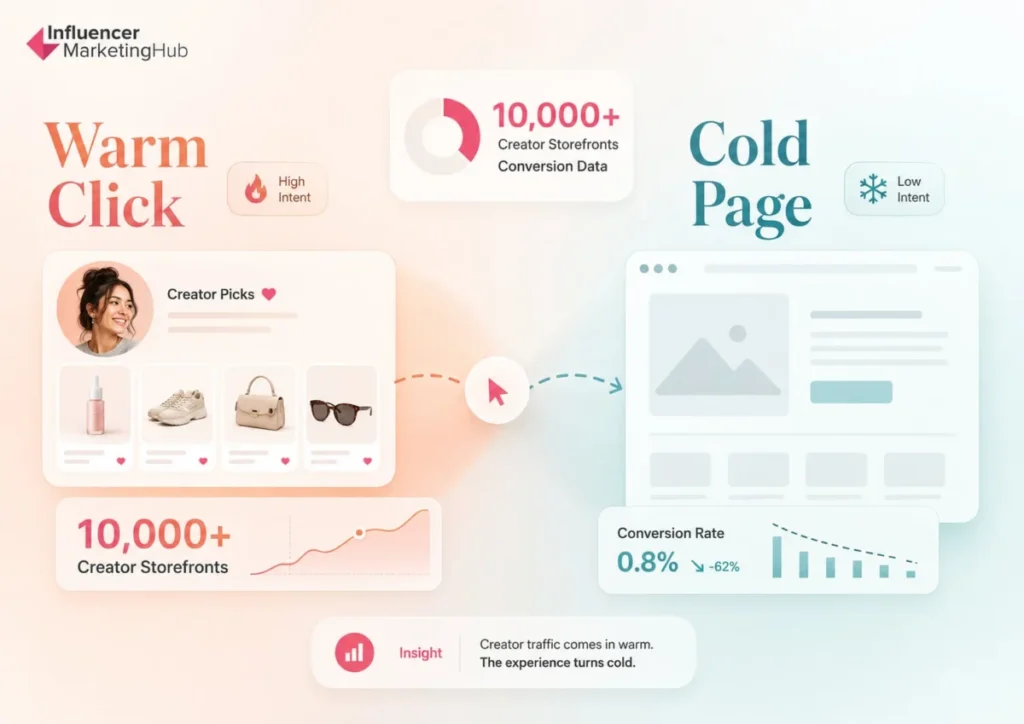
Recent industry data suggests that the culprit isn’t the content, the audience, or the offer. Instead, it is a structural failure in the user journey—a phenomenon now widely identified as the "Warm Click, Cold Page" problem.
The Anatomy of the Conversion Gap
The journey of a prospective customer in an influencer campaign is delicate. A follower watches a video, reads a post, or engages with a story from a creator they have trusted for months or even years. That creator provides the necessary context—explaining why a skincare product solved their acne, or how a specific fitness tool fits into their daily routine. When the follower clicks that link, they are "warm." They are primed, pre-sold, and ready to buy.
However, once that user clicks, the magic often evaporates. Instead of being met with a continuation of the creator’s narrative, they are dumped onto a generic brand homepage or a standard product page.
This is the "Cold Page." It is a page that has no memory of the creator who sent the traffic. It doesn’t recognize the context, the endorsement, or the specific value proposition the influencer provided. To the landing page, the visitor is just another anonymous browser. When the context is stripped away, the trust built by the creator dissolves, and the conversion rate plummets.
A Chronology of the Shift: From Affiliate Links to Creator Storefronts
For the past 18 months, industry analysts have been tracking a significant shift in how top-tier brands manage their creator programs.
The "Old Guard" Approach (2018–2022)
Historically, influencer marketing was treated as an extension of traditional affiliate marketing. Brands provided creators with a static link—often a simple UTM-tagged URL—that directed traffic to the main website. The primary goal was tracking: "Did the click come from Creator X?" If yes, pay the commission. This period was defined by volume and broad-stroke attribution, ignoring the psychological disconnect of the landing experience.
![What Conversion Data From 10,000+ Creator Storefronts Reveals [Warm Click, Cold Page Problem]](https://influencermarketinghub.com/wp-content/uploads/2026/07/5a619d4d-chatgpt-image-jul-3-2026-12_33_04-pm.jpg)
The Rise of Personalization (2023–Present)
As customer acquisition costs (CAC) spiked, brands began looking for ways to squeeze more value out of existing traffic. The industry began experimenting with "Creator-Specific Landing Pages." These are not just standard pages with a different header; they are bespoke, co-branded experiences that feature the creator’s face, their specific product picks, and their unique voice. This structural pivot has turned the landing page from a passive receptacle into an active part of the sales funnel.
The Data: Proving the "Warm Click" Hypothesis
The efficacy of dedicated creator storefronts is no longer just anecdotal. Multiple case studies across diverse industries demonstrate that the "destination" is as important as the "promotion."
Case Study: The 214% Lift
Cozy Earth, a premium home goods brand, conducted a side-by-side comparison of its standard affiliate traffic versus traffic routed to custom creator storefronts. The result was a staggering 214% increase in conversion rates. Perhaps more impressive was the 67% lift in Average Order Value (AOV), proving that when a creator curates a selection, they effectively act as a personal shopper, guiding the customer toward higher-value bundles.
The Health and Wellness Standard
Healf, a UK-based wellness marketplace, has scaled its program to over 1,700 creator partnerships. By implementing a system where every creator gets a dedicated, co-branded page, they achieved a consistent 40.8% conversion rate—a figure that significantly outpaces the industry baseline for the health and wellness sector. According to their affiliate lead, the creator-page model became a powerful recruitment tool in itself: creators were more willing to partner with a brand when they had a beautiful, professional, and personalized page to showcase to their audience.
Beauty and Beyond
Buttah Skin reported a 30% jump in conversion and a 78% increase in AOV by moving away from standard product pages. Similarly, electrolyte brand Electro revealed that creator-led storefronts now generate 81% of their total e-commerce revenue. These brands are not spending more on creators; they are simply being smarter about where that traffic lands.
Implications for Brand Strategy
The data points toward a fundamental restructuring of how marketing teams operate. If your brand’s conversion rate from influencer traffic is hovering under 2%, while your site-wide conversion is 3–4%, you have a "destination" problem.
1. Curation Depth Over Catalog Size
One of the most common mistakes is giving the visitor too many choices. A creator page should not be a mirror of the entire brand catalog. It should be a curated boutique. Pages featuring 6 to 15 products consistently outperform larger selections. The creator has already done the "selling" of the brand’s value; the landing page’s job is to finalize the transaction. By limiting the selection, the brand reduces decision fatigue.
![What Conversion Data From 10,000+ Creator Storefronts Reveals [Warm Click, Cold Page Problem]](https://s.influencermarketinghub.com/imaginary/convert?type=webp&url=https://influencermarketinghub.com/wp-content/uploads/2026/07/d15fc009-image3-1024x490.jpg)
2. Trust Continuity
The creator must remain visible throughout the entire checkout process. If the landing page features the creator’s face but the checkout page is a sterile, corporate interface, the visitor feels the disconnect. Maintaining the creator’s brand identity—their name, voice, and personal endorsement—throughout the final click is essential to preserving the trust that motivated the initial visit.
The 30-Day Diagnostic Test
Brands looking to rectify their conversion gaps should not jump into a full-scale overhaul. Instead, implement a 30-day "Creator-Landing" pilot program:
- Select 5–10 active creators: Choose partners who have a track record of driving traffic but low conversion.
- Build bespoke pages: Use a landing page builder to create simple, high-converting pages that include the creator’s curated top picks and their personal brand assets.
- A/B Test: Route that specific creator’s traffic to the new page instead of the homepage.
- Monitor three KPIs:
- Conversion Rate: Expect a 20–30% lift within the first month.
- AOV: If this stays flat, ensure your page has editorial content (the "why" behind the products).
- 30-Day Repeat Rate: High repeat rates indicate that the "warm click" resulted in a customer who is actually aligned with the brand, not just a one-time discount seeker.
Scaling the Solution
The challenge for large enterprises is operational efficiency. How do you manage 500+ creator pages without drowning your engineering team in tickets? The solution lies in automated creator-commerce infrastructure. Platforms now exist that allow brands to spin up personalized storefronts at scale, ensuring that every creator feels like they have a "home" on the brand’s domain.
For brands like Crocs, which generated 350,000 sessions from a single creator-led drop with Kai Cenat, the ability to build and deploy these experiences is no longer a "nice-to-have"—it is a competitive necessity.
Conclusion: The New Era of Influencer Marketing
We are entering an era where the "influence" in influencer marketing is being redefined. It is no longer just about the reach of the creator; it is about the "last mile" of the customer journey. Brands that continue to treat creator traffic as a generic flow of clicks will continue to lose out to competitors who understand that a "warm click" requires a "warm destination."
The conversion gap is not a mystery. It is a technical and psychological hurdle. By focusing on trust continuity and curated shopping experiences, brands can finally close the gap between a creator’s endorsement and a completed sale. The technology is available, the data is undeniable, and the strategy is clear: stop sending your creator traffic to a cold, anonymous homepage. Bring them home to a page that remembers why they clicked in the first place.
