

The API Bottleneck: Why Your MarTech Stack May Not Be Ready for the AI Agent Revolution
The viability of enterprise AI strategy is increasingly colliding with a stark technical reality: the success of autonomous AI agents depends far less on the intelligence of the LLMs powering them, and far more on the programmatic plumbing of the software platforms they are tasked with navigating.
A newly published dataset from SaaStr, the AI Agent API Report Card, has evaluated 152 B2B APIs on their "agent-readiness." The findings provide a sobering diagnostic framework for enterprise technology buyers, mapping out exactly where current software stacks can seamlessly support autonomous automation—and where legacy infrastructure is actively holding organizations back.
This architectural divide has taken on urgent financial significance. As enterprises contemplate replacing traditional Software-as-a-Service (SaaS) platforms with bespoke, "vibe-coded" internal alternatives, legacy software vendors face existential pressure. Earlier this year, approximately $300 billion in market value evaporated across software stocks following Anthropic’s release of Claude Code and Claude Cowork—autonomous developer tools capable of building and modifying software without human intervention.
According to projections from Deloitte, citing Gartner research, roughly 35% of point-product SaaS tools will either be completely replaced by AI agents or absorbed into broader, agentic ecosystems by the year 2030. Whether a vendor survives this transition will largely depend on the quality of its application programming interfaces (APIs).
Chronology: The Road to the "SaaSpocalypse"
To understand the urgency of the API crisis, it is necessary to trace the rapid evolution of enterprise software integration over the last decade.
+------------------------------------+
|  Phase 1: The Human UI Era         | -> Software built for human eyes;
|  (2010s - Early 2020s)             |    APIs treated as secondary developer tools.
+------------------------------------+
                  |
                  v
+------------------------------------+
|  Phase 2: Generative AI Ingestion  | -> LLMs integrated via chat windows;
|  (2023 - 2024)                     |    manual copilots assist human workflows.
+------------------------------------+
                  |
                  v
+------------------------------------+
|  Phase 3: The Agentic Pivot        | -> $300B stock dip; Anthropic releases
|  (Late 2024 - 2025)                |    Claude Code; rise of "vibe coding."
+------------------------------------+
                  |
                  v
+------------------------------------+
|  Phase 4: The Headless Era         | -> Current market shift; API readiness
|  (2026 & Beyond)                   |    dictates software renewal and survival.
+------------------------------------+
The Human UI Era (2010s–Early 2020s)
For nearly two decades, SaaS giants built empires around the human user interface (UI). The primary product was the screen that a sales representative, marketer, or customer success agent logged into every morning. APIs were often treated as secondary considerations—developer-facing afterthoughts designed for basic data synchronization rather than high-frequency, autonomous execution.
The Generative AI Ingestion (2023–2024)
The mainstreaming of generative AI initially focused on copilots and chat interfaces. Humans remained the primary operators, copy-pasting outputs from LLMs into legacy systems. Software vendors scrambled to add superficial AI features within their existing UIs, leaving underlying data models and integration pipelines unchanged.
The Agentic Pivot and the $300B Market Shock (Late 2024–2025)
The paradigm shifted dramatically with the arrival of fully autonomous AI agents capable of executing multi-step workflows. When Anthropic introduced Claude Code and Claude Cowork, demonstrating that AI could build and deploy software autonomously, Wall Street reacted violently. The sudden evaporation of $300 billion in software stock value signaled a structural change: buyers realized they could potentially bypass expensive point-solution SaaS subscriptions altogether by using agents to write, run, and maintain customized, internal applications.
The Headless Era (2026 and Beyond)
Today, the industry is entering a "headless" transition. Software platforms are no longer judged solely on user experience, but on how effectively they function as background databases for autonomous AI workers. This has divided the market into modern, agent-friendly systems and legacy platforms facing rapid obsolescence.
Supporting Data: Dissecting the SaaStr API Report Card
The SaaStr AI Agent API Report Card rates B2B software platforms out of 100 based on six core technical dimensions, with a particular emphasis on "agent readiness." The data reveals a massive performance gap between legacy giants and modern, API-first platforms.

       B2B API Agent-Readiness Scores (Out of 100)
       ===========================================

       OpenAI/Anthropic  [██████████████████████████████████] 90
       HubSpot           [████████████████████████████] 80
       Clay              [██████████████████████████] 75
       Salesforce        [██████████████████████████] 75
       Intercom Fin      [████████████████████████] 70
       Outreach          [██████████████████████] 65
       Gong              [█████████████████████] 63
       Hunter.io         [████████████████████] 60
       Freshdesk         [████████████████████] 58
       Mailchimp         [███████████████████] 57
       Zoho CRM          [███████████████████] 57
       Freshsales        [██████████████████] 55
       ActiveCampaign    [██████████████████] 53
       Marketo           [█████████████████] 50
       Gainsight         [████████████████] 47
       Workday           [██████████████] 42
Marketing Automation: The Legacy Bottleneck
Marketing automation platforms represent some of the lowest-performing systems in the report card.
- Marketo (Score: 50/100): Adobe’s Marketo scores a meager 4 out of 10 for agent readiness. It receives flat 5s across API design, webhooks, rate limits, and documentation. The report highlights its dated architecture and highly complex Launchpoint authentication protocol, making it exceptionally difficult for autonomous systems to navigate. Furthermore, the Marketo REST API’s default allocation of 50,000 calls per day is highly restrictive; an AI agent running continuous audience segmentation and lead-scoring workflows can exhaust this limit in a matter of hours.
- Mailchimp (Score: 57/100) & ActiveCampaign (Score: 53/100): Both platforms struggle with similar legacy constraints, featuring rigid rate limits and lacking the real-time push capabilities required by autonomous systems.
Customer Success: A Study in Contrasts
Customer success software shows a wide divergence between legacy systems of record and modern engagement platforms.
- Gainsight (Score: 47/100): Scoring near the bottom of the list, Gainsight suffers from poor developer documentation (3/10) and low agent readiness (4/10).
- Intercom Fin (Score: 70/100): In contrast, Intercom’s Fin platform earns a 9 out of 10 for agent readiness. This high score is a direct result of Intercom’s deliberate strategy to build its API platform specifically for third-party AI agent developer integration.
Sales Intelligence and CRMs
- Clay (Score: 75/100): Earning a 9 out of 10 for agent readiness, Clay is praised as a highly flexible, visual agent builder.
- Salesforce (Score: 75/100) & HubSpot (Score: 80/100): The CRM market leaders have invested heavily in their developer interfaces. Salesforce’s Agentforce 360 and Agent Script capabilities secured it a 9 out of 10 in agent readiness, while HubSpot’s recent headless push has positioned it as a highly capable platform for autonomous orchestration.
- Zoho CRM (Score: 57/100) & Freshsales (Score: 55/100): Mid-market CRM alternatives remain significantly less prepared for autonomous agents, leaving them highly vulnerable to churn.
Defining "Agent Readiness"
The report card highlights "agent readiness" as the single most critical metric for modern software evaluation. Unlike traditional software integration, which assumes a human engineer is writing custom code to handle exceptions, autonomous agents require specific programmatic guardrails to operate safely and effectively.
To be considered "agent-ready," a platform’s API must feature:
+-------------------------------------------------------------------------+
|                       Four Pillars of Agent Readiness                   |
+-------------------------------------------------------------------------+
|  1. Testing Sandboxes       | Safe, isolated environments where agents  |
|                             | can test actions before running them live.|
+-----------------------------+-------------------------------------------+
|  2. Structured Error Codes  | Machine-interpretable error messages that |
|                             | tell the agent exactly how to self-correct|
+-----------------------------+-------------------------------------------+
|  3. Idempotency & Retries   | The ability to safely retry failed tasks  |
|                             | without creating duplicate records.       |
+-----------------------------+-------------------------------------------+
|  4. Real-Time Webhooks      | Instant push updates that allow agents to |
|                             | respond to data changes in real time.     |
+-------------------------------------------------------------------------+
Without these safeguards, an autonomous agent attempting to execute workflows in platforms like Marketo or Gainsight is highly likely to hit integration errors, create duplicate records, or run out of API limits.
Official Responses and Expert Perspectives
Industry leaders and analysts are divided on whether this shift represents an existential threat to SaaS vendors or a natural evolution of the enterprise software stack.
The Vendor’s Reality: Jason Lemkin, Founder of SaaStr
SaaStr founder Jason Lemkin argues that the quality of a vendor’s API has become the primary factor in software retention. Having run more than 20 AI agents in production over an 18-month period, Lemkin noted:
"The single biggest variable in whether a vendor stays or goes hasn’t been the UI. It hasn’t been the price. It hasn’t been the brand. It’s been the API. These legacy companies built empires with a human UI as the product. The API was an afterthought. That worked for 15 years. It doesn’t work now."
Lemkin predicts that the rise of natural-language software generation—or "vibe coding"—will spark a massive renaissance of custom-built software, allowing companies to build specialized tools that bypass traditional, poorly integrated SaaS products entirely.
The System of Record Defense: Jen Grant, CMO of Quiq
Jen Grant, Chief Marketing Officer of conversational AI platform Quiq, offers a more grounded view of the "SaaSpocalypse" narrative, arguing that core enterprise platforms are not in danger of extinction.
"The ‘SaaS apocalypse’ narrative is more about acceleration than extinction. Systems of record—your CRM, your data warehouse, your core operating platforms—are not going away. What is shifting is the layer above them."
According to Grant, while point-product tools designed solely for human data entry may disappear, foundational databases will remain secure—provided they can open their systems to agentic interaction layers.
The Pragmatic View: Scott Brinker and Frans Riemersma
In their Martech for 2026 report, Scott Brinker (editor of the Martech Landscape) and Frans Riemersma (founder of MartechTribe) urge enterprise technology leaders to balance innovation with skepticism.
"Big changes are happening in the stack and in the market. AI agents are real, and they are rewiring the ways marketers market—and the ways buyers buy. But the hype still exceeds reality. You should lean in and learn. But maintain healthy skepticism toward the AI equivalent of ‘wild-eyed pistol wavers’ pushing for a radical rebuild of your entire stack. Experiment boldly, but scale wisely."
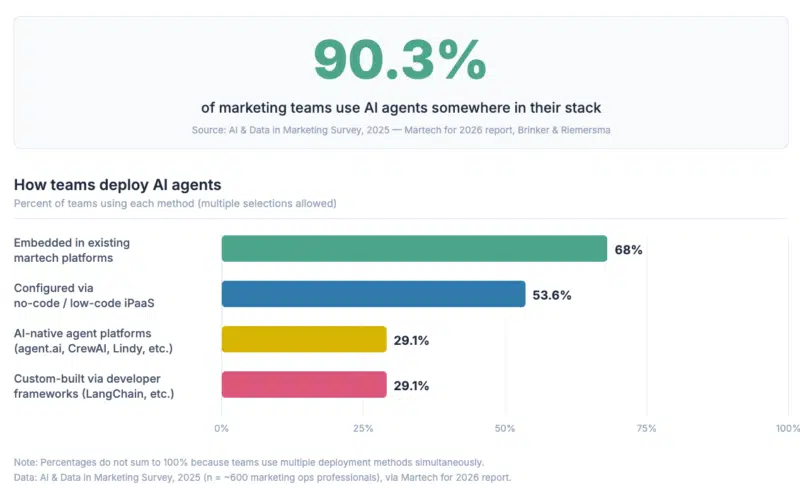
Their research confirms a highly practical adoption pattern: while 90.3% of marketing teams report using AI agents somewhere in their operations, the vast majority (68%) run these agents embedded directly within their existing platforms, rather than deploying independent, custom-coded systems.
Implications for Enterprise Tech and Marketing Operations
For enterprise technology buyers and marketing operations managers, the SaaStr API Report Card serves as a vital diagnostic tool. It shifts the purchasing conversation away from front-end features toward deep, back-end integration capabilities.
                  Legacy Stack vs. Agent-Ready Stack
                  ==================================

        Legacy Stack                        Agent-Ready Stack
     (e.g., Marketo, Gainsight)           (e.g., HubSpot, Intercom)
   +---------------------------+       +---------------------------+
   |  Human-First Web UI       |       |  Flexible Agent Framework |
   |  (Rigid, manual entry)    |       |  (Autonomous execution)   |
   +---------------------------+       +---------------------------+
                 |                                   |
                 v                                   v
   +---------------------------+       +---------------------------+
   |  Restricted, Slow APIs    |       |  Idempotent, High-Limit   |
   |  (Prone to rate limits)   |       |  APIs with Sandboxes      |
   +---------------------------+       +---------------------------+
                 |                                   |
                 v                                   v
   +---------------------------+       +---------------------------+
   |  Frequent Errors          |       |  Continuous, Automated    |
   |  (Requires human fix)     |       |  Self-Correction          |
   +---------------------------+       +---------------------------+
Navigating Vendor Renewals
When negotiating contract renewals, operations leaders should move past traditional product roadmaps and focus on technical integration criteria. Key questions to bring to the table include:
- Does the API support idempotency keys? Can an agent safely retry a failed action (such as sending an email or updating a contact record) without risk of duplicating the action?
- Are there machine-readable error payloads? When an API call fails, does the system return clear, structured error codes that an LLM can interpret and self-correct, or does it return generic HTML error pages?
- What are the real-time push capabilities? Does the platform support robust webhooks to instantly notify agents of data changes, or must the agent constantly poll the system, consuming valuable API limits?
- Is there a dedicated developer sandbox? Can an autonomous agent test its workflows in an isolated, safe environment before interacting with live customer data?
The Vendor Divide
The market is rapidly splitting into two camps. Forward-thinking vendors are investing heavily in their developer interfaces to secure their place in the agentic ecosystem. HubSpot’s Spring 2026 headless push and Breeze AI Agent APIs, alongside Salesforce’s Agentforce 360, show that the industry’s largest players are actively building for a headless future.
Conversely, legacy platforms that treat their API as a secondary developer tool are making themselves highly vulnerable. If an AI agent cannot easily read from or write to a software platform, enterprise buyers will inevitably replace it with an API-first competitor. In the age of autonomous systems, a software platform’s survival is no longer determined by the beauty of its user interface, but by the readiness of its API.
