
The AI Marketing Revolution: Navigating the New Frontier of Intelligent Automation
The landscape of modern marketing is undergoing a tectonic shift. It is no longer a question of whether artificial intelligence (AI) will play a role in your organization’s strategy, but rather how quickly you can distinguish between fleeting "shiny objects" and transformative technologies that will define the next decade of commercial success.
Name an AI use case today—from predictive search intent to hyper-personalized account intelligence—and you will find a tool promising to revolutionize it. The market is saturated, moving at a velocity that makes traditional tech adoption cycles look like relics of a bygone era. For CMOs and marketing practitioners alike, the challenge is no longer a lack of options; it is a crisis of curation.
As we look toward the future of the industry, the imperative is clear: the goal is not to adopt every tool that enters the market, but to identify the specific technologies capable of disrupting your day-to-day operations and fundamentally augmenting the human capability of your team.
The State of the AI Marketing Landscape
We are currently witnessing an explosion of specialized AI platforms. While general-purpose tools like Large Language Models (LLMs) captured the initial headlines, the market has pivoted toward vertical-specific solutions. We are seeing platforms dedicated solely to campaign optimization, predictive customer journey mapping, autonomous content scaling, and real-time sales intelligence.
This specialization is a natural progression of the "AI-first" enterprise. As marketers move past the novelty phase of using AI for basic drafting or image generation, they are entering the integration phase. Here, the focus is on ROI, seamless data flow, and—most importantly—the shift from doing tasks faster to achieving outcomes that were previously impossible.
Chronology: From Experimentation to Enterprise Integration
The trajectory of AI in marketing has been rapid, moving from fringe experiment to a board-level priority in less than three years.
- 2022: The Generative Awakening. The public release of generative AI tools brought AI into the spotlight. Marketers began experimenting with prompt engineering to assist in blog drafting and social media captioning.
- 2023: The Year of Scaling. Organizations moved from individual "lone wolf" experimentation to structured departmental adoption. Marketing teams began seeking enterprise-grade tools that offered security, privacy, and team-based collaboration features.
- 2024: The Integration Era. Focus shifted toward APIs and data ecosystems. Marketers started demanding that their AI tools talk to their CRMs, CDPs, and ERPs. This was the year that "AI-washing" began to be weeded out by practitioners who demanded measurable performance metrics.
- 2025 and Beyond: The Autonomous Frontier. We are currently entering a period where AI is moving from a co-pilot to an autonomous agent. The tools featured at this year’s Marketing AI Conference (MAICON) represent this shift—platforms that don’t just offer suggestions, but execute complex, multi-stage campaigns based on real-time data.
Supporting Data: Why AI Adoption is No Longer Optional
According to recent benchmarks from the Marketing AI Institute, the pressure to adopt is driven by performance disparities. Organizations that leverage AI for content production report a 40% reduction in time-to-market for campaigns. Even more compelling is the data regarding personalization: firms utilizing AI-driven account intelligence see a 25% increase in conversion rates compared to peers relying on manual segmentation.
The data suggests a bifurcated market. On one side, "Early Adopters" are using AI to build proprietary data moats, training their internal processes to be faster, more precise, and more cost-effective. On the other side, "Late Adopters" are struggling with legacy workflows that are becoming increasingly expensive to maintain.
Expert Perspectives: The Human-AI Partnership
Cathy McPhillips, Chief Marketing Officer at the Marketing AI Institute and SmarterX, emphasizes that the most intriguing tools aren’t those that simply replace human labor. "The most intriguing AI tools aren’t just helping us do existing jobs faster," McPhillips notes. "They are augmenting our capabilities and expanding what’s possible, allowing marketers to view their roles in a new light."
This perspective is shared by industry leaders who advocate for a "Human-in-the-Loop" (HITL) approach. While the technology is capable of automating 80% of routine tasks, the remaining 20%—strategy, ethical oversight, brand voice, and emotional intelligence—remains the exclusive domain of the human professional. The goal of the AI-powered marketer is to offload the "grunt work" to machines so that human capital can be reallocated to higher-order creative and analytical problem solving.
Implications for the Modern Marketing Department
What does this shift mean for your organizational structure? It implies three distinct changes:
1. The Reskilling Mandate
Every member of the marketing team, from the junior copywriter to the VP of Demand Gen, must develop a baseline level of "AI literacy." This does not necessarily mean learning how to code; it means understanding how to interact with AI models, how to audit them for bias, and how to verify their output for accuracy.
2. Data Integrity as a Competitive Advantage
AI models are only as good as the data they are fed. If your company’s first-party data is siloed or unorganized, your AI tools will produce inferior results. The implication is that the "AI revolution" is actually a "Data Governance revolution." Companies that clean their data now will be the winners of the next decade.
3. The Shift from Volume to Value
The barrier to entry for content production has effectively dropped to zero. Because AI can produce content at an infinite scale, the volume of content is no longer a competitive differentiator. The new differentiator is value. Marketers must use their newfound time to focus on deep research, original reporting, and strategic storytelling—elements that AI still struggles to synthesize effectively without human guidance.
The 23 Platforms to Watch: A Curated Selection
While the landscape is vast, certain platforms consistently rise to the top of the conversation. These selections, featured at MAICON, represent the cutting edge of what is possible.
(Note: These organizations are distinguished by their commitment to advancing the industry through education and their participation in the upcoming Marketing AI Conference.)
These tools fall into several critical categories:
- Predictive Analytics: Tools that look at historical trends to forecast future customer behavior with high precision.
- Generative Media: Platforms that automate the creation of high-fidelity video, audio, and visual assets, drastically reducing production timelines.
- Account-Based Intelligence: AI that identifies "in-market" accounts by analyzing digital body language, allowing sales and marketing teams to align their outreach.
- Operations & Workflow: Platforms that act as the "connective tissue" between different marketing apps, automating the movement of data and the triggering of workflows.
Bridging the Gap: From Theory to Practice
Reading about AI marketing tools is one thing; seeing them in action is another. The primary hurdle for most teams is not knowing if a tool works, but how it works within their specific tech stack.
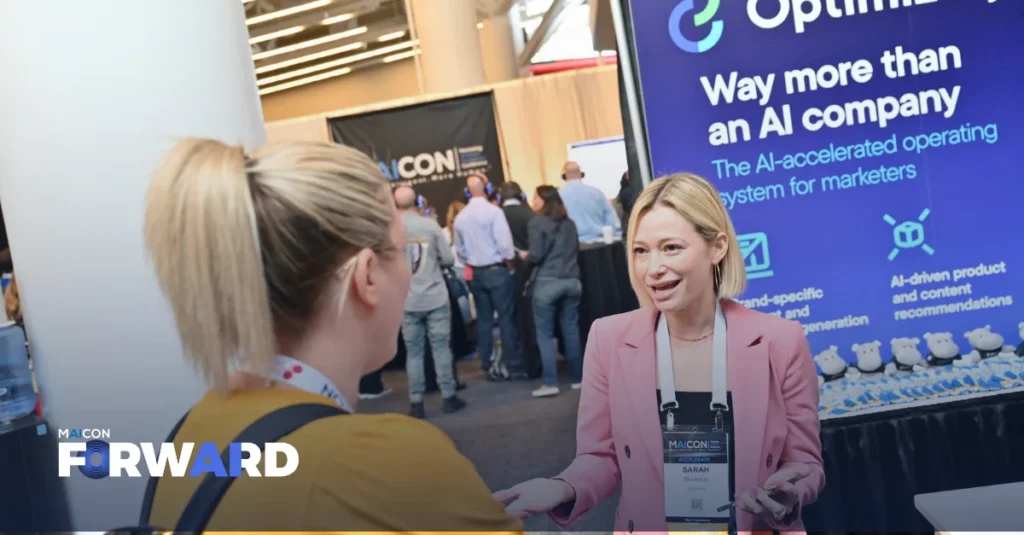
The Marketing AI Conference (MAICON) serves as the industry’s central hub for this kind of discovery. Scheduled for October 13–15, 2026, in Cleveland, Ohio, the 7th annual event is designed to move beyond the hype cycle. Attendees will have the opportunity to:
- Access Live Demos: See firsthand how these 23+ platforms handle real-world scenarios.
- Hear from Practitioners: Engage with the marketers who are currently implementing these tools, learning from their failures and successes.
- Explore Cross-Functional Integration: Understand how AI can be deployed across the entire marketing function, from PR and communications to sales and customer success.
Conclusion: The Path Forward
The AI revolution in marketing is not a destination; it is a continuous evolution. As the industry moves forward, the divide between those who master these tools and those who are mastered by them will only grow wider.
The platforms highlighted at MAICON represent more than just software; they represent a new paradigm. They offer the potential to strip away the mundane, allowing marketers to reclaim the creative, strategic, and human elements of their work that were often buried under a mountain of manual, repetitive tasks.
We are only just getting started. The next few years will see the emergence of tools that we cannot currently imagine, solving problems we have yet to define. For those ready to lean in, the future of marketing is not just bright—it is more efficient, more creative, and more impactful than ever before.
Join the conversation in Cleveland this October. See the technology, meet the pioneers, and prepare your organization for the next era of intelligent marketing.
