

Shopify vs. Basecamp: Why Your Ecommerce Stack Needs Both, Not a Choice Between Them
In the rapidly evolving landscape of digital business in 2026, entrepreneurs often fall into the trap of comparing "apples to oranges." Among the most frequent, yet fundamentally flawed, comparisons is the debate between Shopify and Basecamp. These are two of the most recognizable powerhouses in their respective categories, yet they solve entirely different problems.
After conducting a comprehensive analysis—spanning a full sprint of mapping feature sets, evaluating pricing tiers, and assessing their roles in a modern ecommerce stack—we have reached a definitive conclusion: Shopify runs your store, while Basecamp runs your team.
If you are building an online business today, the question is not which one to choose; it is how to integrate them effectively. This guide breaks down where each tool shines, where they hit their limits, and how to determine which one acts as the primary bottleneck in your current business growth.
The Strategic Divide: Core Functions
To understand the relationship between these two platforms, one must look at the "Job-to-be-Done" (JTBD) framework.
Shopify: The Commerce Engine
Shopify is a hosted ecommerce platform designed to facilitate the exchange of value. Its primary function is to enable merchants to launch, manage, and scale a retail presence across web, mobile, social, and physical storefronts.

- Core Job: Processing payments, managing inventory, and creating customer-facing storefronts.
- Target User: Founders, ecommerce managers, and retail operators.
Basecamp: The Collaboration Hub
Basecamp is a project management and team communication platform designed to organize human effort. It does not touch inventory, payments, or product catalogs. Instead, it creates a digital workspace where communication is structured and tasks are tracked.
- Core Job: Coordinating work, centralizing team conversations, and managing project timelines.
- Target User: Agency owners, team leads, and internal operations managers.
Chronology of Adoption: A Roadmap for Scaling
In a typical business lifecycle, the order of operations for adopting these tools is rarely simultaneous.
Stage 1: The "Launch" Phase
When starting an online business, your immediate priority is revenue. You need a storefront, a payment processor, and a way to list products. Here, Shopify is the non-negotiable entry point. Most solo founders begin with Shopify’s Basic plan, leveraging its pre-built themes to go live in days rather than months.
Stage 2: The "Operational Complexity" Phase
Once the store is live, the business begins to scale. You hire your first VA, a marketing freelancer, or a fulfillment assistant. This is the moment "email sprawl" begins. You are likely juggling updates in Slack, attachments in Gmail, and task lists on sticky notes. This is the inflection point where Basecamp becomes essential. It brings order to the chaos by consolidating project-related discussions and deliverables into one unified space.
Stage 3: The "Integrated Stack" Phase
At the enterprise or high-growth level, these tools should talk to each other. By using middleware like Zapier or Make, you can trigger operational workflows. For example, a high-value order in Shopify can trigger an automatic task in Basecamp for your logistics team to ensure premium packaging. At this stage, you aren’t choosing one over the other; you are building an infrastructure that separates your commerce data from your team execution.

Supporting Data: Pricing and Total Cost of Ownership (TCO)
The financial models of these two platforms are fundamentally distinct, reflecting their different business roles.
Shopify: Scaling with Revenue
Shopify operates on a tiered SaaS model. While the base subscription fee seems affordable (starting at $39/month), the TCO is variable:
- Payment Fees: A percentage of every transaction (Shopify Payments starts at 2.9% + $0.30).
- App Ecosystem: To achieve feature parity with custom builds, most stores invest in 5–10 third-party apps, each with monthly recurring costs.
- The Verdict: Shopify is a variable cost that grows alongside your success. It is a value-driven investment because the platform provides the infrastructure to capture revenue.
Basecamp: Predictable Team Scaling
Basecamp eschews the industry-standard "per-seat" pricing model. Instead, it offers a flat monthly fee for the entire team, regardless of how many people are added.
- The Advantage: As your team grows from five to fifty, your Basecamp bill remains stable. This creates massive cost-efficiency for agencies and growing operations teams.
- The Verdict: Basecamp is a fixed cost. It rewards team expansion, making it a predictable line item in your monthly budget.
Implications of the "Tool Sprawl"
The modern workplace is plagued by "tool sprawl"—the tendency for teams to use too many disparate applications, leading to context switching and information silos.
Shopify’s Ecosystem vs. Basecamp’s Simplicity
Shopify’s strength lies in its extensibility. With over 8,000 apps, it is a modular platform that allows you to build a custom tech stack. However, the implication is that you must manage the complexity of those integrations.
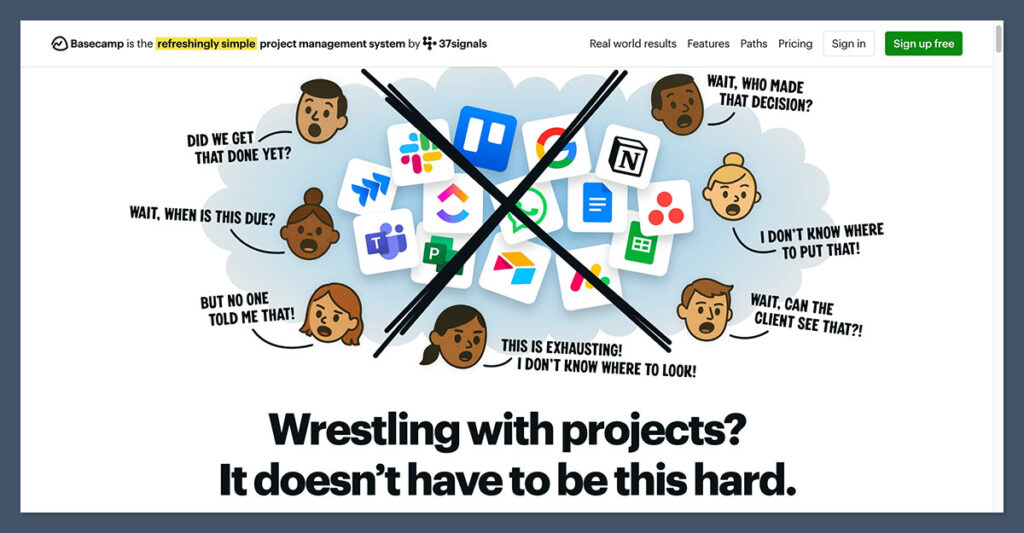
Basecamp, by contrast, thrives on opinionated simplicity. It refuses to offer Gantt charts, complex dependency mapping, or thousands of integrations. It forces your team to communicate within a specific, structured environment. The implication here is that your team must adapt to Basecamp’s philosophy of "calm" project management, rather than forcing the tool to do everything.
Official Perspectives: When to Use Which
Industry experts and the companies themselves often highlight distinct use cases that define the "versus" debate.
- Shopify’s Stance: The platform emphasizes "headless" capabilities and enterprise-grade APIs. They position themselves as the backbone of global commerce. They do not claim to manage your team’s internal communication; they provide the data logs and staff permissions necessary to ensure the store stays secure.
- Basecamp’s Stance: The founders of Basecamp famously advocate for "Shape Up"—a methodology that focuses on shipping meaningful work in six-week cycles. They argue that most project management tools are too complex, leading to "project management about project management." They position themselves as the cure for digital anxiety.
Final Verdict: The Reality of the Modern Stack
The debate between Shopify and Basecamp is a false dichotomy. They serve different masters: Shopify serves the customer, and Basecamp serves the employee.
When to prioritize Shopify:
- You have a product to sell.
- You need a secure, reliable payment gateway.
- You are looking for a mobile-responsive, professional storefront out of the box.
When to prioritize Basecamp:
- You have an established team that struggles with email threads.
- You are an agency managing multiple client projects simultaneously.
- You find yourself spending more time tracking work than actually doing it.
The Bottom Line: If you are building a scalable business in 2026, you will likely reach a point where you need both. Shopify provides the revenue-generating engine that justifies the cost of the project management tools required to keep your team organized. Don’t look for a winner; look for a way to integrate these two specialized pillars into a cohesive, high-performance business stack.
