
Peak Martech: Has the Great Expansion Finally Hit the Ceiling?
For fifteen years, the Marketing Technology (martech) industry has defied gravity. Since 2011, when the industry landscape consisted of a modest 150 solutions, the market has undergone an explosion of innovation, investment, and sheer volume. It became a rite of spring for marketers to wait for the release of the annual "Martech Landscape" graphic, bracing themselves for the inevitable—and often overwhelming—increase in logos, categories, and existential complexity.
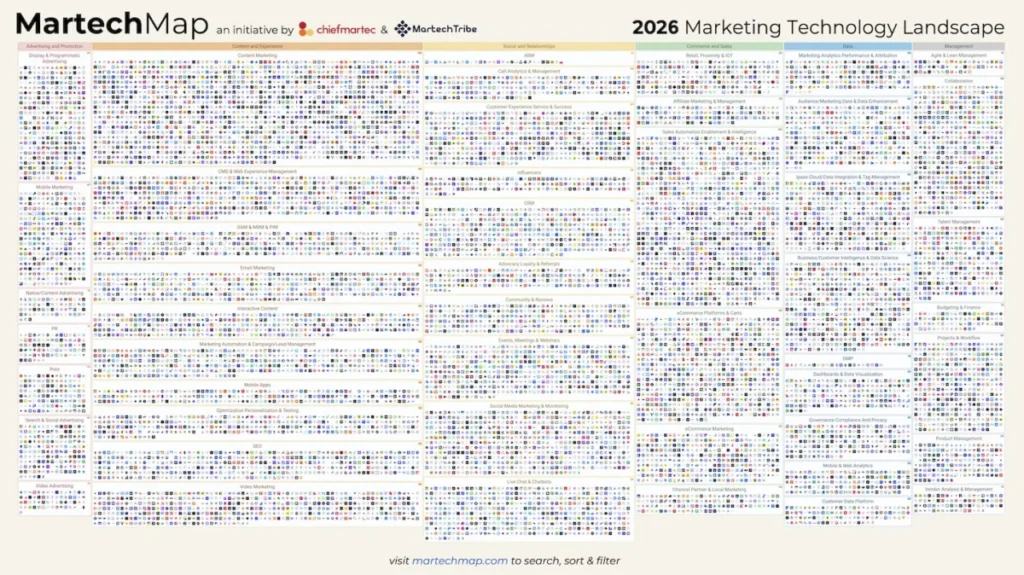
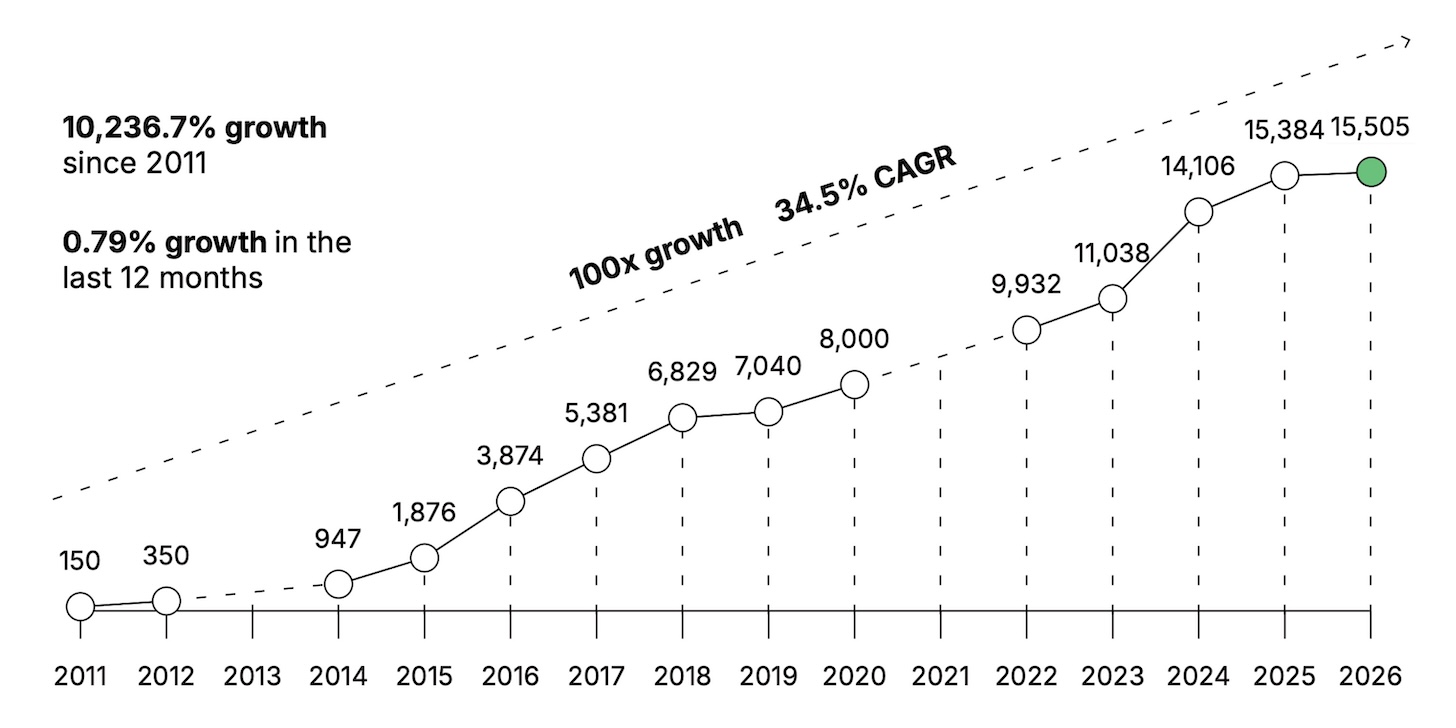
But in 2026, the narrative has shifted. The latest data from the State of Martech 2026 report suggests that the era of runaway, unchecked growth has reached an inflection point. With a total of 15,505 products, the landscape has seen a nominal increase of only 0.79% over last year’s count of 15,384. While proponents of growth might point to the absolute number as evidence of continued momentum, the reality is clear: the martech landscape has effectively plateaued.
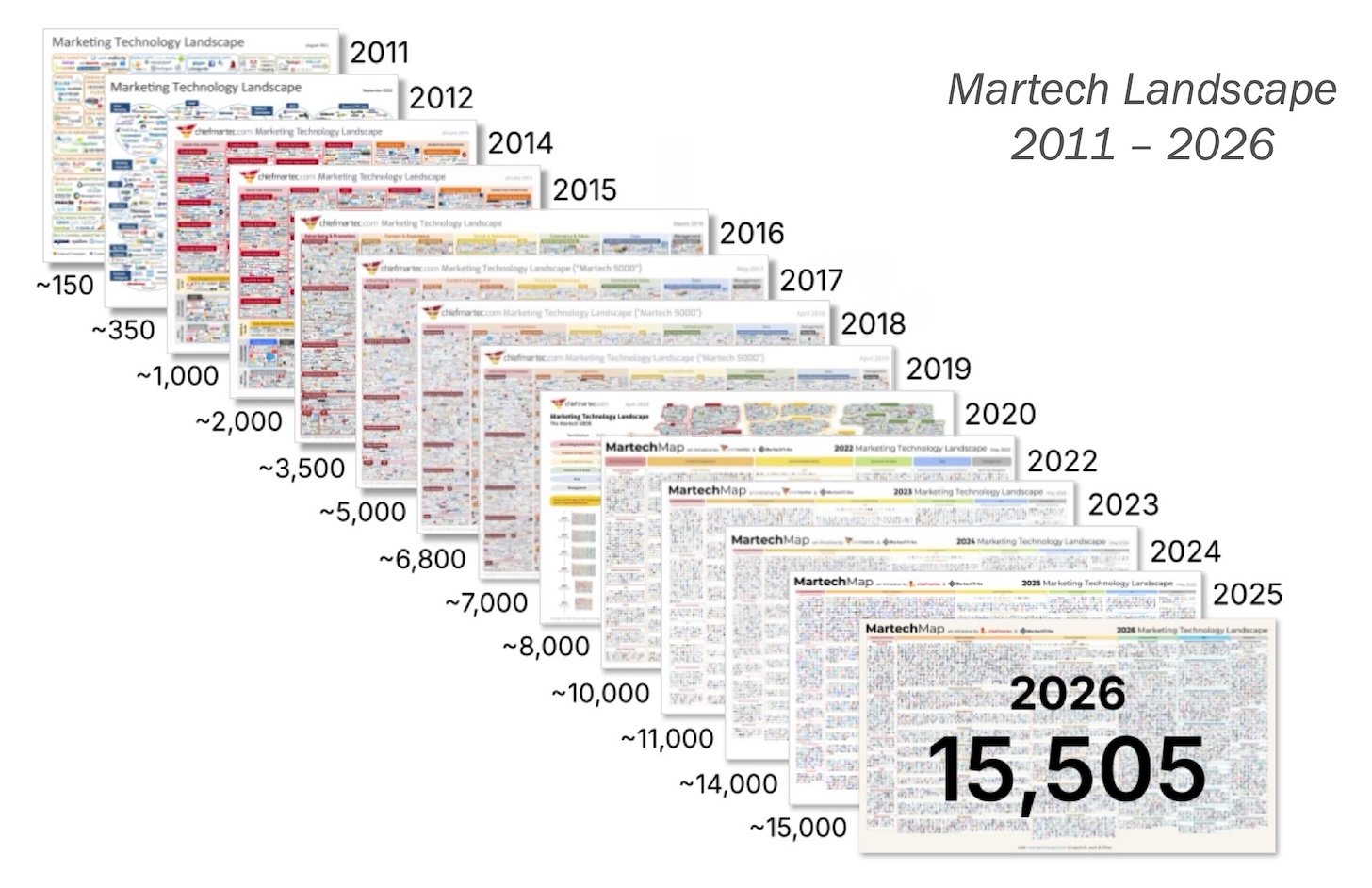
A Chronology of Expansion: From 150 to 15,000
To understand the gravity of this year’s stagnation, one must look at the trajectory of the past decade and a half. The evolution of the martech landscape is a mirror of the digital transformation of the global economy.
- 2011–2015: The Emergence. The landscape began as a niche observation of a burgeoning sector, growing from 150 to nearly 2,000 products. It was the "wild west" of SaaS.
- 2016–2020: The Proliferation. Cloud adoption and the democratization of software development led to a explosion in point solutions. Marketers began stitching together "stacks," and the landscape grew to over 8,000 products.
- 2021–2024: The AI Gold Rush. The arrival of generative AI triggered a massive influx of new entrants, pushing the total count past the 15,000 mark. It was widely assumed that this velocity was permanent.
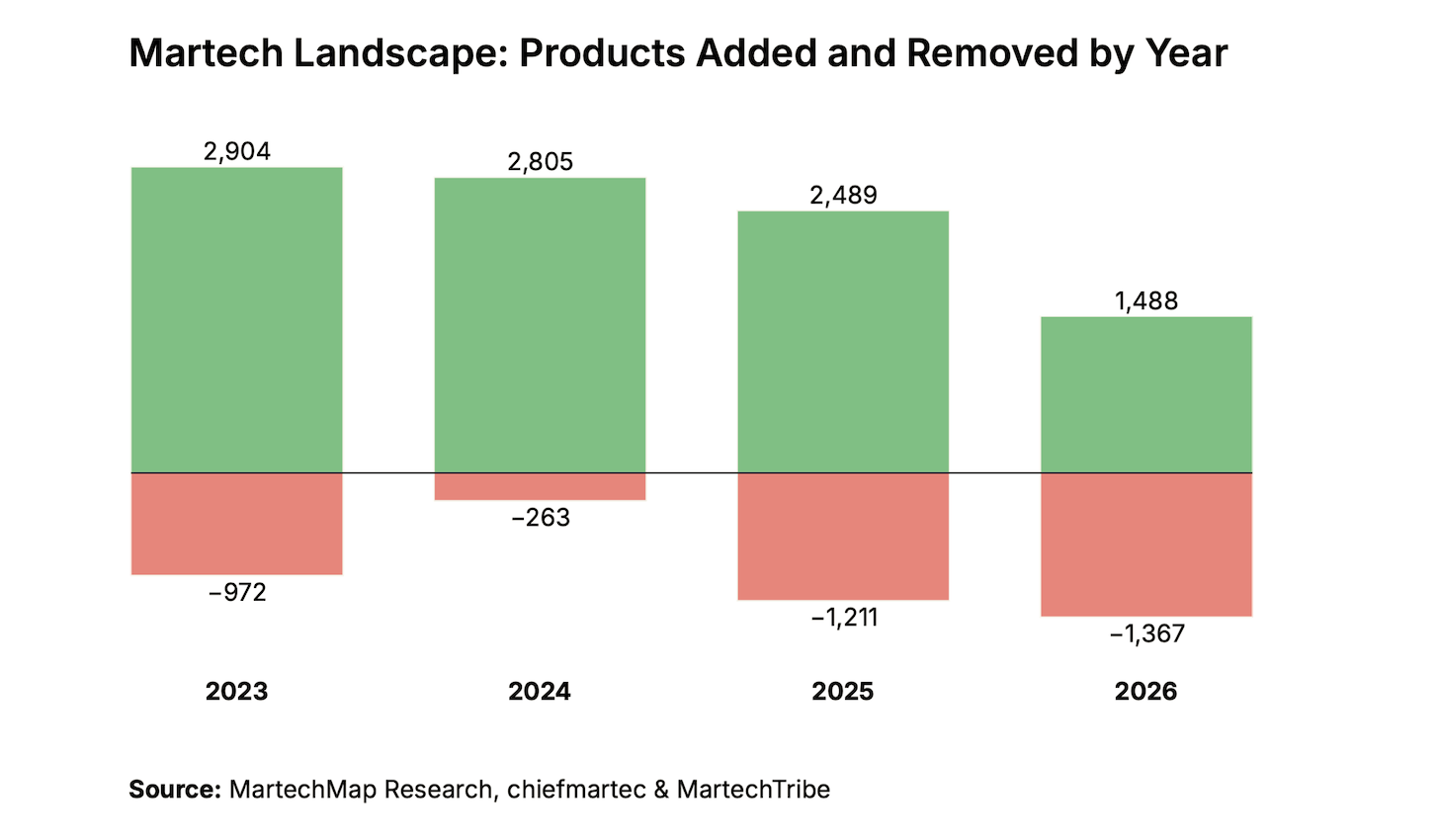
- 2025–2026: The Great Correction. The industry has seen a 40% decline in new entrants compared to the previous year, while churn—the removal of existing products—has accelerated.
This year marks the first time in history that the rate of new product additions has been nearly perfectly offset by the rate of removals. The "jurassic" growth—where martech always "found a way" to expand—has encountered a hard regulatory and economic barrier.
The Data Behind the Plateau
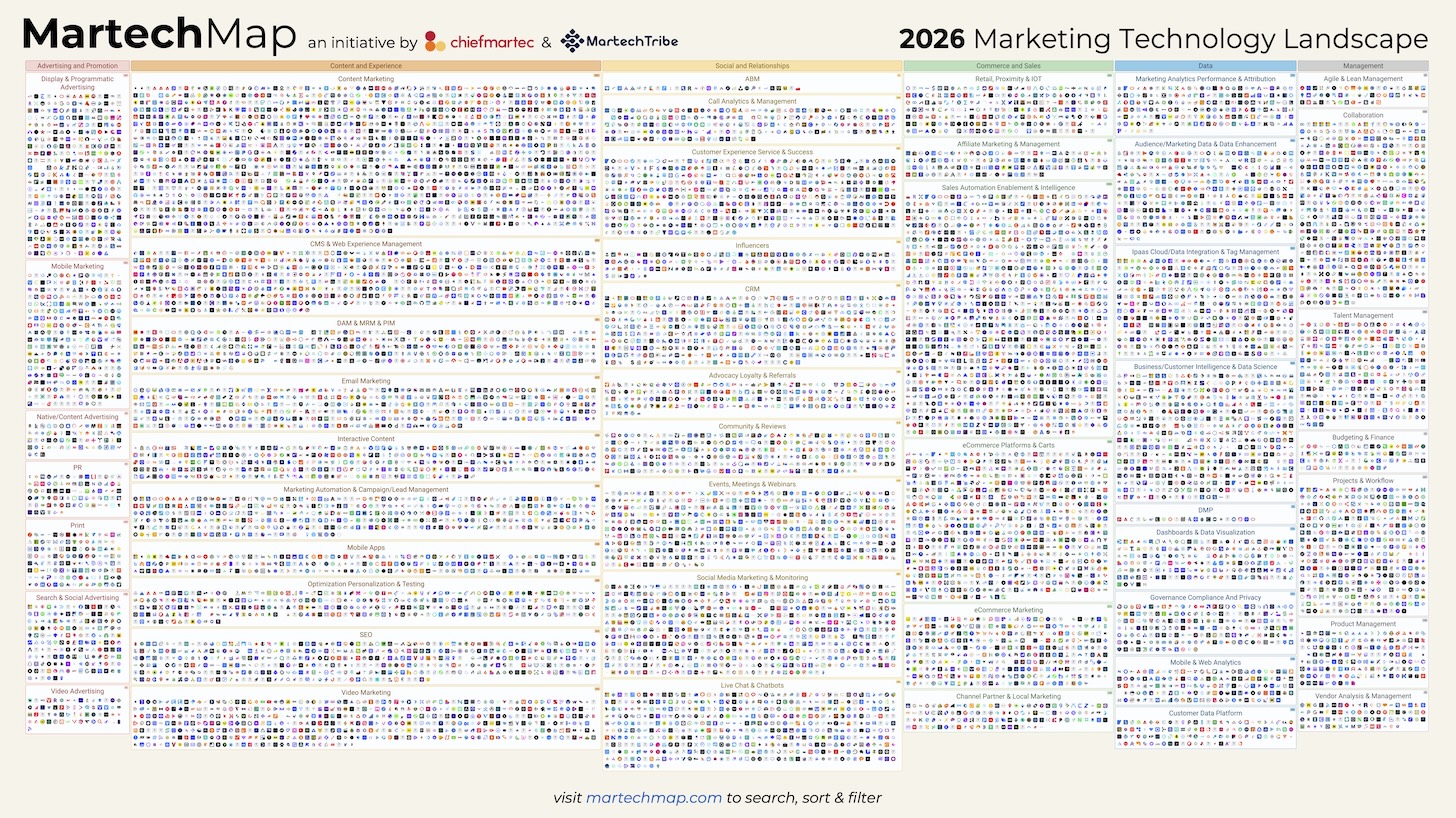
The headline figure of 15,505 products masks a period of extreme volatility. Beneath the surface, the market is undergoing a structural "shake-out." The 2026 data shows that 1,488 products were added to the map, while 1,367 were removed.
The Anatomy of the Exit
The removals are not merely a result of failed "AI wrappers"—the flash-in-the-pan tools launched during the early hype cycle of LLMs. In fact, over 51% of the products removed from the 2026 landscape were part of the initial wave of SaaS innovation from 2010–2019. This suggests a systemic culling of legacy technology that has been rendered obsolete by modern, AI-integrated platforms.
The demographic of these departures is also telling:
- 45.5% of removed products held annual revenue between $1 million and $10 million.
- 41.2% were micro-organizations with 1–10 employees.
- 38.7% were small-to-medium businesses with 11–50 employees.
These companies represent the "squeezed middle." They reached sufficient scale to be viable businesses but lacked the competitive moat to survive in a market where incumbent platforms are bundling AI features from above and agile, AI-native startups are disrupting from below. Buyers, meanwhile, are fatigued by "bloated stacks" and are actively rationalizing their vendor lists, favoring integrated ecosystems over fragmented point solutions.
The Renaissance of Mature Categories
If the overall landscape is flat, where is the growth? The most striking finding in the 2026 report is that innovation is not occurring in new, fringe categories, but rather in the "infrastructure" layers of the martech stack.
AI-Driven Growth
- CMS & Web Experience Management: Up 21.4% (from 504 to 612 products).
- Ecommerce Platforms & Carts: Up 19.9% (from 547 to 656 products).
These categories were once considered "done." However, the advent of AI has forced a total re-architecture of how these systems function. For twenty years, websites were designed for two primary audiences: humans and search engine crawlers. Today, a third, critical audience has arrived: machines.
AI search assistants, agentic browsers, and automated procurement bots do not "browse" a website in the traditional sense. They need to extract, compare, summarize, and act. This shift is driving demand for CMS and ecommerce tools that prioritize structured, machine-readable data.
Context Engineering
The "new" growth is defined by what industry experts are calling "Context Engineering." As companies deploy their own AI agents—concierges, sales assistants, and advisors—the efficacy of these agents depends entirely on their ability to access real-time, high-fidelity context. This includes customer history, pricing models, inventory levels, and brand guidelines. Consequently, the tools that manage this "connective tissue" are seeing a surge in development.
Implications: The Shift from "More" to "Better"
The plateau of the martech landscape is not a signal of market failure; it is a sign of market maturity. The era of "more logos" has been replaced by the era of "more integration."
1. The Death of the "Point Solution"
The ease with which marketers can now build custom agents or leverage native AI features within large suites means that many narrow, single-feature tools are no longer necessary. The market is moving toward consolidation, where the value lies in platforms that can orchestrate actions across the entire customer journey.
2. The Rise of Invisible Infrastructure
Categories like iPaaS (Data Integration), which grew by 8.0%, and Governance, Compliance & Privacy, which grew by 7.1%, are becoming the most vital pieces of the martech puzzle. As AI agents gain the power to act on behalf of the company, the rules governing those actions become as important as the actions themselves.
3. Analytics in the Age of AI
With Mobile & Web Analytics growing by 11.3%, it is clear that marketers are struggling to maintain visibility. As more customer interactions occur within opaque, AI-mediated environments, the ability to instrument and track the "gaps" in the customer journey has become a high-priority investment area.
A Final Assessment: What Comes Next?
We have reached "Peak Martech" in terms of quantity, but we are only at the beginning of a transformation in quality. The State of Martech 2026 report serves as a definitive document for this transition. The landscape has grown over 100 times since its inception in 2011—a staggering 10,236.7% increase—but the "sprint" is over.
The industry is entering a "marathon" phase, characterized by rigorous consolidation, a focus on data governance, and the integration of AI into the very core of business operations. For CMOs and technologists, the task for 2026 and beyond is not to acquire the latest, shiniest logo, but to curate a stack that is intelligent, compliant, and capable of collaborating with the next generation of machine agents.
The water, as they say, is still deep. But the days of chasing an ever-expanding horizon of fragmented software are drawing to a close. The future of martech belongs to the orchestrators, not the collectors.
