
The Future of B2B Go-To-Market: Navigating the AI-Driven Shift in 2026
As the B2B marketing landscape enters 2026, the industry finds itself at a critical inflection point. Jon Miller, the visionary co-founder of Marketo and a foundational architect of modern Account-Based Marketing (ABM), has released his annual forecast, painting a picture of a sector undergoing a fundamental, albeit uneven, transformation. Moving away from the hype of "SaaS is dead," Miller argues that the next 12 months will be defined by "hybrid experimentation," where human-led strategy and agentic AI begin their first major, tangible integration.
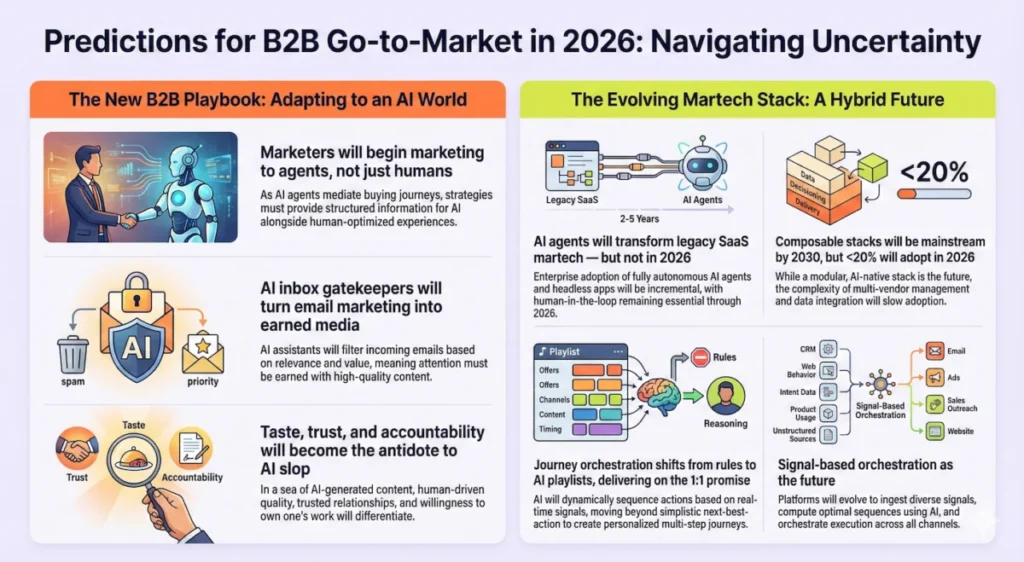
The New Reality: Marketing to Agents and Humans
The most profound shift identified in Miller’s 2026 analysis is the evolution of the buying committee. It is no longer composed solely of humans; it now includes AI agents tasked with researching, filtering, and evaluating vendors.
The Rise of Agent-Centric GTM
For decades, marketers have optimized content for human consumption. In 2026, they must pivot to "Answer Engine Optimization" (AEO). With 90% of B2B buyers already utilizing AI tools for preliminary research, the way an AI agent positions a company’s capabilities relative to competitors is becoming a critical product marketing KPI.
Miller suggests that marketers must adopt a "headless" content architecture. This model decouples the delivery of information into two streams:
- Human-Facing: Branded, emotionally resonant content designed to build trust and facilitate complex, high-stakes decision-making.
- Agent-Facing: Structured data, pricing APIs, and machine-readable services that allow AI agents to fetch accurate, real-time specifications without human intervention.
Chronology of the AI Disruption
To understand the current state of the industry, one must look at the recent trajectory of technological adoption:
- 2023-2024: The "Gold Rush" phase, where LLMs became common, but implementation remained ad-hoc and experimental.
- 2025: The year of "Answer Engine Optimization," where AEO became a recognized necessity, with over 50% of companies increasing investment in AI-optimized content over traditional SEO.
- 2026: The year of "Hybrid Integration." AI is no longer a bolt-on; it is becoming a core component of GTM strategy. However, Miller notes that true, full-scale autonomous agency remains a 2-5 year horizon, not an immediate reality for the average enterprise.
Supporting Data and Market Trends
The transition toward an AI-integrated stack is supported by significant shifts in how organizations allocate resources and manage technology.
The "Composable Lite" Movement
While the industry is buzzing about "composable stacks"—where businesses abandon monolithic suites for modular, best-in-class components—Miller notes that adoption remains low. Currently, fewer than 20% of B2B teams are running fully composable architectures. The complexity of managing multiple vendors and the lack of marketing-specific data warehouses are the primary friction points. Instead, most firms are moving toward "composable lite," where data stays centralized in warehouses, but execution remains within established, trusted marketing automation platforms (MAPs).
Employment and the "Silent Freeze"
One of the most sobering aspects of the 2026 outlook is the impact on labor. Research from the Stanford Digital Economy Lab indicates a 16-20% decline in employment for AI-exposed positions, specifically hitting early-career roles. This "Silent Freeze" is not necessarily a wave of layoffs, but a failure to backfill junior roles, effectively destroying the "on-ramp" for the next generation of marketers.
Implications for Marketing Operations
The transition from rules-based automation to reasoning-based AI is perhaps the most significant operational shift.
From Rigid Rules to Reasoning Models
Traditional marketing automation relies on brittle "if-then" logic: If X, wait two days, then send Y. These systems are failing under the weight of market volatility. In contrast, 2026 will see the rise of "Reasoning AI." These models can handle ambiguity, learn from outcomes, and weigh multiple signals simultaneously.
For the modern Marketing Operations (MOPs) professional, this changes the day-to-day role:
- Context Engineering: Ops teams will now focus on capturing the "tribal knowledge" that makes a business unique—naming conventions, strategic reasoning behind Salesforce schemas, and the nuances of campaign goals—and structuring that data so AI can execute effectively.
- Signal-Based Orchestration: The future platform is not a campaign builder, but a signal processor. By ingesting signals from CRM, product usage, and third-party data, the AI curates "playlists"—sequences of actions that move buyers forward based on real-time behavior rather than static workflows.
Official Responses and Strategic Shifts
Industry analysts and organizations are responding to this shift with a renewed emphasis on "Proof" over "Persuasion." As Forrester’s Predictions 2026 report suggests, trust is becoming highly fragmented. B2B customers are increasingly turning toward personal networks and curated, verified sources.
The Antidote to "AI Slop"
As content becomes effectively free to produce, the market is becoming flooded with "AI slop"—polished but valueless content. To combat this, Miller identifies three pillars that will define successful brands in 2026:
- Taste: The editorial sensibility to discern what is actually valuable to a target audience.
- Trust: The credibility built through human-to-human relationships, which is why founder-led content and individual influencer relations are seeing massive budget increases.
- Accountability: The willingness to stake a reputation on AI-assisted output. Much like a legal record requires a human signature, high-level B2B content will require human verification to hold weight in the eyes of buyers.
Navigating the Year Ahead
The overarching theme for 2026 is uncertainty. With the World Uncertainty Index reaching historic highs, business leaders are advised to stop trying to predict every move and instead focus on navigating the environment as it unfolds.
Recommendations for Leadership
- Bank Efficiency: Use AI to drive productivity and "bank the savings." An efficient, lean organization is more resilient and capable of pivoting when market conditions shift.
- Upskill the Human: Teach teams to use AI as a coach, not a replacement. The most successful teams will be those that combine deep subject matter expertise with fluid AI tool usage.
- Rethink Org Design: The era of hyper-specialized silos is ending. Leaders should look for "generalist" talent capable of thinking strategically across data, content, and execution.
In conclusion, 2026 will not be a year of wholesale transformation where SaaS vanishes overnight. Instead, it will be a year of building the infrastructure for a future that is undeniably AI-native. As Jon Miller emphasizes, while the tools and methods are evolving, the core of the B2B GTM remains the same: it is a human-centric discipline of building trust, creating value, and solving complex problems. The AI simply provides the new, more powerful toolkit with which to do it.
