
Peak Martech: Has the Era of Unchecked Expansion Finally Come to an End?
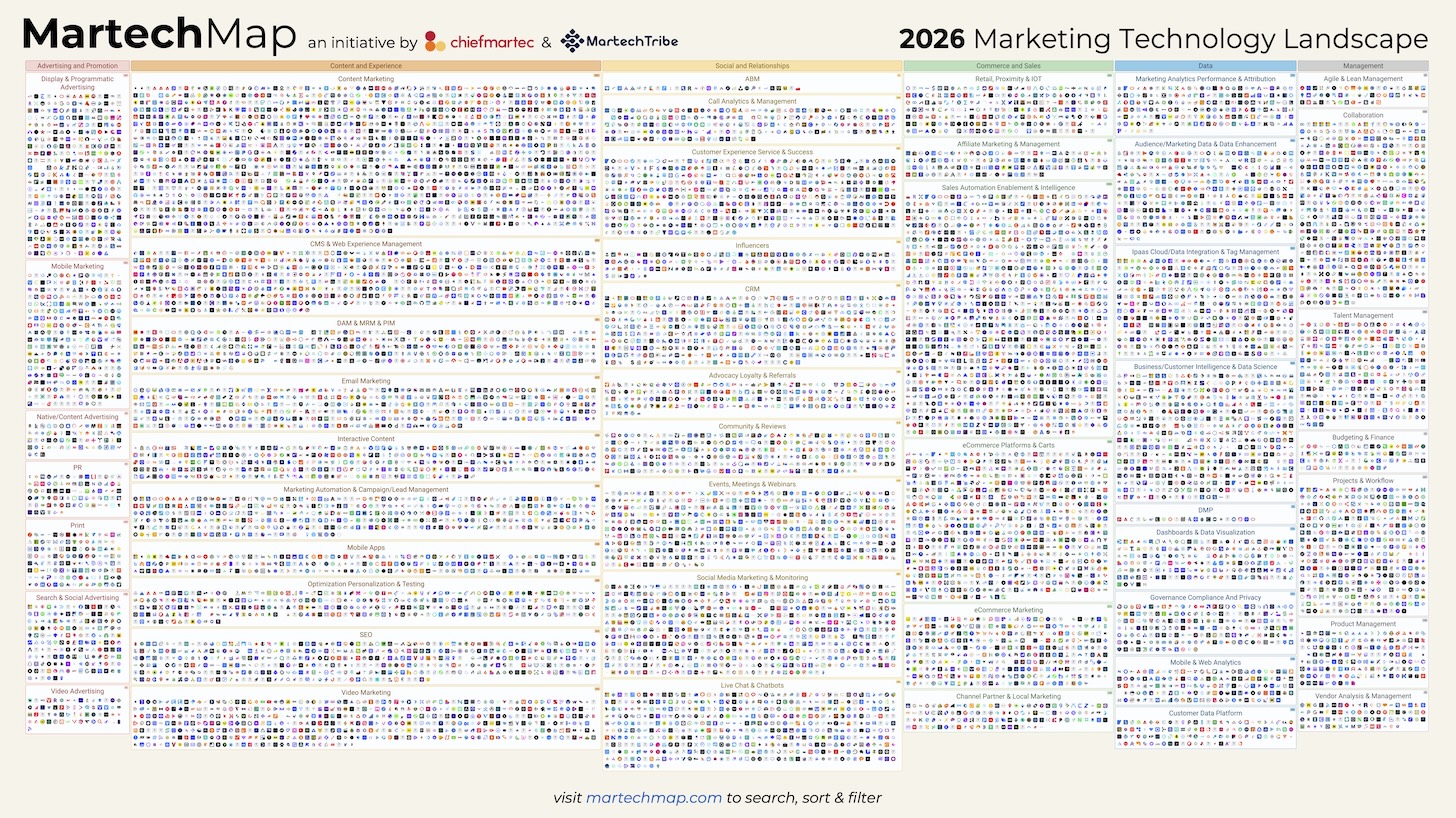
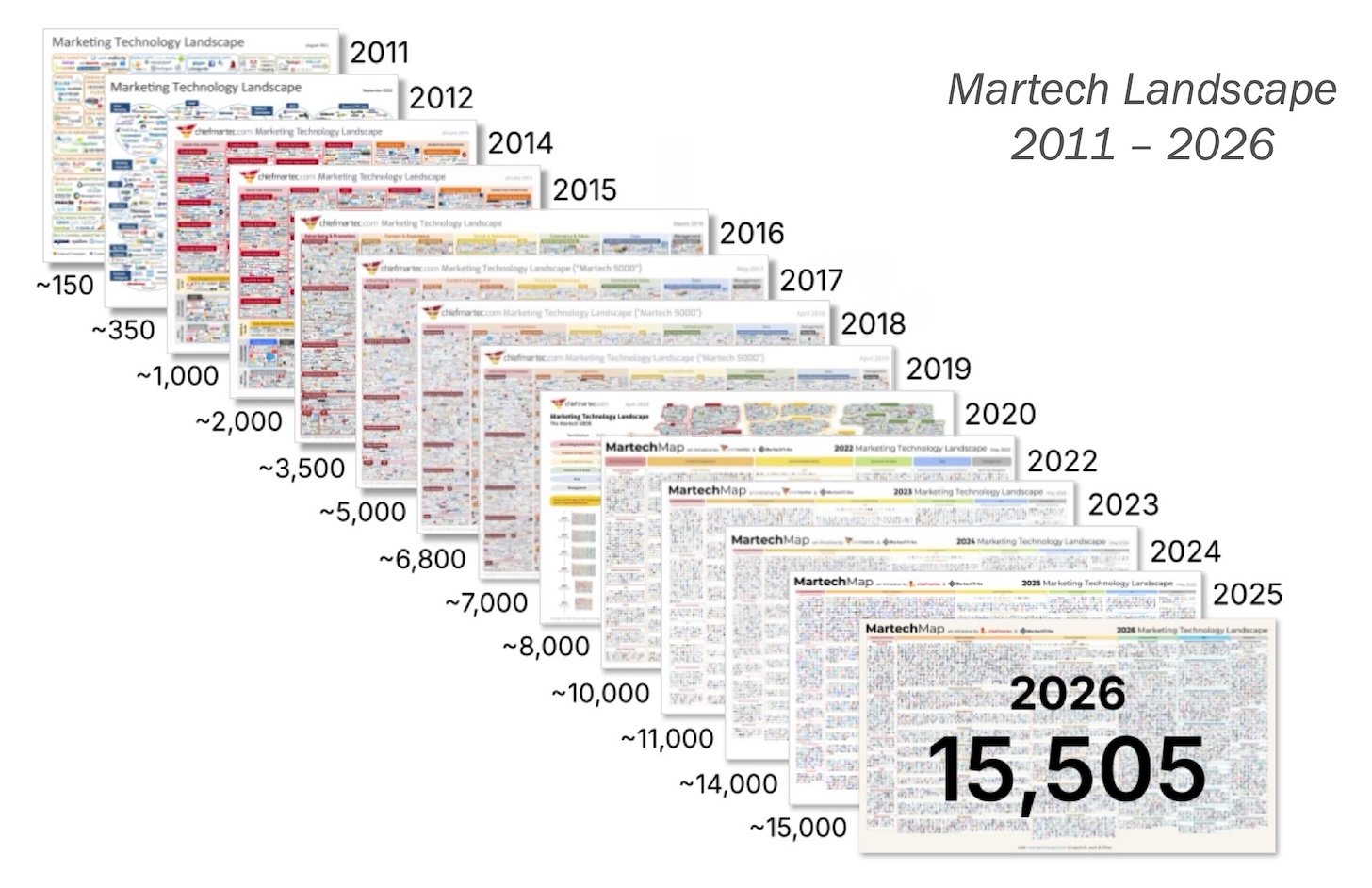
For fifteen years, the annual release of the Marketing Technology Landscape—the definitive “Martech Map”—has been an exercise in astonishment. Since its inception in 2011, when it featured a mere 150 companies, the industry has operated under a single, relentless mandate: growth. Every year, marketers and technologists braced themselves for a sprawling infographic that seemed to defy the laws of physics, expanding from a single slide into an unmanageable collage of thousands of logos.
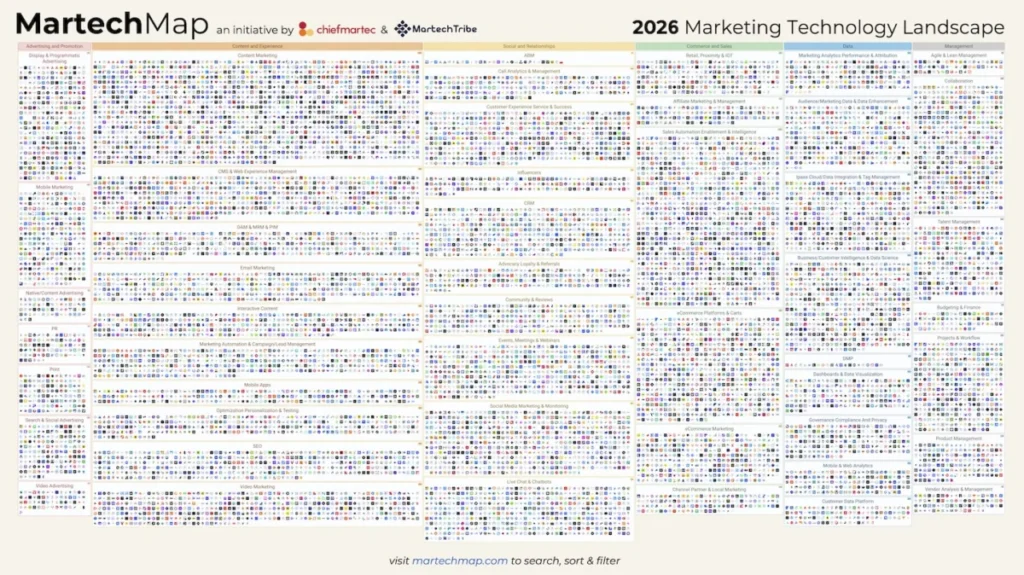
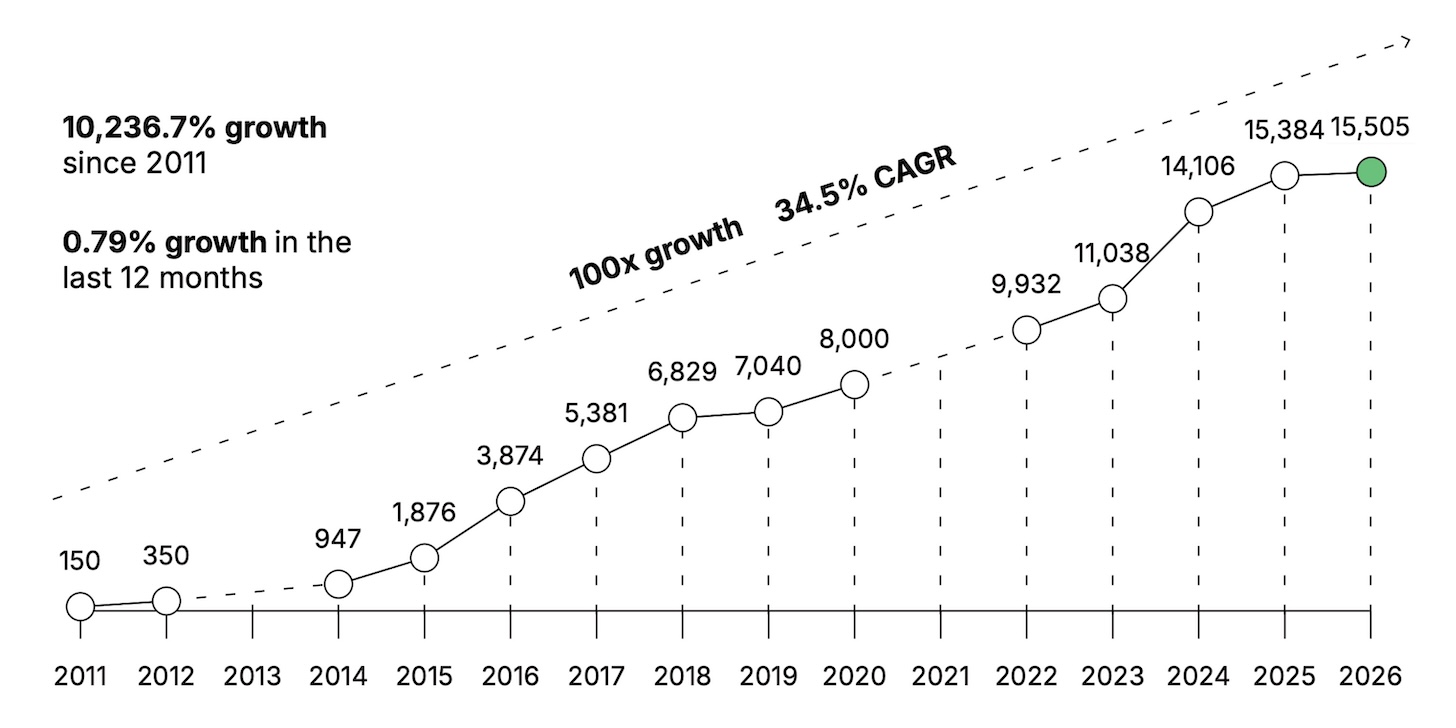
However, the 2026 edition, unveiled today, tells a fundamentally different story. For the first time in the history of the industry, the martech landscape has effectively reached a plateau. With 15,505 products now documented, the year-over-year growth has slowed to a mere 0.79%—a statistical whisper compared to the thunderous expansion of previous cycles. We have, it appears, finally reached "Peak Martech."
The Main Facts: A Market in Equilibrium
The headline figure of 15,505 products, up only 121 from the 15,384 recorded in 2025, masks a period of profound volatility. To conclude that the industry is stagnant would be a grave error; rather, the ecosystem has transitioned from a phase of explosive, unchecked creation into a phase of intense, Darwinian churn.
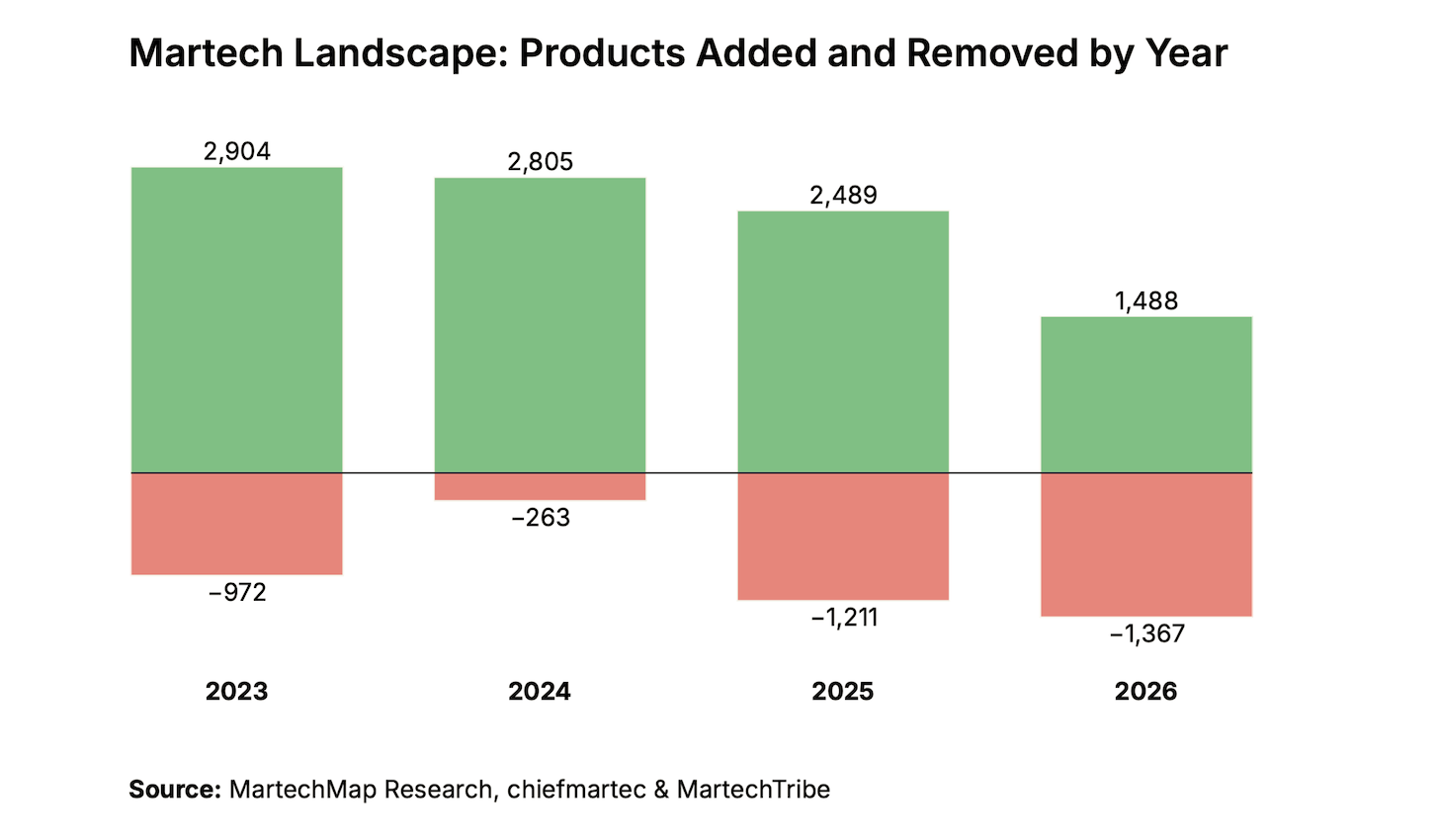
This year, the data reveals a high-velocity cycle of replacement. While 1,488 new products entered the landscape, 1,367 were removed. This is not the quiet death of a dying industry, but the aggressive self-correction of a mature one. The "bonfire of the vanities," as some observers have called the removal of thousands of "AI wrapper" startups, is only one part of the story. A significant portion of the departures includes the first generation of SaaS martech platforms—companies that were once disruptors but are now finding themselves unable to survive in an era dominated by AI-native challengers and massive incumbent bundling.
A Chronology of Expansion and Correction
To understand the current state, one must look at the trajectory of the last decade and a half. In 2011, the landscape was a curiosity—a way to map a nascent ecosystem. By 2015, it had become a survival guide for CMOs. By 2020, it was a source of existential dread.
Throughout this period, the industry operated on the assumption that "more" was always better. Every problem was met with a new category; every niche was filled by a new logo. The growth was consistent and largely decoupled from the broader economic climate. Even during periods of market correction, the martech landscape found a way to add volume.
However, the 2026 data indicates that the "land grab" phase is over. The 40% decline in new entrants—dropping from 2,489 last year to 1,488 this year—suggests that the barrier to entry has shifted. Capital is no longer flowing into "me-too" SaaS products. Instead, the market is favoring consolidation, integration, and high-utility AI applications. We are seeing the closure of the first major chapter of the SaaS era, where over half of the removed products originated from the 2010–2019 wave of innovation.
Supporting Data: Dissecting the Churn
The demographic of the "exits" provides a clear picture of the current squeeze. The companies being purged are not necessarily failures in the traditional sense; many achieved $1M to $10M in revenue and maintained headcount between 11 and 50 employees.
These firms found initial traction but lacked the "inevitability" required to scale in a hyper-competitive environment. They are being squeezed from two directions:
- The Incumbents: Large, established platforms are rapidly integrating AI features directly into their existing suites, rendering standalone point solutions redundant.
- The AI-Native Startups: Lean, agile new entrants are utilizing modern LLMs to perform the same tasks as legacy tools at a fraction of the cost and complexity.
Furthermore, the data shows that 45.5% of removed products were in the $1M–$10M revenue bracket. This confirms that the "middle class" of martech is the most vulnerable. These companies are too large to be ignored by major players but too small to compete with the feature-bloat of global enterprise suites.
The Resurrection of Mature Categories
Perhaps the most surprising finding in the 2026 report is where the actual growth is occurring. While many expected growth to be confined to "Generative AI" categories, the strongest momentum is appearing in the most mature segments of the landscape.
- CMS & Web Experience Management: Grew 21.4%, moving from 504 to 612 products.
- Ecommerce Platforms & Carts: Grew 19.9%, jumping from 547 to 656.
These are not "new" categories, but they are being fundamentally re-engineered by the rise of AI. For twenty years, websites were designed for two primary audiences: humans and search engine bots. Today, there is a third, dominant audience: the machine agent.
The growth in CMS and Ecommerce is driven by the need to optimize content for "agentic browsers," shopping agents, and procurement bots. These entities do not "browse" websites in the traditional sense; they extract, compare, and summarize data. Consequently, companies are scrambling to upgrade their infrastructure to provide the clean, structured, machine-readable data that these agents require.
Implications: The Shift Toward Context Engineering
The shift toward AI-mediated interactions has significant implications for how marketing is practiced. As more of the customer journey disappears into "black box" interactions, the ability to instrument and track the remaining touchpoints becomes a competitive necessity.
This explains why Mobile & Web Analytics grew by 11.3% and Call Analytics by 8.9%. Marketers are desperate to maintain visibility in a world where the path to purchase is increasingly obscured by AI intermediaries. Similarly, the growth in iPaaS/Data Integration (8.0%) and Governance & Privacy (7.1%) reflects the reality that when agents are empowered to take actions across disparate systems, the "connective tissue" of the stack becomes the most important layer.
The core challenge for the modern CMO is no longer just "content creation," but "context engineering." The quality of an AI-driven interaction—whether it’s a chatbot, a shopping concierge, or an automated sales assistant—is entirely dependent on the context it can access. This includes product data, customer history, pricing, and brand guidelines. As a result, the "old" tools of the martech stack are being reactivated. Marketing Automation, a category long declared "dead" by industry skeptics, grew by 5.9% this year as it becomes the primary engine for orchestrating these new, agent-driven workflows.
Conclusion: The "River" Metaphor
While it is tempting to view the 2026 landscape as a sign of industry maturity or a "death" of innovation, the reality is more nuanced. Martech is a river, not a lake. The water is constantly moving, even if the total volume remains stable.
The era of 100x growth since 2011—a staggering 10,236.7% increase—has served its purpose by building the foundation of the modern digital economy. We are now entering an era of integration and refinement. The next few years will not be defined by the number of tools a company uses, but by the cohesion of the ecosystem.
For the marketing technologist, the message is clear: the period of collecting logos is over. The period of engineering high-performance, AI-integrated customer experiences has begun. As we look at the 15,505 products on the 2026 map, the question is no longer "what can I add to my stack?" but "what can I remove to make my stack smarter?"
The 2026 State of Martech report, available in full online, provides the roadmap for this transition. It is a vital resource for any professional looking to navigate a landscape that is no longer expanding outward, but diving deep. The era of Peak Martech is not the end of the journey; it is merely the beginning of a more sophisticated, AI-augmented chapter.
