
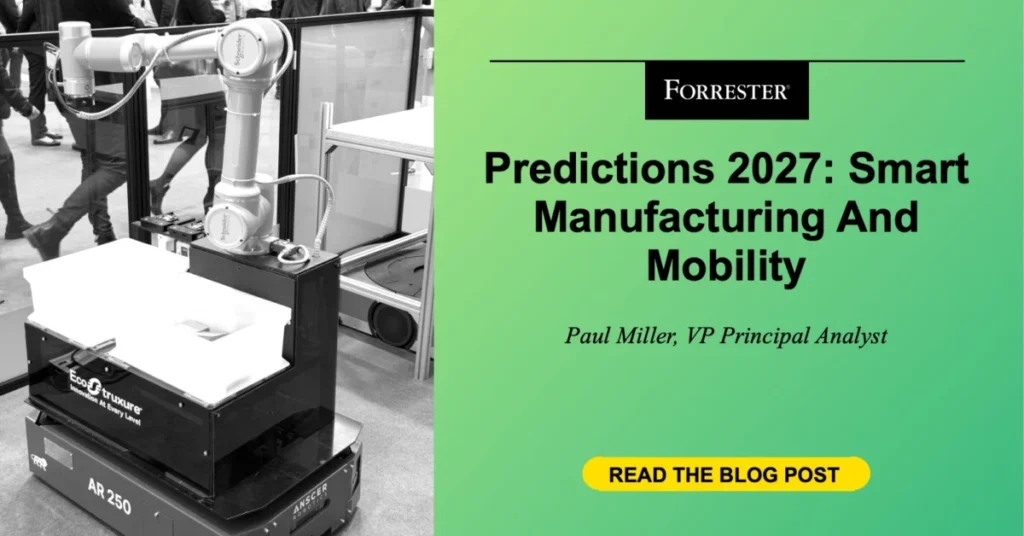
Navigating the Precipice of 2027: The High-Stakes Balancing Act for Smart Manufacturing and Mobility
As the global economy inches closer to the late 2020s, the industrial landscape finds itself caught in an unprecedented crucible of change. Geopolitical volatility, structurally shifting supply chains, escalating operational costs, and the dual-edged sword of robotics and artificial intelligence (AI) are converging to make 2027 a pivotal year for the manufacturing sector.
According to recent strategic analyses from research and advisory firm Forrester, traditional industrial organizations are facing an unforgiving mandate: they must walk a razor-thin line between executing bold, necessary technological transformations and abandoning costly, unviable experiments that drain capital.
Unlike fast-moving, asset-light industries such as software or digital media, manufacturers have historically lagged in transformation velocity. Heavy machinery, physical footprints, complex supply chains, and stringent safety requirements have naturally made the sector more cautious. However, the sheer magnitude of modern technological disruption—spanned by advancements in generative and agentic AI, quantum computing, and advanced industrial robotics—means that the manufacturing sector can no longer afford its historical hesitation.
Business and technology leaders in smart manufacturing and mobility now face an existential tightrope walk. They must carefully balance the operational disruption and financial risks of adopting new technologies too quickly against the catastrophic peril of being overtaken, or digitally compromised, by failing to adopt them quickly enough.
Main Facts: The 2027 Manufacturing Paradox
The overarching narrative for industrial enterprises looking toward 2027 is defined by several core realities:
- The Transformation Velocity Gap: Asset-heavy industries continue to modernize at a fraction of the speed of digital-first sectors, yet modern macroeconomic pressures demand immediate adaptability.
- The AI and Robotics Double-Edged Sword: While automation and machine learning promise unprecedented efficiencies, the capital expenditure (CapEx) and operational integration risks associated with them can derail unprepared organizations.
- Geopolitical and Supply Chain Fragility: Trade realignments, shifting global alliances, and localized manufacturing mandates are forcing firms to rethink their entire operational footprint.
- The Quantum Horizon: Emerging fields like quantum computing are beginning to transition from theoretical physics to practical supply chain optimization challenges, adding another layer of complexity for enterprise architects.
To survive and thrive in this landscape, executives cannot rely on business-as-usual strategies. They must embrace a pragmatism that reconciles the urgency of innovation with the realities of physical-world manufacturing.
Chronology: How the Industry Reached This Critical Juncture
Understanding the high-stakes decisions awaiting manufacturers in 2027 requires looking back at the evolutionary trajectory that has shaped modern industrial operations over the past decade.
Phase 1: Industry 4.0 and the IoT Awakening (Mid-2010s to 2020)
The journey toward smart manufacturing began in earnest with the concept of Industry 4.0. Enterprises rushed to install Internet of Things (IoT) sensors on legacy machinery, aiming to capture telemetry data and transition from reactive maintenance to predictive maintenance. However, many early adopters struggled with data silos, lack of standardization, and unclear return on investment (ROI).
Phase 2: Pandemic Disruptions and Supply Chain Realignment (2020–2023)
The COVID-19 pandemic exposed the fatal vulnerabilities of hyper-optimized, just-in-time global supply chains. Manufacturers learned painful lessons about single-source dependencies and geopolitical fragilities. This period shifted executive priorities from pure cost-reduction to supply chain resilience, nearshoring, and regionalization.
Phase 3: The Generative AI Boom and Automation Surge (2023–2025)
The public explosion of generative AI and rapid advancements in collaborative robots (cobots) injected a new kind of urgency into the market. While tech companies integrated AI into software overnight, manufacturers grappled with how to apply these digital tools to physical assembly lines, quality control, and factory-floor logistics without halting production.
Phase 4: The Strategic Reckoning (2026–2027 Approach)
As the industry looks directly toward 2027, the era of unbridled, speculative experimentation is drawing to a close. Boardrooms are demanding clear accountability for digital transformation budgets. Companies are realizing that pilot projects that fail to scale are a luxury they can no longer afford, setting the stage for a ruthless consolidation of viable technological strategies.
Supporting Data and Contextual Trends: Beyond the Factory Floor
The challenges facing manufacturers do not exist in a vacuum; they are part of a broader macroeconomic and technological shift touching every corner of the global enterprise ecosystem. Similar pressures are reshaping adjacent sectors like retail and digital commerce, illuminating universal truths about the trajectory of enterprise technology.
The Value-Driven Retail Realities of 2027
In the retail sector—closely tied to manufacturing through consumer goods and supply chains—meaningful growth is notoriously difficult to secure. Winning market share in 2027 requires far more than aggressive discounting or superficial AI implementations. Economic pressures, shifting consumer expectations, and the rise of agentic AI are completely rewriting retail dynamics. Retailers are learning that operational efficiency and value creation must go hand in hand, a lesson directly applicable to how manufacturers must price and deliver goods.
The Post-Click Era of Digital Commerce
Concurrently, digital commerce is entering a "post-click era." Autonomous AI agents are taking over larger portions of the consumer and B2B buying journey. Discovery, evaluation, and purchasing are increasingly occurring beyond the direct control of traditional brand websites. For manufacturers operating B2B portals or direct-to-consumer (D2C) channels, this means that their digital storefronts must be optimized not just for human eyeballs, but for machine-to-machine transactions and AI-driven procurement systems.
The Industrial Capital Dilemma
When mapping these trends back to smart manufacturing and mobility, the underlying theme is clear: autonomy and intelligence are replacing manual oversight. Whether it is an AI agent negotiating component purchases or a collaborative robot sorting defective parts on an assembly line, the margin for error is shrinking. Capital investments in 2027 must be laser-focused on technologies that offer verifiable resilience, speed-to-market, and risk mitigation.
Industry Perspectives and Strategic Guidance
Analysts and industry leaders are urging manufacturing executives to adopt a structured, disciplined approach to the coming years. The consensus from strategic advisory firms emphasizes that technology adoption must be tied directly to measurable operational outcomes rather than hype-driven FOMO (fear of missing out).
According to enterprise research frameworks, organizations are being advised to evaluate their technology portfolios through three distinct lenses:
- Pragmatic Integration: Avoiding the trap of abandoning proven legacy systems entirely while systematically integrating modular, scalable automation solutions.
- Cybersecurity and Resilience: As factories become more connected through IoT, edge computing, and AI, they also become prime targets for sophisticated cyberattacks. Protecting operational technology (OT) networks must run parallel to IT modernization.
- Workforce Transformation: Robots and AI are not merely replacing human workers; they are shifting the required skill sets on the factory floor. Upskilling existing personnel to manage, maintain, and collaborate with advanced automation is just as critical as purchasing the hardware itself.
Strategic Implications: What Manufacturers Must Do Next
As 2027 approaches, the decisions made in executive suites today will determine which industrial players dominate the next decade and which fall by the wayside. The implications of this current transition period point toward several mandatory actions for enterprise leaders:
1. End the Era of Unfocused Experimentation
The days of running endless, open-ended proof-of-concept (PoC) projects without a clear path to production are over. Business leaders must demand rigorous validation criteria for all digital transformation initiatives. If an AI or robotics initiative cannot demonstrate a clear path to ROI and operational scalability within a defined timeframe, resources must be reallocated to core operational stability.
2. Prepare for Autonomous Supply Chains
With digital commerce entering advanced agentic eras, manufacturing supply chains must become equally responsive. Enterprise resource planning (ERP) systems and supply chain management (SCM) platforms must evolve to interface seamlessly with autonomous buying agents and predictive analytics engines. Agility will no longer be measured in weeks or days, but in real-time adjustments.
3. Balance Agility with Risk Management
The tension between moving too slowly and moving too recklessly will define strategic planning. Leaders must foster a culture of calculated risk-taking—empowering innovation teams to test new applications in controlled environments while maintaining robust fail-safes to protect core manufacturing operations from catastrophic downtime.
Looking Ahead
The path to 2027 is fraught with complexity, but it is equally rich with opportunity for those willing to navigate the complexities with a clear-eyed, pragmatic vision. By harmonizing technological ambition with disciplined execution, smart manufacturing and mobility leaders can transform the hurdles of today into the competitive advantages of tomorrow.
