
Navigating the Future: Unpacking the "Martech for 2026" Industry Blueprint
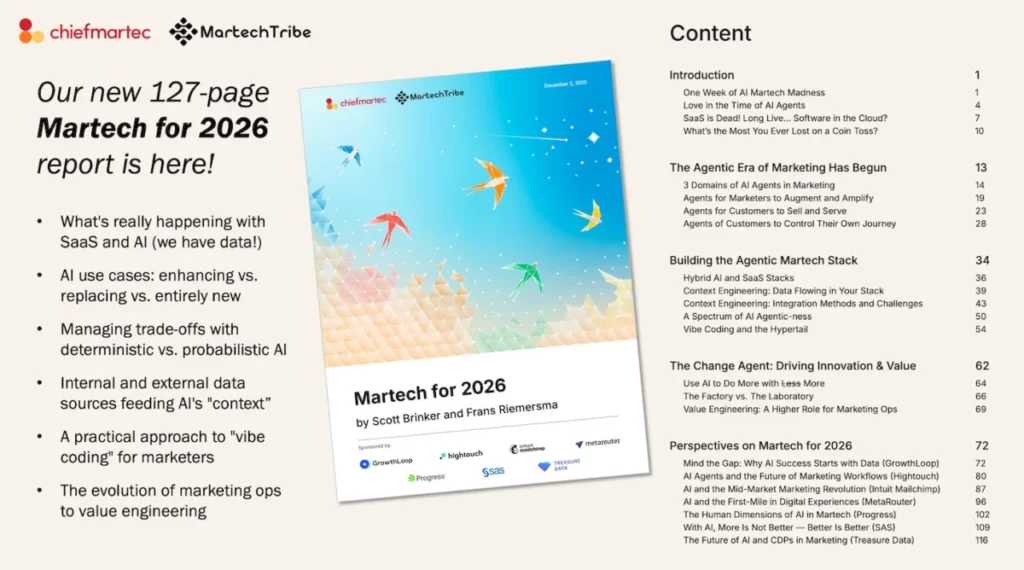
In a landscape defined by rapid technological shifts and the relentless integration of artificial intelligence, marketing technology professionals are constantly searching for a compass. Today, that search is made significantly easier with the release of the "Martech for 2026" report—a comprehensive, 127-page deep dive into the state of the industry. Authored by industry stalwarts, this report serves as a vital resource for navigating the complexities of the next two years.
Unlike many industry white papers that hide behind paywalls, complex lead-generation forms, or social media engagement mandates, this report takes a refreshingly transparent approach: it is available as a direct, ungated PDF download. This decision reflects a commitment to democratizing high-level insights within the marketing community.
Main Facts: A Blueprint for the Coming Era
The "Martech for 2026" report is not merely a collection of trends; it is an extensive analysis of how AI and data governance will reshape the marketing function. The report synthesizes months of rigorous research, including the latest data from the AI & Data in Marketing survey conducted earlier this year.
By eschewing techno-jargon in favor of plain-language explanations and clear, data-driven visual illustrations, the authors have created a document that is accessible to both the technical architect and the marketing executive. The report aims to bridge the gap between "hype" and "utility," focusing on the actionable steps organizations must take to remain competitive as we move toward 2026.
Chronology: The Evolution of the 2026 Vision
The development of this report followed a structured, multi-month lifecycle, ensuring that the findings remained grounded in both empirical data and real-world application:
- Phase 1: Data Gathering (Q3 2024): The team initiated the AI & Data in Marketing survey, collecting feedback from thousands of professionals across the globe to gauge the current adoption rates and challenges surrounding generative AI and advanced data analytics.
- Phase 2: Editorial Synthesis (Q4 2024): The authors spent months distilling the survey data into core themes. The goal was to avoid superficial commentary, opting instead for a structural analysis of the martech stack.
- Phase 3: Industry Collaboration (Late Q4 2024): Recognizing the need for diverse perspectives, the authors engaged seven industry leaders. Unlike traditional sponsored content, these contributors did not have editorial oversight. Instead, the authors conducted deep-dive interviews to capture these companies’ unique philosophies on the evolution of martech.
- Phase 4: Publication (December 2025): The final report was launched to the public, providing a definitive roadmap for the industry as it enters the 2026 fiscal cycle.
Supporting Data: What the Industry Tells Us
The core value of the report lies in its empirical foundation. The AI & Data in Marketing survey highlights several critical trends that will define the next 24 months:
- The Integration Gap: While many companies have access to AI tools, a significant portion struggles with "data readiness." The survey data suggests that AI performance is directly correlated to the cleanliness and accessibility of customer data—a concept often referred to as the "data-to-intelligence" bottleneck.
- Workflow Transformation: The data indicates a shift away from manual campaign management toward the use of "AI Agents." These autonomous or semi-autonomous systems are beginning to take over repetitive tasks, shifting the role of the marketer from an "executor" to an "orchestrator."
- The Shift Toward Quality: A recurring theme in the survey results is a move away from the "more is better" mentality. Professionals are increasingly prioritizing the quality of AI-generated insights over the volume of content or data points.
Official Responses: Insights from Industry Leaders
To provide depth, the report features seven distinct chapters written in collaboration with industry pioneers. These chapters offer a glimpse into how different sectors are approaching the 2026 horizon:
The Technical and Strategic Pillars
- GrowthLoop: Focuses on "Mind the Gap," emphasizing that AI success is entirely dependent on the underlying data infrastructure.
- Hightouch: Explores the future of "AI Agents," arguing that the next iteration of marketing will be defined by how effectively these agents can execute workflows across disparate systems.
- Intuit Mailchimp: Provides a specialized look at the "Mid-Market Marketing Revolution," highlighting how smaller organizations can leverage AI to compete with larger enterprises.
- MetaRouter: Discusses the "First-Mile in Digital Experiences," addressing the critical importance of data privacy and collection at the source.
- Progress: Offers a human-centric perspective, exploring the "Human Dimensions of AI," reminding the industry that technology serves to augment, not replace, human creativity.
- SAS: Advocates for a shift in philosophy: "Better Is Better." The report argues that focusing on precision and model efficacy will outperform brute-force AI strategies.
- Treasure Data: Analyzes the future of Customer Data Platforms (CDPs), mapping how AI will transform these platforms into active "intelligence engines" rather than passive storage repositories.
Implications for the Future of Martech
The "Martech for 2026" report suggests that we are at an inflection point. For the past decade, the industry has been defined by the proliferation of tools—a "fragmentation" era. The next phase will be defined by "consolidation and orchestration."
1. The Death of the "Black Box"
As AI becomes embedded in every layer of the martech stack, the report implies that marketers must demand greater transparency. Organizations can no longer afford to treat their AI tools as black boxes. They must understand the data lineage and the logic models behind the recommendations their tools provide.
2. The Rise of the AI Orchestrator
The professional of 2026 will be defined by their ability to manage a network of agents. The report suggests that the most successful marketing teams will not be those with the most staff, but those with the most effective "agent-stack," where humans define the strategy and AI executes, optimizes, and iterates at scale.
3. Privacy-First Data Architectures
With the increasing scrutiny on data privacy and the sunsetting of traditional tracking methods, the report underscores the importance of the "first-mile." Companies that fail to secure their data collection processes at the point of origin will find themselves at a distinct disadvantage as regulatory environments tighten.
4. The Human Element
Perhaps the most significant takeaway is the reaffirmation of human judgment. While the report celebrates the technical advancements of 2026, it concludes that the "human dimension" remains the final arbiter of quality. The ability to interpret context, exercise ethical judgment, and align technology with brand identity remains a uniquely human skill that AI is currently ill-equipped to replicate.
Conclusion: A Call to Action
The "Martech for 2026" report serves as both a warning and a roadmap. It warns against the inertia of traditional, siloed marketing approaches and provides a roadmap for those willing to embrace the complexity of AI-driven, data-first strategies.
For professionals looking to stay ahead of the curve, the report is an essential read. It strips away the noise, provides clear guidance, and, perhaps most importantly, offers a path forward that is both technically ambitious and practically grounded. As we look toward 2026, the question is no longer whether AI will change marketing—the question is how quickly you can integrate these insights into your own operational DNA.
To explore these findings in full, readers are encouraged to access the document directly. By doing so, they join a growing community of 42,000+ professionals committed to shaping the future of the industry through knowledge, transparency, and collaborative intelligence. The future of martech is not something that happens to us; it is something we build, and for 2026, the building blocks are finally laid out in clear, plain language.
