
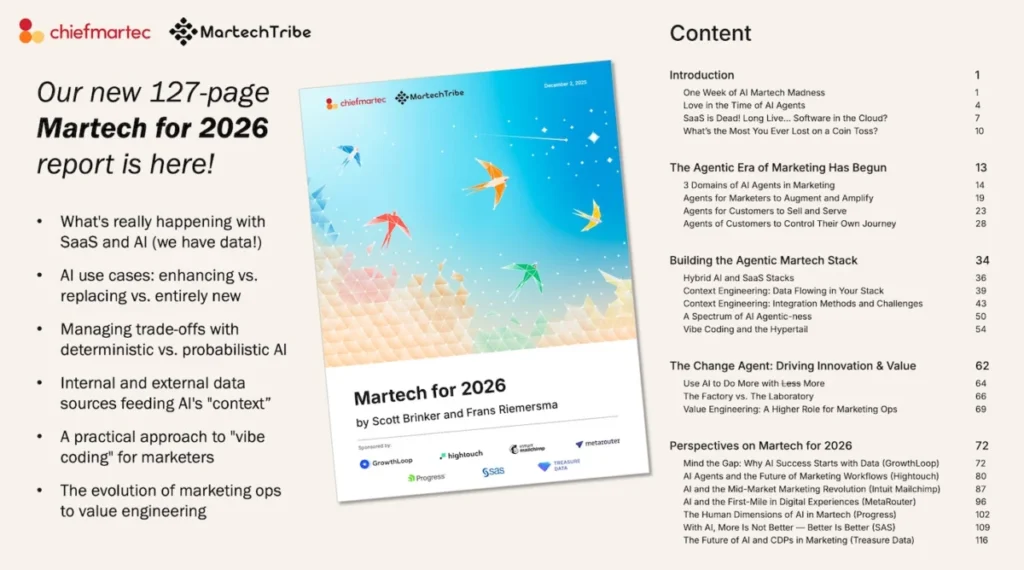
Navigating the Future: Unpacking the Comprehensive "Martech for 2026" Industry Report
The marketing technology landscape is undergoing a transformation of unprecedented speed and complexity. As we look toward the horizon of 2026, the convergence of artificial intelligence, data architecture, and human-centric strategy has become the definitive frontier for CMOs and marketing technologists alike. To cut through the noise, industry luminaries—led by the team behind ChiefMartec—have released a definitive, 127-page roadmap titled "Martech for 2026."
This report represents a significant departure from standard industry whitepapers. Eschewing the typical "gated" content model that forces professionals to trade personal data for insights, the authors have released the full document as an open-access resource. This move is not merely a gesture of goodwill; it is an attempt to democratize the knowledge required to navigate the next 18 months of digital disruption.
The Main Facts: A New Blueprint for Marketing
At its core, "Martech for 2026" is a deep dive into the practical application of AI within marketing stacks. The report moves beyond the speculative hype that characterized 2024 and 2025, focusing instead on structural integrity, workflow automation, and the ethical integration of machine learning into the customer journey.
The report identifies seven pillars of focus for 2026, synthesized from months of research, surveys, and expert interviews. It operates on the premise that marketing technology is no longer an "add-on" or a departmental tool—it is the foundational infrastructure upon which the entire customer experience is built. By stripping away techno-jargon and favoring visual illustrations and plain-language analysis, the authors provide a guide that is as accessible to the C-suite as it is to the technical practitioner.
Chronology: From AI Hype to Practical Implementation
The development of this report was not an overnight endeavor. It reflects a multi-phase research initiative that spanned several months in late 2025.
- Phase 1: Data Acquisition: The process began with an extensive AI & Data in Marketing survey, capturing the sentiment and operational reality of thousands of marketing professionals.
- Phase 2: Synthesis and Analysis: Throughout the fall of 2025, the research team—spearheaded by key industry figures—spent months distilling this data into actionable trends.
- Phase 3: The Expert Dialogue: In a unique editorial approach, the team invited leaders from seven industry-leading firms to provide their perspectives. Crucially, these sponsors had zero editorial oversight over the core findings; they were invited only after the foundational report was drafted, ensuring that their input remained a commentary on the trends rather than an attempt to shape the narrative.
- Phase 4: Release: The final, polished 127-page document was unveiled to the public in December 2025, serving as the industry’s compass for the upcoming year.
Supporting Data: What the Industry is Saying
The report draws its strength from the AI & Data in Marketing survey, which serves as a pulse check on the industry. The findings suggest that while adoption rates for AI tools are skyrocketing, the efficacy of those tools is often hampered by fragmented data silos.
The research indicates that for many organizations, the hurdle to 2026 is no longer the availability of technology, but the maturity of data governance. The report highlights a critical disconnect: many marketing departments possess the AI tools to generate sophisticated content or predictive models, yet they lack the "first-mile" data quality necessary to feed those models effectively. The data clearly suggests that those who focus on data infrastructure—specifically the integration of Customer Data Platforms (CDPs) and real-time data streaming—will significantly outperform their competitors in the next 24 months.
Official Perspectives: Expert Commentary
One of the most valuable aspects of the report is the inclusion of specific chapters dedicated to industry-leading perspectives. By partnering with seven influential companies, the report offers a multi-faceted look at the challenges ahead:
The AI-Data Nexus
- GrowthLoop highlights the "Mind the Gap" phenomenon, emphasizing that AI success is fundamentally rooted in data readiness. Without clean, actionable data, AI models are essentially operating in a vacuum.
- Treasure Data focuses on the future of CDPs, arguing that the integration of AI within the CDP layer is what will define the next era of personalized marketing at scale.
Workflow and Human-Centricity
- Hightouch delves into the rise of "AI Agents" and how they are fundamentally rewriting marketing workflows. It is no longer about human-led tasks, but about human-managed agents executing complex operations.
- Progress provides a critical counter-narrative, focusing on the "Human Dimensions of AI." They argue that as we automate, we must double down on the human elements of creativity and ethical oversight to ensure that technology serves the brand, not the other way around.
Market-Specific Realities
- Intuit Mailchimp explores the "Mid-Market Marketing Revolution," detailing how AI is leveling the playing field, allowing smaller, leaner teams to punch above their weight class.
- MetaRouter tackles the "First-Mile" problem in digital experiences, emphasizing the importance of server-side tracking and data ownership in a privacy-first world.
- SAS offers a sobering reminder: "With AI, more is not better—better is better." They argue that the obsession with the sheer volume of AI output is a distraction from the necessity of high-quality, high-impact implementation.
Implications for the Future
The release of this report signals a maturing of the martech industry. The era of "blind adoption" is ending; we are entering the era of "strategic integration."
Strategic Shifts
The implications for professionals are clear:
- Consolidation over Proliferation: The days of buying dozens of niche tools are waning. The focus is shifting toward integrated ecosystems where data flows seamlessly between agents and platforms.
- Data as a Strategic Asset: Data is no longer a byproduct of marketing; it is the fuel. Organizations that do not prioritize data hygiene and accessibility will find themselves unable to leverage the generative power of AI.
- Human-AI Collaboration: The role of the marketer is evolving into that of an "orchestrator." The ability to manage, prompt, and audit AI agents will become a more valuable skill set than manual execution.
Addressing the Cost of Knowledge
Perhaps the most profound implication of this report is its accessibility. By sourcing the costs of research through sponsorships rather than charging the end-user, the authors have effectively removed the barrier to entry for small-to-medium enterprises (SMEs) and independent practitioners. This ensures that the best practices for 2026 are not reserved for those with the largest budgets, but are available to anyone with the initiative to learn.
Conclusion: A Living Document
The "Martech for 2026" report is more than a static file; it is a call to action. As the authors, including Frans Riemersma, suggest, the goal is to provide a framework that is genuinely useful for the challenges of today and the requirements of tomorrow.
For those in the marketing field, the takeaway is simple: the next 18 months will be defined by how well you can bridge the gap between technical capability and human strategy. With this report as a guide, the complexities of AI, data, and automation become not just manageable, but actionable.
To prepare for the future, professionals are encouraged to review the full 127-page document and integrate these insights into their strategic planning for 2026. As the landscape continues to shift, staying informed—and critically, staying ahead—is the only way to thrive.
For those interested in following this ongoing dialogue, the authors continue to publish regular insights, reaching over 42,000 professionals globally. The full, un-gated PDF of the report remains available for immediate download via the official portal.
