
Institutionalizing the Agency Model: 617 Collective’s Bold Strategy to Reshape the Creator Economy
The landscape of marketing services is currently undergoing a structural metamorphosis. As the creator economy surges toward a projected $480 billion valuation by 2027, the agencies fueling this growth have become prime targets for acquisition. Yet, a persistent tension remains: how does one scale a boutique, founder-led creative shop without stripping away the very culture and independence that made it successful?
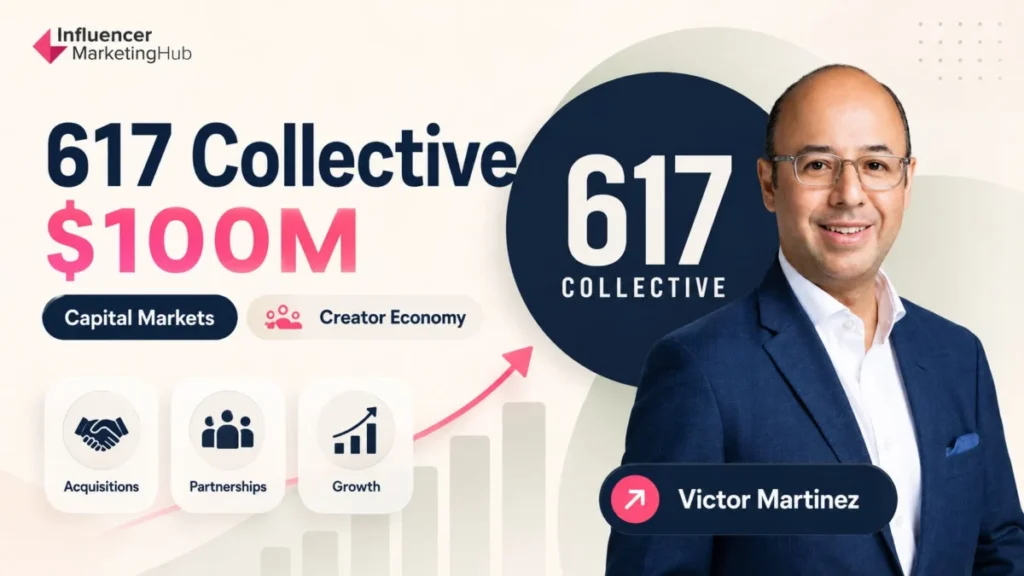
617 Collective, a New York-based acquisition platform, believes it has found the answer. By rejecting the traditional, heavy-handed "roll-up" playbook in favor of a "partner-holdco" model, the firm is attempting to blend the agility of an independent agency with the financial muscle of a legacy holding company. The latest signal of this ambition is the appointment of Victor Martinez—a veteran investment banker from Citi and JPMorgan—as Partner and Head of Capital Markets.
The Strategic Mandate: Why a Wall Street Banker?
The hiring of Victor Martinez is more than a standard executive appointment; it is a declaration of intent. Martinez brings over two decades of experience in capital formation, financing, and public-market positioning for technology and media giants. His role is to build the sophisticated financial infrastructure required to deploy $100 million in acquisition capital over the next twelve months.
For a firm that only announced its first acquisition five months ago, this level of capital deployment is aggressive. It signals that 617 Collective is no longer content with being an boutique player; it is preparing to compete directly with industry titans like Omnicom and Publicis Groupe for the most sought-after independent agencies in the influencer, PR, and creative services sectors.
Martinez’s mandate focuses on three critical pillars:
- Lender Relations: Establishing deep ties with banks, family offices, and private investment firms to ensure a steady, reliable flow of acquisition capital.
- Financing Structures: Engineering bespoke financial vehicles that allow 617 Collective to compete in high-stakes bidding wars against better-capitalized private equity platforms.
- Corporate Development: Creating a robust pipeline of acquisition targets that align with the firm’s specific, founder-first investment criteria.
A Chronology of Growth: From Launch to Institutionalization
617 Collective’s rapid evolution since its inception in August 2025 provides a roadmap for its ambitious scaling strategy.
- August 2025: The firm launches as a family-office-backed holding company. Its initial thesis centers on Northeast-based agencies generating between $1 million and $5 million in revenue, with a specific focus on agencies possessing deep connections to Gen Z and millennial demographics.
- January 2026: The firm makes its first significant move by acquiring Nominee Design, an Oklahoma-based creative studio with a decade of brand-building experience. Simultaneously, Cynthia Monroy, a seasoned CPA and former CFO of Band of Insiders, is brought on as Managing Partner to oversee operations and post-acquisition integration.
- April 2026: 617 Collective expands its geographic and cultural footprint by acquiring Zanahoria Azul, a Miami-based talent management firm specializing in the U.S. Hispanic and Latin American markets.
- June 2026: The hiring of Victor Martinez marks the transition from an experimental startup phase to a period of "continued institutionalization," effectively bridging the gap between founder-friendly values and Wall Street-grade financial rigor.
Supporting Data: The Fragmentation of the Creator Economy
The aggressive strategy employed by 617 Collective is a direct response to the structural state of the creator economy. While estimates on the size of this market vary, the consensus is clear: it is a massive, rapidly compounding industry. According to Influencer Marketing Hub, the creator economy is expected to reach a staggering $480 billion by 2027, maintaining an annual growth rate of over 20%.
Despite this explosive growth, the market remains notoriously fragmented. Thousands of small, specialized agencies compete for a shrinking pool of institutional investment. This fragmentation has naturally led to a surge in M&A activity. Quartermast Advisors reported 81 creator-economy transactions in 2025—a 17.4% increase from the previous year. Furthermore, marketing services M&A activity rose by 14% year-to-date in 2025, even as broader economic indicators signaled a downturn in general deal volume.
The competitive landscape is dominated by massive holding companies that have already begun their own consolidation efforts. With Omnicom’s $13.5 billion merger with Interpublic Group and Publicis Groupe’s $500 million acquisition of the influencer platform Influential, the barrier to entry for smaller players is rising. To survive, firms like 617 Collective must prove that they offer more than just a check; they must provide the structural support and capital access that these massive networks offer, without the stifling bureaucracy.
The "Partner-Holdco" Philosophy: An Official Stance
At the heart of the 617 Collective pitch is a rejection of the "roll-up" stigma. In a traditional roll-up, acquired agencies are often stripped of their identity, forced to adopt central back-office software, and merged into a monolithic brand. 617 Collective advocates for the opposite: maintaining the original leadership, culture, and client relationships of the acquired firms while providing them with the capital and strategic infrastructure necessary to scale.
"We built 617 Collective to be the opposite of a roll-up," noted Managing Partner Cynthia Monroy following the Nominee Design acquisition. This sentiment was echoed during the announcement of Martinez’s hire, with the leadership framing the move as a necessary step toward building a sustainable, long-term organization.
The firm’s approach draws inspiration from "permanent capital" models, such as those pioneered by Constellation Software and Andrew Wilkinson’s Tiny. These models prioritize long-term value creation over the standard three-to-five-year exit strategy common in agency private equity. By focusing on profitable, established businesses rather than "flipping" assets, 617 Collective hopes to attract founders who are weary of the traditional corporate acquisition model.
Implications: The Risks of Scaling
While the "partner-holdco" model is compelling on paper, it faces significant scrutiny as it scales. As noted by consultants at Ebiquity, there is a fine line between a holding company that empowers its subsidiaries and one that eventually becomes a consolidated network.
Key risks include:
- Conflict of Interest: As a holding company accumulates multiple agencies, it risks data-sharing exposure across competing client accounts.
- Operational Creep: Even with a "hands-off" approach, the introduction of a central capital markets office, shared infrastructure, and cross-referrals often leads to a subtle erosion of the very independence the firm promised to protect.
- Culture Clash: Successfully integrating a Wall Street-driven financial approach with the creative, decentralized cultures of boutique agencies is a delicate balancing act.
Ultimately, 617 Collective is betting that the market’s hunger for scale will outweigh these risks. Founders in the creator economy are increasingly aware of their leverage. They want the resources to compete with the giants, but they are wary of losing their autonomy.
The arrival of Victor Martinez signals that 617 Collective is ready to play in the big leagues. By building a bridge between the high-octane world of institutional finance and the grassroots, founder-led world of creative services, the firm is attempting to create a new category of agency ownership. Whether this model can withstand the pressures of rapid growth or whether it will eventually succumb to the gravitational pull of traditional consolidation remains one of the most interesting storylines in the 2026 M&A landscape.
As $100 million in capital prepares to enter the market, the industry will be watching to see if 617 Collective can truly deliver on its "partner-not-owner" promise, or if the demands of institutional finance will inevitably reshape the firm in the image of its predecessors.
