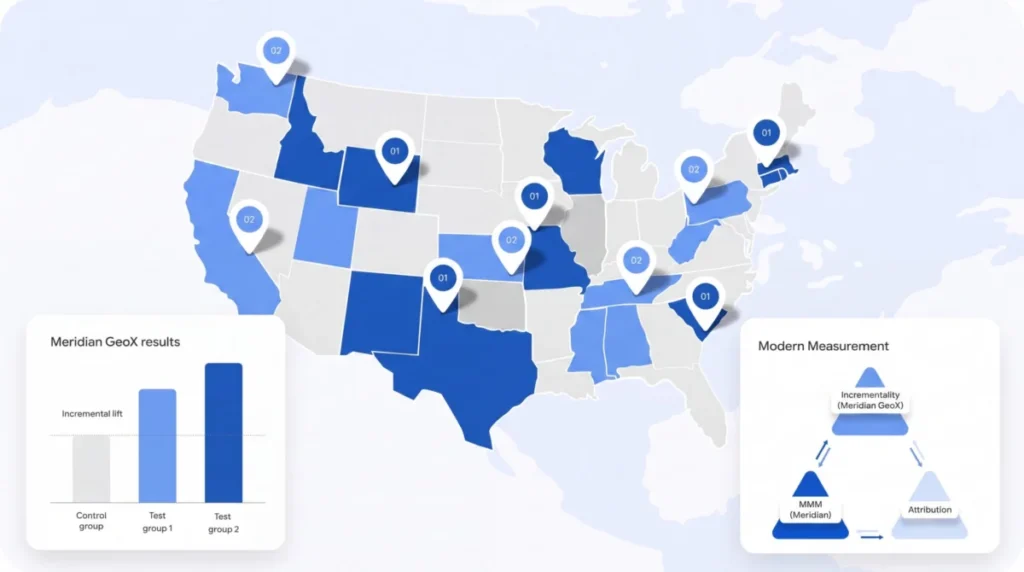
The tech giant is doubling down on causal measurement and incrementality, equipping brands with open-source tools to navigate complex cross-platform media landscapes and cookieless tracking challenges.
Executive Summary & Main Facts
Google has rolled out a sweeping suite of updates to Meridian, its flagship open-source Marketing Mix Modeling (MMM) tool. The announcement centers heavily on bridging the gap between historical statistical modeling and real-world causal experimentation.
The primary updates include:
Global General Availability of Meridian GeoX: Moving out of its beta phase, GeoX is now globally accessible, allowing advertisers to run geographic incrementality experiments across multi-platform media mixes.
Agentic AI Model-Building Assistants: New automated features designed to audit data quality, troubleshoot errors in real time, and streamline the technical implementation of MMMs.
Expanded Brand Signal Integration: The ability to incorporate longer-term metrics, such as Branded Google Query Volume, directly into Meridian models to measure upper-funnel and brand-building impact.
Enhanced Backend Efficiency: Computational optimizations to process complex datasets and deliver faster analytical insights.
These additions arrive at a critical juncture for enterprise marketing teams. As consumer privacy regulations tighten, third-party cookies crumble, and siloed platform attributions become less reliable, brands are actively seeking transparent, cross-channel methodologies to defend their budget allocations to executive leadership.
Chronology: From Preview to Global Availability
Understanding the trajectory of Google’s measurement framework highlights the rapid evolution of privacy-safe analytics over the past year:
May 2026 (The Preview): Google first previewed Meridian GeoX as an experimental open-source framework aimed at solving the inherent limitations of standard geographic incrementality testing.
Mid-2026 (The Open-Source Launch of Meridian): Google introduced the base version of Meridian to the developer and marketing community, providing a free, modern MMM framework built in Python that relies on advanced Bayesian modeling.
September 2026 (The Global Expansion): Google officially shifts Meridian GeoX from beta to general availability worldwide, while simultaneously deploying agentic AI tools and long-term brand-tracking capabilities into the core ecosystem.
This timeline illustrates Google’s strategy to transition Meridian from a simple statistical calculator into an end-to-end measurement suite that pairs continuous macro-modeling with micro-level experimentation.
Supporting Data & Technical Architecture
While Meridian is free from software licensing fees—being an open-source tool—deploying it requires robust organizational infrastructure. The integration of GeoX and agentic tools introduces specific technical prerequisites for marketing analytics teams:
1. Infrastructure and Computational Demands
GPU Requirements: Google explicitly recommends dedicated GPU resources for running Meridian models. The Bayesian statistical engines and Markov chain Monte Carlo (MCMC) sampling methods used to calculate media effectiveness are compute-intensive.
Data Granularity: GeoX requires rigorous daily time-series data and sufficient geographic variation (e.g., Designated Market Areas or postal codes) to construct reliable treatment and control groups.
2. Experimental Design Constraints
Media Holding and Reallocation: Running geo-experiments often requires advertisers to artificially fluctuate spend—increasing, holding flat, or blacking out budgets in specific test markets—to accurately isolate the incremental lift of a campaign.
Cross-Platform Compatibility: Unlike walled-garden attribution models that favor the host platform, GeoX is channel-agnostic. Marketers can test media investments across Meta, TikTok, Connected TV (CTV), and traditional linear channels simultaneously.
3. Handling Confounding Variables in Brand Signals
Branded Search Integration: Meridian now ingests Branded Google Query Volume to map the downstream effects of upper-funnel investments (such as television or out-of-home advertising).
The Caveat: Google acknowledges that organic search spikes are not solely caused by advertising. Analysts must account for confounding factors such as seasonal shifts, promotional pricing, public relations, and aggressive competitor activity to avoid misattributing organic demand spikes strictly to media spend.
Official Responses and Strategic Intent
Industry analysts point out that Google’s development of Meridian is a direct response to the industry-wide erosion of deterministic, user-level tracking. By open-sourcing these advanced tools, Google is positioning itself as an essential partner in modern measurement infrastructure without forcing brands into proprietary, closed ecosystems.
In official statements accompanying the release, Google representatives emphasized that the updates are designed to alleviate the "black box" criticism historically lobied against Marketing Mix Models.
"By combining the broad macroeconomic view of MMM with the sharp causal evidence of GeoX experiments, marketers are no longer forced to choose between historical prediction and live testing," notes product documentation from Google’s ads and commerce division.
Furthermore, the introduction of agentic AI assistants addresses a major labor bottleneck. Historically, setting up an MMM required specialized data science teams to manually hunt down missing values, correct multicollinearity errors, and debug Python code. The new real-time auditing tools aim to democratize advanced modeling for a broader segment of marketing analysts.
Implications for Advertisers and Enterprise Brands
The convergence of Meridian, GeoX, and agentic AI carries significant strategic, operational, and financial implications for enterprise marketing departments:
Bridging the C-Suite Credibility Gap
One of the most persistent hurdles in digital marketing has been defending multi-million-dollar budget reallocations based solely on abstract statistical models. Executives often struggle to trust outputs derived from complex mathematical assumptions.
By running GeoX experiments that validate (or challenge) the outputs of a Meridian model, marketing leaders gain dual layers of evidence. If a geographic holdout test confirms that a specific channel is driving true incremental profit, marketing directors can present a bulletproof case to CFOs and CEOs.
The Shift Toward "Triangulated Measurement"
Smart brands are moving away from single-source attribution and embracing triangulation. This methodology cross-references three distinct pillars:
Marketing Mix Modeling (Meridian): For macro-level budget allocation across historical data.
Geographic Incrementality Experiments (GeoX): For causal, real-world testing of specific tactics or channels.
First-Party Data and Conversion Lift Studies: For immediate user-level insights where privacy consent allows.
Who Benefits Most? (The Accessibility Divide)
Despite Meridian being free of licensing fees, it is not a plug-and-play dashboard for small-to-medium businesses (SMBs). The barrier to entry remains high due to:
The Need for Specialized Talent: Data scientists or advanced analytics translators are required to interpret Bayesian outputs.
Media Investment Scale: Running geo-experiments requires sufficient advertising volume to safely shift budgets across regions without collapsing regional revenue streams.
For enterprise brands with the requisite scale, data maturity, and technical talent, however, these updates transform Meridian from a static research project into a dynamic, operational command center for media investment.
Future Outlook: What Lies Ahead for Open-Source MMM
As Meridian gains global adoption, the most fascinating dynamic to watch will be how brands handle discrepancies between their models and their live experiments.
Inevitably, a GeoX experiment will occasionally contradict a Meridian model’s historical forecast—perhaps revealing that a favored channel is underperforming, or conversely, that an overlooked channel is driving hidden incremental lift. Rather than signaling a flaw in the tools, industry experts view these discrepancies as the most valuable output: they force marketing teams to question outdated assumptions, refine their data inputs, and ultimately achieve a truer understanding of return on ad spend (ROAS).
With agentic AI easing the technical burden and global geo-experimentation providing causal validation, Google’s latest updates signal that the future of marketing measurement belongs to those who successfully marry data science with active, real-world experimentation.