
Beyond the Prompt: Why the Future of Marketing Lies in Building, Not Just Browsing
For the past two years, the marketing industry has been obsessed with a singular question: "How can AI help me do my job faster?"
From drafting social media copy in seconds to automating the grunt work of email segmentation, the prevailing narrative around Artificial Intelligence has been one of velocity. But as the initial novelty of generative AI begins to wane, a more sophisticated strategy is emerging—one that shifts the focus from using AI as a temporary crutch to building it into the very architecture of the marketing department.
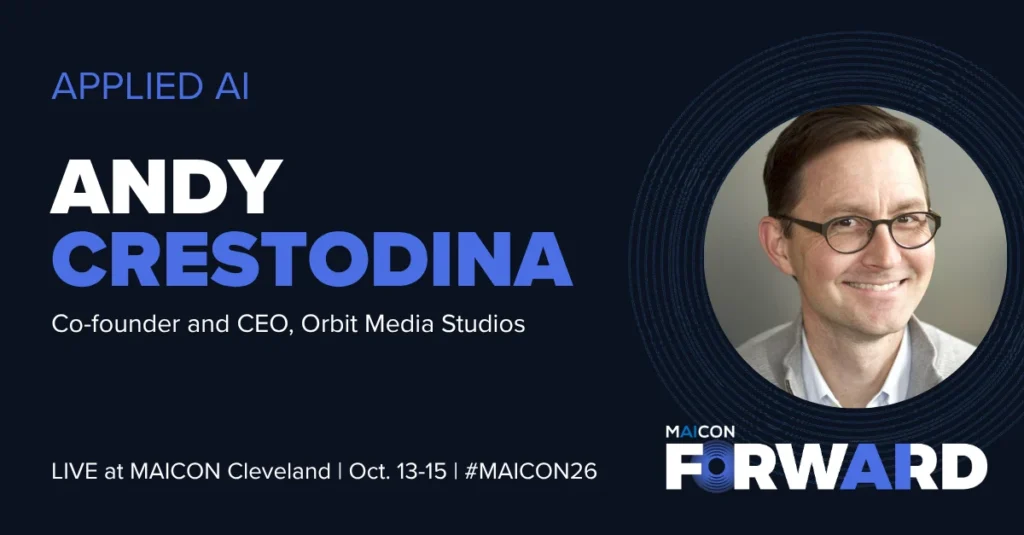
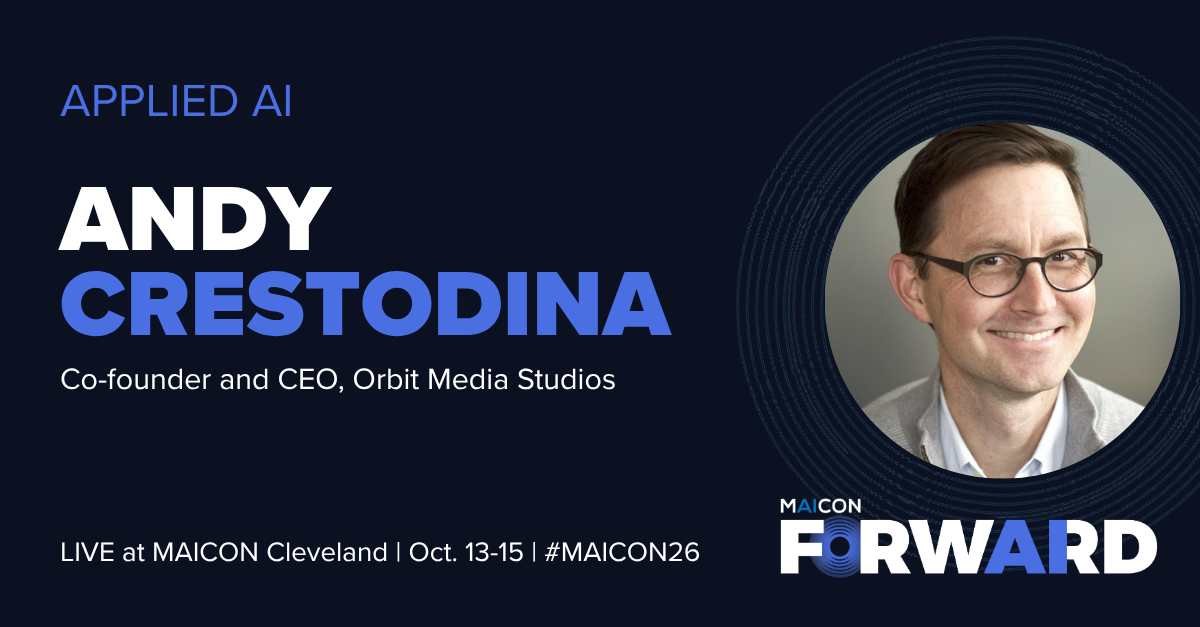
Andy Crestodina, the co-founder and CMO of Orbit Media, argues that the real opportunity isn’t just "faster work"—it is the transformation of individual marketing tasks into autonomous, repeatable tools. This paradigm shift will serve as the centerpiece of his upcoming keynote at MAICON 2026: "From Process to Prompt to Automation: How a Marketing Job Becomes a Marketing Tool."
The Evolution of Marketing Workflows
The current state of marketing AI is often characterized by "one-off" prompting—a trial-and-error approach where a human asks a question, gets an answer, and moves on. Crestodina suggests that this is merely the first stage of a much longer, more intentional evolution.
"The work of marketing has changed," Crestodina observes. "Modern marketing workflows evolve in a specific sequence, starting from 100% manual execution by human hands, moving toward assistance, and eventually landing on a model where the AI does the heavy lifting while the human acts as the curator and quality control."
This progression, however, is not instantaneous. Crestodina warns that many teams fail because they expect immediate, high-quality results from a single prompt. He likens the development of an AI assistant to the training of a junior employee: "My most powerful assistants evolved gradually. I don’t think you can ‘one-shot’ a great AI worker bee."
True automation requires a foundation of rigorous documentation and a deep understanding of the specific processes being outsourced. It is a transition from doing the work to architecting the system that does the work.
Experts: The Unlikely Architects of AI
A common misconception in the current tech landscape is that "prompt engineering" is a role reserved for IT specialists or data scientists. Crestodina contends that this is a fundamental error. The most effective AI builders are, in fact, the subject matter experts themselves.
"The best assistants are built by people who already do that job well," he says. "The expert at the job is the best suited to evaluate AI’s output, judge it, and make improvements."
By positioning the expert—the SEO specialist, the email strategist, the content editor—as the architect, companies can leverage AI as the world’s most powerful skill-transfer tool. When a senior marketer codifies their methodology into a prompt or a chain of workflows, they aren’t just saving time; they are creating an internal asset that allows less-skilled team members to perform at a higher level, effectively democratizing institutional knowledge.
The New Literacy: Prompts as Code
The barrier to entry for building these sophisticated systems is lower than ever, provided marketers change how they view the language of AI. Referencing a famous observation by OpenAI co-founder Andrej Karpathy—"The hot new programming language is English"—Crestodina emphasizes that prompts are, in essence, code.
"Your prompts are code. They are functions. They are tools. Work hard on them," he advises.
In this framework, the prompt becomes a piece of software that requires the same lifecycle management as any enterprise application:
- Definition: Clearly articulating the task and the desired output.
- Iteration: Testing the output against real-world scenarios.
- Refinement: Adjusting the "code" (the English instructions) to handle edge cases.
- Integration: Combining disparate prompts to create a seamless, end-to-end workflow.
When a prompt moves from a fleeting thought to a documented, tested, and shared function, it ceases to be a gimmick and becomes a company asset. Crestodina encourages teams to keep these prompt libraries in a centralized location, fostering a culture of collaborative engineering where prompts from different departments can be combined to solve complex business problems.
Implications for the Industry
The shift from "using tools" to "building tools" has profound implications for how marketing agencies and in-house teams are structured.
The Death of the "AI Tool" Obsession
Marketing teams currently suffer from "shiny object syndrome," constantly subscribing to new software-as-a-service (SaaS) platforms that promise to "fix" their workflows. Crestodina’s philosophy suggests a leaner, more robust approach: stop shopping for third-party solutions that force you to adapt to their workflow and start building bespoke tools that adapt to yours.
The Value of Institutional Memory
When a company relies on third-party software, their process is hidden within a black box. When they build their own prompt-driven workflows, that process becomes part of the company’s intellectual property. This creates a sustainable competitive advantage that cannot be replicated simply by purchasing a subscription to the same tool as a competitor.
Redefining Career Development
If the expert’s job is to build the machine, the junior marketer’s job becomes one of oversight and system maintenance. This changes the hiring landscape, placing a premium on "AI literacy"—the ability to think procedurally and logically—rather than just the ability to perform manual tasks.
Preparing for MAICON 2026
As marketers look toward the future, the session at MAICON 2026 promises to provide a blueprint for this transition. With over 25 years of experience in the digital space, Crestodina brings a pragmatic perspective to a field often clouded by hype.
His work remains anchored in the fundamentals of content marketing—a philosophy best captured in his influential book, Content Chemistry. He recognizes that regardless of the tools used, the ultimate goal of marketing remains the same: driving qualified leads and proving ROI. AI, in this context, is not a replacement for strategy; it is the engine that executes the strategy at scale.
Attendees of the upcoming conference can expect to walk away with:
- A Framework for Transition: A step-by-step guide to moving from manual work to prompt-driven prototypes.
- The "Build vs. Buy" Assessment: Tools to help identify which processes within a team are truly ripe for automation.
- Expertise Codification: Practical strategies for turning the "tacit knowledge" of senior staff into reusable, high-performance prompts.
The Only Limit is Imagination
The recurring theme of the upcoming presentation is one of empowerment. For years, marketers have been told that AI is a force that will "do the work for them." Crestodina flips this: AI is a force that allows you to rebuild your work.
"Don’t look for new tools. Make your own tools," he urges. "The only gap is our own imaginations."
As we approach 2026, the industry is entering a new phase of maturity. The era of playing with chatbots is ending, and the era of engineering marketing systems is beginning. For those who embrace the shift, the ability to build and iterate upon these "English-language functions" will become the most valuable skill in the modern marketer’s toolkit.
The question for leaders is no longer whether they are using AI, but whether they are building the systems that will define their department’s output for years to come. By treating prompts as code and workflows as products, marketers can move beyond the busywork and into a future of sustained, high-leverage growth.
For more information on the evolving landscape of AI in marketing and to hear from industry leaders like Andy Crestodina, register for MAICON 2026. The conference continues to serve as the premier destination for real-world AI strategy, implementation, and leadership.
