
Decoding the Future: Why the "Martech for 2026" Report is Essential Reading for Modern CMOs
As the calendar turns toward December, the marketing industry is once again inundated with the annual flurry of speculative "prophecy" pieces. These end-of-year missives—often filled with hyperbolic, fever-dream predictions—rarely provide actionable intelligence. However, for the past several years, the partnership between industry thought leader Scott Brinker and researcher Frans Riemersma has offered a refreshing, evidence-based alternative.
Their upcoming release, Martech for 2026, is not a collection of baseless prognostications. Instead, it serves as a pragmatic, deeply researched audit of the current state of marketing technology. By analyzing real-world patterns currently embedded within marketing stacks and broader industry infrastructure, Brinker and Riemersma provide a roadmap for the next 6 to 12 months. The report is set to launch on Tuesday, December 2, accompanied by a comprehensive virtual event designed to help practitioners navigate an increasingly complex landscape.
The Core Objective: Pragmatism Over Prophecy
The central thesis of the Martech for 2026 report is that industry evolution is rarely driven by sudden, magical shifts, but rather by the iterative maturation of existing technologies. Brinker emphasizes that the goal of this annual deep-dive is to strip away the "hype cycle" noise that currently dominates marketing discourse.
"These aren’t the crazy, eye-rolling predictions you’re used to," says Brinker. "It’s a pragmatic assessment of what is actually happening inside marketing tech stacks and the martech industry as a whole. We are looking at existing, real-world patterns that can be reasonably extrapolated to get you prepped for the year ahead."
The report, spanning over 100 pages, is designed to be a functional manual for Chief Marketing Officers (CMOs), marketing operations (MOps) leads, and technology architects. It aims to bridge the gap between theoretical AI capabilities and the gritty reality of production-level marketing operations.
Chronology of a Shifting Landscape
To understand why 2026 feels like a pivot point, one must look at the recent trajectory of the industry:
- 2023: The AI Awakening: The industry saw a massive influx of generative AI tools. While experimental, these tools shifted the focus from "what can we do" to "what should we do" with large language models.
- 2024: The Integration Phase: Organizations began moving beyond chatbots, attempting to integrate AI agents into their existing SaaS ecosystems. This period was marked by the realization that data hygiene is the primary bottleneck for AI performance.
- 2025: The Rise of Autonomous Agents: We witnessed the emergence of "agentic" workflows—systems that don’t just generate text or images, but execute multi-step tasks.
- 2026 (The Outlook): The focus shifts to "Context Engineering" and the systemic integration of AI agents as core components of the martech stack rather than bolted-on novelties.
Supporting Data: The Three Domains of AI Agents
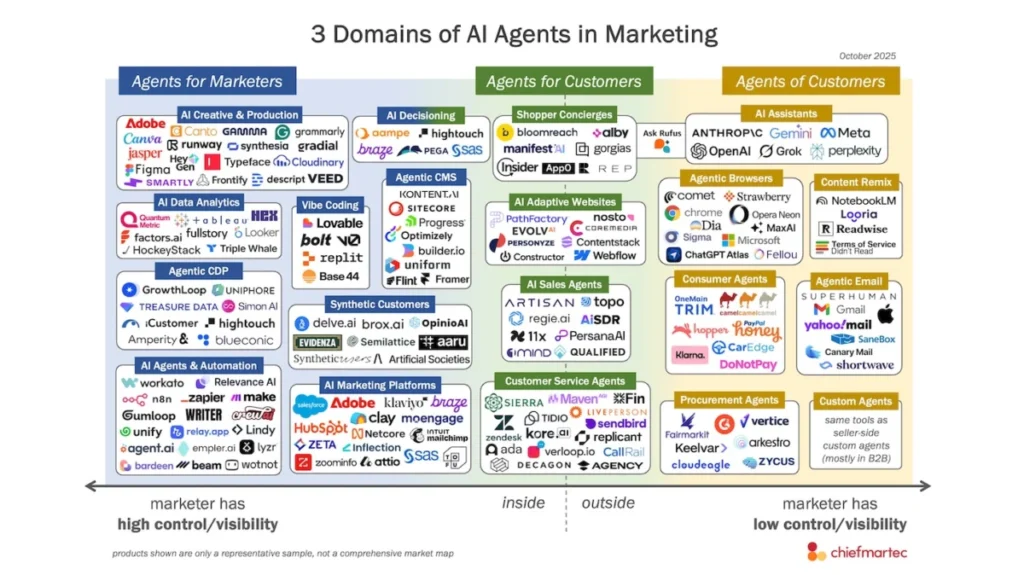
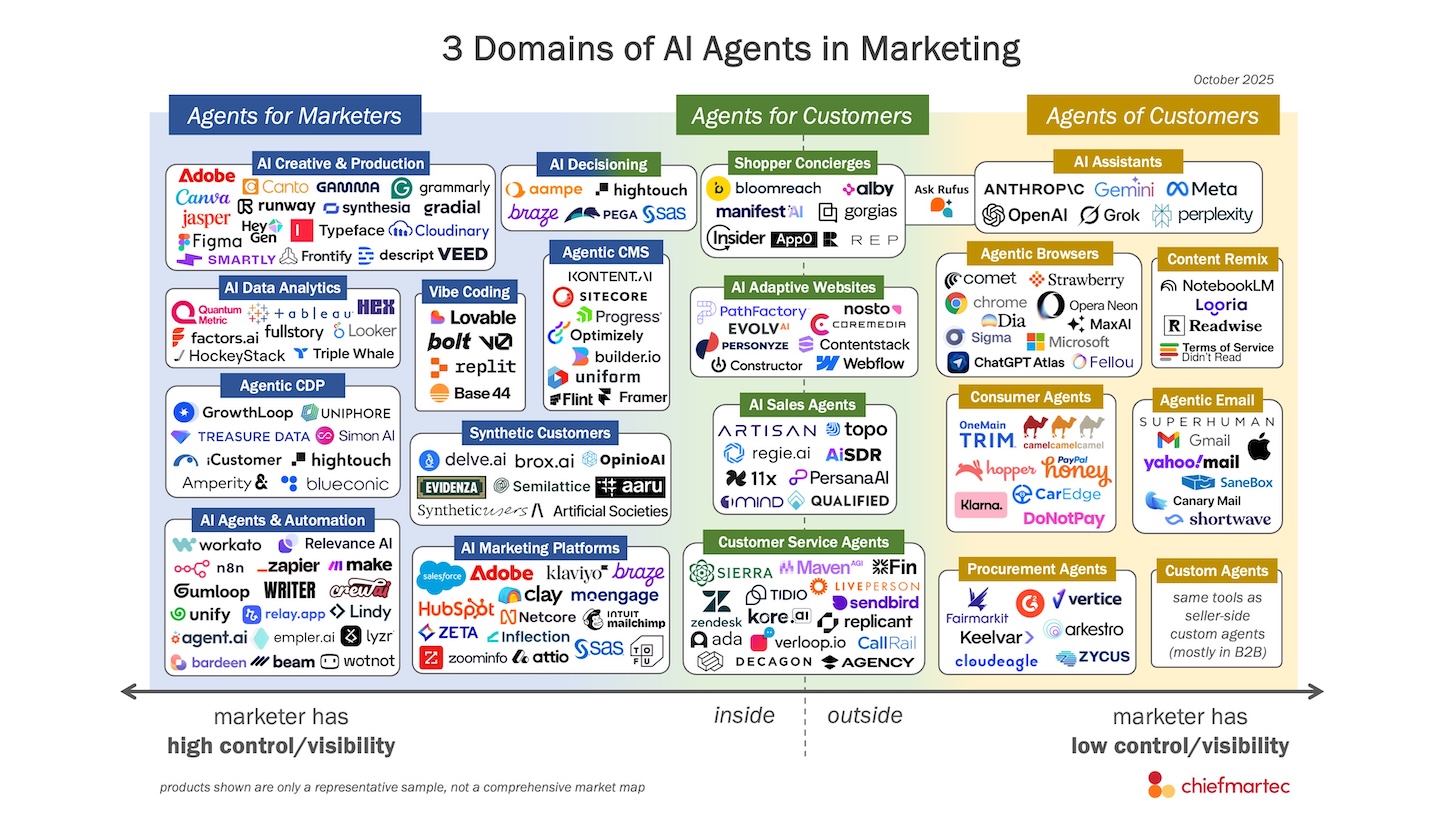
A cornerstone of this year’s report is a detailed analysis of AI agents. Brinker and Riemersma have categorized the vast array of new tools into three distinct domains. By doing so, they provide a framework for marketers to evaluate which technologies are worth the investment and which are still in the "science fair" phase.
1. The Production Frontier
This category includes agents that are already scaling. These are the tools that handle high-volume, repetitive tasks where the cost of error is low and the efficiency gains are high. The report uses data from the AI & Data in Marketing survey to pinpoint which specific platforms are successfully transitioning from prototype to production.
2. The Context Engineering Domain
Arguably the most critical chapter of the report, this section explores how organizations are feeding data into AI agents. "Context Engineering" refers to the art of curating, structuring, and grounding the data that informs agentic decision-making. The report highlights that without high-quality data pipelines, even the most sophisticated agent will fail to deliver business-relevant outcomes.
3. The SaaS Integration Layer
The report tackles the burning question: Will AI replace the apps in your current stack, or augment them? By analyzing the evolving relationship between existing platforms (such as CRM, CDPs, and Marketing Automation) and new AI agents, the authors provide a clear-eyed view of where software budgets should be directed in 2026.
Official Perspectives: A "No-Sales-Pitch" Dialogue
Unlike many industry events that serve as backdrops for vendor marketing, the Martech for 2026 event features a unique, candid approach. Following the keynote presentation by Brinker and Riemersma, the stage will be opened to senior product and marketing leaders from key industry players, including:
- GrowthLoop
- Hightouch
- Intuit Mailchimp
- MetaRouter
- Progress
- SAS
- Treasure Data
These sessions are strictly curated to avoid "sales-pitch" rhetoric. Instead, the focus is on a transparent exchange regarding what these leaders are witnessing within their own organizations and among their diverse client bases. This provides an invaluable opportunity for attendees to hear the "unvarnished truth" from the architects of the technology they use every day.
Implications for Marketing Operations in 2026
The implications of this research are profound for the structure of marketing teams. As AI agents become more autonomous, the role of the "Marketing Technologist" is shifting toward "Orchestration Architect."
The Shift from "Doing" to "Governing"
As AI takes on execution (content creation, ad bidding, data mapping), the human role moves toward governance. Marketers will spend less time in the UI of individual tools and more time ensuring that the "Context Engineering" mentioned earlier is sound, ethical, and compliant with privacy regulations.
Tech Stack Rationalization
The data suggests that the "infinite stack" era is coming to a close. Organizations are beginning to consolidate. If an AI agent can bridge the gap between two disparate platforms, the need for a separate piece of middle-ware software may vanish. The Martech for 2026 report will likely serve as a filter for teams looking to trim their budgets and double down on the platforms that offer the best "agentic" compatibility.
How to Access the Findings
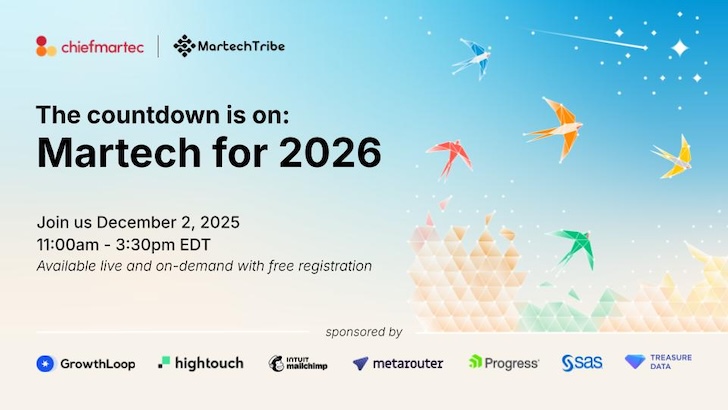
The release of Martech for 2026 is scheduled for Tuesday, December 2. Access to both the 100-plus page report and the accompanying virtual seminar is free, thanks to the support of the aforementioned sponsors.
Registration details:
- Format: Live and on-demand sessions.
- Availability: Content will be accessible throughout the month of December, allowing professionals to consume the findings before the holiday break.
- Registration Link: Martech for 2026 Official Event Page
By signing up in advance, attendees gain priority access to the findings, ensuring they are at the front of the line when the research goes live.
Conclusion: Preparing for the Year Ahead
In an industry defined by rapid change, the ability to discern signal from noise is the ultimate competitive advantage. By focusing on the how and why of current technological integration, Brinker and Riemersma provide a grounding force in an often-volatile environment.
Whether you are a CMO looking to justify your next budget cycle, or a marketing operations professional tasked with cleaning up a fragmented stack, Martech for 2026 offers the data-backed insights necessary to steer your organization in the right direction.
Don’t let the end-of-year rush leave you unprepared. Take the opportunity to engage with the research, join the conversation, and ensure that your team is positioned to leverage the full potential of AI as we enter 2026.
To stay updated on the latest insights and analysis, join the 42,000+ professionals currently subscribed to the chiefmartec community.
