
Breaking the Algorithm: How Global News Publishers Are Adapting to Nuanced Audience Behavior in the Social Video Era
In the modern media landscape, news publishers are no longer simply competing against one another for the fleeting attention of the public. Instead, they are engaged in a high-stakes, constant battle against complex algorithmic factors—relevance scoring, timing precision, format constraints, and platform-specific distribution mechanics. Across international regions and diverse social video ecosystems, recent performance patterns reveal an undeniable truth: audience behavior within the News & Politics genre on social video is remarkably nuanced. Success in this hyper-competitive domain is no longer a matter of simply breaking stories first; rather, it hinges entirely on a publisher’s ability to seamlessly align their content strategy with how viewers actually consume, digest, and react to media in real time.
Drawing upon comprehensive Tubular Intelligence data captured between November 2025 and February 2026, a deep-dive analysis of video length distribution, optimal posting schedules, trending hashtag ecosystems, and top-performing stories across the Asia-Pacific (APAC), Latin America (LATAM), Europe, Middle East, and Africa (EMEA), and North America regions offers a clear window into what is truly driving social video engagement today.
The Main Facts: Navigating the New Rules of Digital News Distribution
The data collected over this four-month observation window shatters long-held assumptions about digital publishing. For years, media organizations operated under generalized best practices—standardizing mid-length video formats, publishing during traditional evening commute hours, and treating social media platforms as mere promotional funnels for print or broadcast products.
Today, those generalized strategies are failing. The algorithms powering platforms like YouTube, Instagram, and TikTok demand precision. According to the Tubular Intelligence metrics, engagement is heavily dictated by regional peculiarities and psychological triggers.
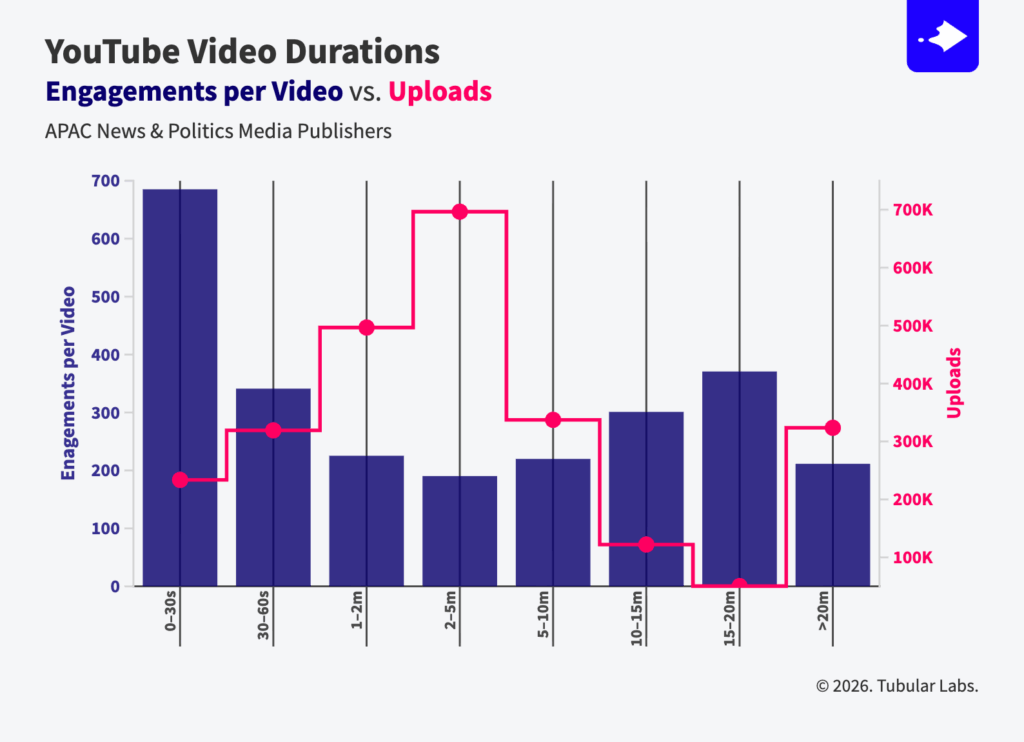
- Format polarization: In regions like APAC, audiences gravitate toward extreme content formats—either ultra-short updates under 30 seconds or deep-dive, long-form explainers stretching past 15 minutes—while standard mid-length videos dominate upload volume with lesser per-video impact.
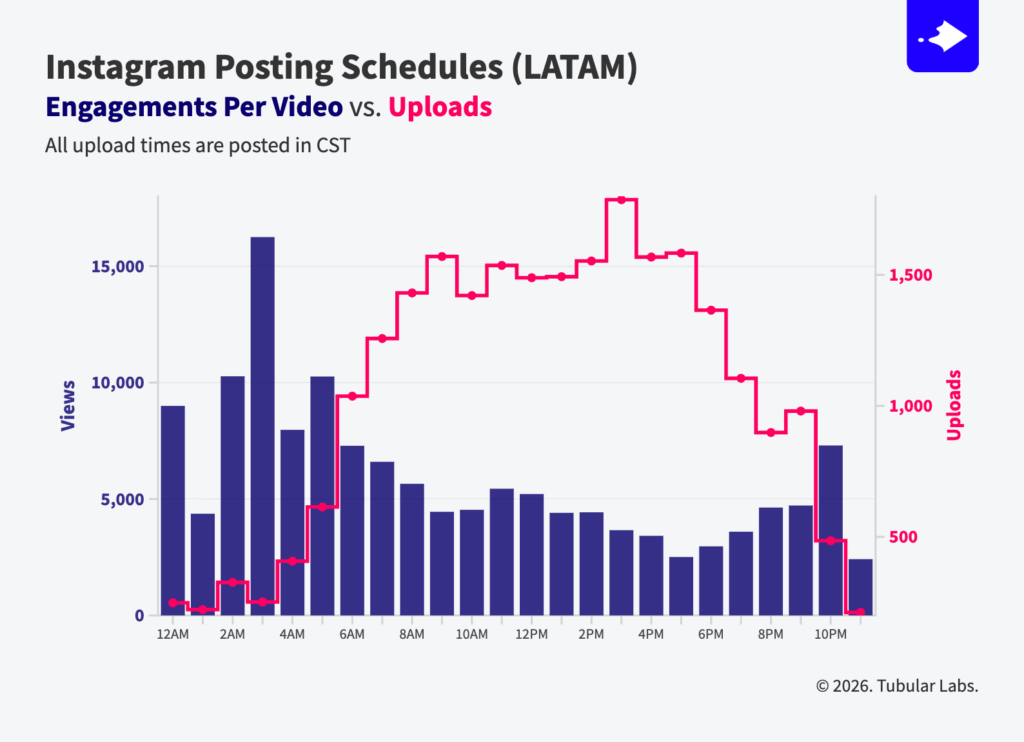
- Timing anomalies: In LATAM, a stark mismatch exists between when publishers upload content (predominantly mid-afternoon) and when audiences actually engage most heavily (the early morning hours).
- Strategic metadata: In EMEA, news organizations are utilizing Instagram hashtags not just for basic categorization, but as sophisticated tools for brand authority, cross-border discoverability, and geopolitical trend-jacking.
- The emotional catalyst: In the United States, while breaking global hard news reliably pulls in massive top-of-funnel view counts on TikTok, true community engagement and comment-driven virality skyrocket when serious topics inadvertently intersect with humor or unexpected human reactions.
A Chronological Look at the Data: The 2025–2026 Shift
To fully understand how the News & Politics genre reached this critical juncture, it is helpful to trace the evolution of social video consumption leading up to the current landscape.
Q4 2025: The Recognition of Algorithm Fatigue
As the fourth quarter of 2025 got underway in November, digital newsrooms globally began reporting diminishing returns on standard, mid-length news clips. Publishers flooded feeds with two- to five-minute summaries of daily political developments, assuming this format hit the "sweet spot" of audience attention spans. However, platform algorithms—increasingly rewarding high completion rates or immediate, rapid-fire re-watches—began penalizing content that failed to hook users within the first three seconds or hold them for comprehensive educational journeys.
December 2025: Regional Divergences Become Clear
By the end of the year, data analytics from Tubular Intelligence highlighted distinct geographical splits in how audiences interacted with political content. APAC audiences increasingly favored binary viewing habits: quick headline bursts on mobile during commutes, paired with extensive, long-form political analysis viewed on connected TVs in the evenings. Concurrently, Western markets witnessed a surge in short-form vertical video dominance, where newsrooms struggled to balance journalistic gravity with the platform-native demand for entertainment and emotional resonance.

January – February 2026: Pinpointing the Optimization Gaps
Entering early 2026, data isolation revealed glaring operational inefficiencies among major publishers. Most notably, LATAM publishing schedules remained anchored to legacy broadcast habits (publishing around 3:00 PM to 3:59 PM local time), completely ignoring the empirical peak in audience engagement occurring in the dead of the early morning (3:00 AM to 3:59 AM CST). By February, forward-thinking media executives began testing asynchronous publishing strategies, tailoring their metadata, length parameters, and posting schedules to match these hidden behavioral windows rather than internal newsroom shift changes.
Supporting Data and Regional Deep-Dives
An examination of the metrics illuminates the exact mechanics behind these shifting trends across the globe.
Optimal Video Length: The APAC Case Study
When looking at News & Politics publishers in the Asia-Pacific region, the disconnect between content creation volume and audience preference is glaring. Data from YouTube spanning November 2025 to February 2026 shows that mid-length videos (ranging from 2 to 5 minutes) account for the highest volume of uploads by media publishers.
However, when measuring engagements per video, audiences clearly favor two distinct extremes:
- Ultra-short updates (0–30 seconds): These quick-hit clips capture immediate attention in fast-scrolling environments, satisfying the desire for rapid situational awareness.
- Deep-dive long-form updates (15–20+ minutes): These comprehensive segments satisfy viewers looking for deep contextualization, investigative journalism, and thorough political analysis.
The takeaway for publishers: Relying heavily on mid-length content is often an operational convenience—optimizing purely for output volume at the direct expense of per-video impact. Newsrooms must evaluate whether their current production pipelines are built to serve human attention spans or simply newsroom quotas.
Optimal Time to Post: The LATAM Scheduling Mismatch
On Instagram, LATAM publishers consistently post most frequently during the late afternoon and evening hours. Yet, Tubular Intelligence data reveals that audience engagement per video peaks significantly earlier—specifically between 3:00 AM and 3:59 AM CST. In contrast, the vast majority of publisher uploads occur hours later, during the 3:00 PM to 3:59 PM CST block.
The takeaway for publishers: This temporal misalignment represents a massive, largely untapped opportunity. Publishers who adjust their distribution workflows to capture early-morning scrolling habits can secure stronger per-video engagement while facing significantly lower content saturation and competition from rival newsrooms.
Hashtag Strategies: The EMEA Discovery Engine
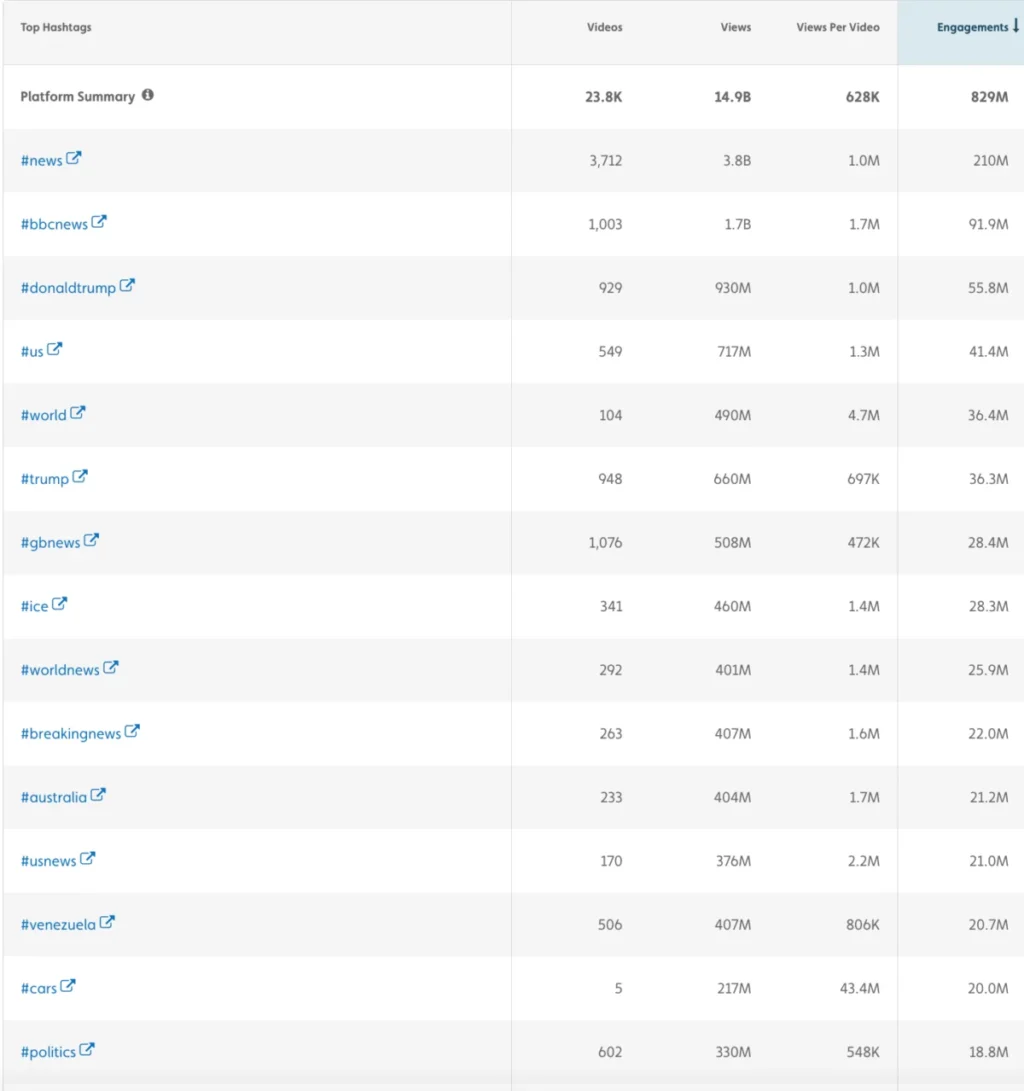
In the EMEA region, an analysis of the most-viewed News & Politics Instagram hashtags from late 2025 through early 2026 reveals a sophisticated multi-layered metadata strategy. Publishers are not merely tagging keywords; they are deploying a strategic blend of:
- Global political flashpoints: Tags such as
#trump,#ICE, and#venezuelacapture international curiosity and feed directly into global algorithmic recommendation engines. - Branded broadcaster identifiers: Tags like
#bbcnewsreinforce institutional trust, brand authority, and direct search recognition. - Country-specific locators: Regional tags expand cross-border discoverability, allowing diaspora populations and international observers to monitor hyper-local developments from abroad.
The takeaway for publishers: Hashtags function as critical search and discovery infrastructure. When optimized correctly, they transform local news items into globally searchable assets.
US TikTok Content: The Power of Emotion and Humor
In the United States, TikTok data underscores a fundamental divergence in how audiences consume hard news versus viral commentary. While high-profile breaking stories (such as reports on high-profile accidents or major geopolitical shifts) pull in massive top-of-funnel view counts—often reaching upwards of 180 million views in a 30-day window—engagement explodes when content sparks unexpected emotional or cultural reactions.
For instance, a street interview at an immigration enforcement (ICE) protest, wherein a participant casually mentioned buying their first AR-15 rifle in response to policy, was intended as a serious news segment. However, online audiences heavily pivoted the narrative, turning the clip into a viral meme filled with mockery and commentary. This dynamic drove massive engagement metrics, reaching over 63.5 million interactions in just seven days.
The takeaway for publishers: TikTok audiences do not process hard news through traditional lenses. While breaking news establishes baseline awareness, cultural resonance, relatability, and subtle humor drive active conversation and community engagement.
Official Responses and Industry Perspectives
As these data-driven insights circulate through media boardrooms, digital strategy leaders and platform analysts have begun publicly addressing the structural changes required to survive the algorithmic shift.
Media strategy consultants emphasize that the traditional "post and pray" methodology is officially obsolete. According to senior digital publishing advisors, newsrooms can no longer treat social video as a digital dumping ground for television packages or print wire stories.
"The algorithm is a harsh editor," noted one digital media strategist commenting on the Q1 2026 data. "It doesn’t care about your Pulitzer Prize history or your legacy broadcast footprint. It cares entirely about whether human beings stop scrolling, stick around to the end, or react so strongly that they pass the content along to someone else. If your video length, posting time, and formatting do not respect the specific psychological state of the user at that exact hour of the day, you are shouting into an empty digital stadium."
Furthermore, platform monetization and audience development teams are increasingly urging newsrooms to lean into platform-native storytelling formats. Rather than attempting to force viewers into legacy consumption habits, publishers are being advised to build modular content networks—distilling a 20-minute investigative report into a 15-second vertical hook that funnels dedicated viewers back to the long-form asset via native platform tools.
Implications for the Future of Digital Journalism
The implications of these findings extend far beyond simple metrics and optimization tricks. They signal a profound structural evolution in how public information is disseminated, consumed, and validated in the digital age.
- Resource Allocation and Production Redesign: Media executives must rethink how newsroom budgets are spent. Pouring resources into the continuous production of mid-length filler content is an inefficient use of capital when data clearly shows audiences prefer high-velocity short-form clips or exhaustive long-form deep-dives. Newsrooms must adopt a bifurcated production strategy.
- Globalized Mindsets and Asynchronous Workflows: The LATAM scheduling anomaly and EMEA hashtag trends prove that borders are increasingly porous in social video discovery. News organizations must embrace automated, data-informed scheduling that respects global time zones and engagement peaks, moving away from 9-to-5 newsroom routines.
- Balancing Gravity with Accessibility: The US TikTok findings present a delicate ethical and strategic tightrope for news organizations. While injecting humor or entertainment into serious political discourse risks trivializing complex issues, failing to understand the emotional mechanics of social platforms leaves publishers entirely disconnected from younger, digital-native demographics. The challenge for modern journalism is to maintain editorial integrity while mastering the native language of the platforms they inhabit.
Ultimately, the overarching lesson from the 2025–2026 Tubular Intelligence dataset is clear: performance in the News & Politics genre is no longer dictated solely by what stories a publisher covers, but how, when, and in what format those stories are delivered.
For newsrooms and commercial brands alike, the path forward does not lie in publishing more content, but in publishing smarter. By tightly aligning content strategy with empirical audience behavior, platform mechanics, and regional nuances, publishers can transform algorithm-driven uncertainty into a predictable engine of global reach, engagement, and sustainable journalistic impact.
