
Beyond the Sandbox: How Enterprise Leaders Must Navigate the Post-Experimentation AI Era
NEW YORK — The honeymoon phase of corporate artificial intelligence is officially drawing to a close. Over the past several years, C-suite executives and technology leaders have been consumed by a singular, wide-eyed inquiry: What can generative artificial intelligence do? Boardrooms echoed with discussions of proof-of-concept projects, LLM capabilities, and automated content generation.
Today, however, that question has been superseded by a far more urgent, high-stakes dilemma: What should we actually do with it?
As the global market floods with an overwhelming array of foundation models, specialized agents, integration platforms, and vendor promises, the primary obstacle facing enterprise leaders is no longer technological capability. It is strategic certainty. Organizations are grappling with a deficit of direction regarding which investments possess true longevity, how to scale infrastructure without courting operational chaos, and what internal transformations are required to pivot from isolated experimentation to sustainable, enterprise-wide business value.
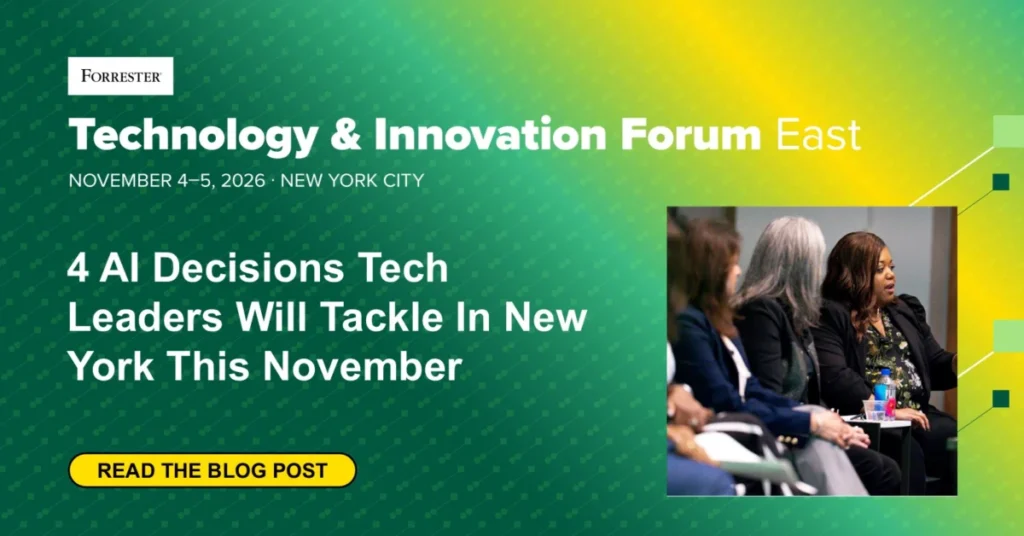
To address these very challenges, industry analysts, strategists, and technology pioneers are converging for the upcoming Forrester Technology & Innovation Forum East, scheduled for November 4–5 in New York City. The curated agenda cuts through the noise of the hype cycle, examining the profound downstream consequences of AI on corporate strategy, capital allocation, enterprise architecture, infrastructure, workforce dynamics, and governance.
Rather than treating AI as a mere software upgrade, the Forum is structured around four foundational decisions that will dictate whether an organization thrives or falters in the post-experimentation era.
The Evolution of Enterprise AI: A Chronological Retrospective
To understand the gravity of the current decisions facing technology leaders, it is instructive to trace the rapid evolution of enterprise AI over the past half-decade.
Phase 1: The Curiosity and Discovery Era (2020–2022)
Following the mainstream breakthroughs in deep learning and the eventual public introduction of advanced generative models, organizations approached AI through a lens of exploratory wonder. Innovation labs and rogue IT teams spun up sandbox environments to test out-of-the-box text generation, basic coding assistants, and automated image creation. During this phase, failure carried very little consequence, and metrics of success were loosely defined around novelty and creative output rather than balance-sheet impact.
Phase 2: The Pilot Proliferation (2023–2024)
Encouraged by early wins, business units across the enterprise began launching independent AI pilots. Marketing departments adopted copywriting tools, customer service functions deployed rudimentary chatbots, and software engineering teams integrated coding copilots. However, this decentralized approach quickly led to fragmented tech stacks, shadow IT spending, and data security vulnerabilities. Organizations proved they could launch AI initiatives, but struggled to unify them.
Phase 3: The Strategic Reckoning (Late 2024–Present)
We have now entered the third and most critical phase: the era of strategic reckoning. CEOs and CFOs are demanding clear Return on Investment (ROI) from their technology budgets. Isolated pilots are no longer enough; systems must scale, integrate with legacy architectures, comply with emerging regulatory frameworks, and fundamentally alter operational productivity. This transitional friction is precisely what the Technology & Innovation Forum East aims to resolve.
Decision #1: Where Should We Place Our AI Bets?
For most modern corporations, the primary hurdle is not an AI opportunity problem; it is a prioritization problem. The sheer velocity of technological iteration means that a model or platform lauded as cutting-edge today risks obsolescence within eighteen months. Consequently, enterprise leaders face the daunting task of identifying which investments will yield durable, long-term value as market expectations shift.
Moving Beyond the Innovation Sandbox
According to insights shared by Forrester analysts, organizations must pivot their focus away from simply chasing the newest technological shiny object and toward building foundational capabilities that withstand market volatility.
Keynotes such as Generating Your Future: Successful Strategies For Driving Business Transformation With AI Engineering delve deep into this exact dilemma. The session explores how forward-thinking companies are moving past endless experimentation to establish repeatable, scalable engineering practices that generate measurable enterprise value. Leaders are taught how to navigate the pitfalls of "pilot purgatory"—a state where organizations spend millions spinning up proofs of concept that never make it to production.
By aligning AI investments directly with core business transformation outcomes, technology executives can filter out vendor noise and commit capital to architectures and partnerships designed to endure.
Decision #2: How Do We Scale AI Without Losing Control?
A pilot can succeed brilliantly in isolation. An enterprise, however, cannot operate in a vacuum. Once an organization attempts to move artificial intelligence out of the developer sandbox and into core production workflows, a host of complex dependencies immediately materialize.
The Hidden Costs of Proliferation
Scaling AI requires confronting difficult realities regarding:
- Infrastructure and Architecture: Can current data pipelines support real-time model inference at scale?
- Financial Sustainability: Are API costs and compute requirements threatening profit margins?
- Technical Debt: Are quick-fix integrations creating long-term maintenance nightmares?
A successful use case deployed by a single marketing team becomes exponentially more complicated when replicated across finance, human resources, and supply chain operations. Throughout the Technology & Innovation Forum East agenda, cost, architecture, infrastructure, and data management are intentionally examined not as isolated silos, but as an interconnected control system for enterprise AI at scale.
Deep-dive sessions address the immediate operational danger of allowing hundreds of successful local experiments to devolve into hundreds of disconnected enterprise problems. Establishing standardized guardrails, robust data governance protocols, and centralized model registries is no longer optional; it is the prerequisite for survival in an automated economy.
Decision #3: What Needs to Change Inside IT?
Perhaps the most underestimated challenge of the AI revolution is its impact on human capital and organizational design. Artificial intelligence is not merely a new set of software tools added to the corporate tech stack; it fundamentally alters how work is conceived, executed, and evaluated.
Redefining Human Responsibility
As machine learning models and autonomous agents shoulder more execution-oriented tasks—such as drafting code, synthesizing financial reports, and triaging customer inquiries—human workers must assume greater responsibility for high-level judgment, strategic oversight, outcome design, and real-time intervention.
This dramatic shift naturally ripples across corporate structures:
- Roles and Workflows: Job descriptions are rewritten to emphasize orchestration over manual execution.
- Decision Rights: Organizations must determine who holds the authority to approve outputs generated by non-deterministic systems.
- Accountability: When an autonomous agent makes a flawed operational decision, the chain of liability must be clear.
Complementary workshops at the Forum—such as Build An AI Workplace Strategy That Deliver Business Outcomes and Drive AI Adoption And Competitive Advantage Through Literacy And Fluency—equip leaders with the frameworks needed to foster true organizational fluency. History demonstrates that many enterprise technology transformations fail not because the underlying software underperforms, but because the organization neglected to adapt how its people collaborate, share responsibility, and make decisions.
Decision #4: How Do We Prepare for What Comes Next?
As machine learning systems evolve from passive tools into increasingly autonomous agents capable of executing multi-step workflows with minimal human supervision, the nature of governance must change accordingly.
From Generation to Authorization
For years, governance discussions centered primarily on output safety: What can this model generate? Today, as systems gain the agency to execute transactions, modify databases, and interact directly with customers and suppliers, the question has shifted radically: What should this system be allowed to do?
The closing keynote of the Forum—appropriately titled AI Governance For The GOOOOOAL!—confronts this exact frontier. The session tackles the complex governance requirements of autonomous agents and interconnected enterprise systems. It provides leaders with actionable strategies for embedding rigorous accountability, fail-safe guardrails, and continuous risk management into their AI deployments without sacrificing the agility and speed required to remain competitive.
These are not speculative, futuristic concerns meant for debate down the road. Chief Information Officers and Chief Technology Officers are making foundational platform, data, and governance decisions today that will dictate whether their organizations can safely harness the hyper-capable AI systems of tomorrow.
Industry Perspectives: The View from the C-Suite
To gauge the broader industry sentiment surrounding these four critical decisions, enterprise technology executives have increasingly voiced the need for holistic, cross-functional alignment.
Industry analysts emphasize that the true value of events like the Technology & Innovation Forum East lies not simply in the accumulation of isolated tactical tips, but in how the agenda bridges disciplines that are traditionally kept separate within corporate hierarchies.
"AI investment directly impacts enterprise architecture. Architecture dictates operating costs. Data quality and cleanliness govern what autonomous agents are capable of achieving. Governance defines the ethical and operational boundaries of where those agents may act. If your operating model is misaligned, none of these elements will yield genuine business value," notes one prominent enterprise systems strategist.
Corporate boards are no longer willing to write blank checks for exploratory AI initiatives. They expect technology leaders to demonstrate a clear line of sight from computational spend to bottom-line efficiency, risk mitigation, and top-line growth. Consequently, CIOs must serve as diplomats and strategists, uniting finance, legal, human resources, and engineering around a unified vision.
Implications for the Modern Enterprise
The upcoming gathering in New York City serves as a timely barometer for the maturity of the enterprise technology sector. The implications for organizations that fail to address these four core decisions are severe:
- Wasted Capital: Companies that continue to fund undisciplined, siloed AI experiments will see diminishing returns, leading to budget fatigue and executive skepticism.
- Operational Vulnerability: Scaling AI without robust architectural controls and data governance invites severe security breaches, regulatory penalties, and reputational damage.
- Talent Attrition: Failing to address the human element of AI adoption—such as upskilling workforces and redefining job roles—will result in employee resistance, anxiety, and disengagement.
- Strategic Obsolescence: Organizations bogged down in internal friction will be outpaced by agile competitors who successfully transition from experimentation to fully integrated, autonomous operations.
Conversely, those organizations that master the interplay between investment prioritization, architectural scaling, workforce transformation, and autonomous governance will define the market standards of the next decade.
Conclusion: Making Better Decisions Through Integrated Strategy
The frantic rush to experiment with artificial intelligence is giving way to a sober, highly strategic phase of enterprise maturation. Technology leaders no longer have the luxury of treating AI as a side project or an isolated IT initiative.
By addressing the four critical decisions—where to place bets, how to scale without losing control, what must change inside IT, and how to govern autonomous systems—leaders can transform uncertainty into enduring competitive advantage.
For executives looking to navigate this complex transition alongside industry peers and Forrester analysts, the Technology & Innovation Forum East offers a vital roadmap. With ticket registration and session planning underway for the November event in New York City, organizations have a closing window to ensure their teams are equipped not just to participate in the AI revolution, but to lead it with clarity, control, and purpose.
