
Beyond the Review: Why Visual Content is the New Frontier of Local SEO
In the competitive landscape of local search, most business owners focus their efforts on two primary pillars: accumulating five-star reviews and ensuring consistent NAP (Name, Address, Phone number) citations. While these remain foundational, a new, highly effective ranking lever is being overlooked by the vast majority of local businesses: visual content.
According to Bill Ross, founder of Emulent Digital Marketing, the secret to dominating Google Maps isn’t just about what customers say about you—it’s about the digital footprint of the media you upload to your Google Business Profile (GBP). In a recent deep-dive interview, Ross outlined how visual assets act as a catalyst for search rankings, user engagement, and, ultimately, conversion.
The Hidden Power of Visual Assets
For years, the SEO community operated under the assumption that images were merely "decoration"—a way to make a listing look professional. Ross’s perspective shifts that narrative entirely. He argues that photos and videos are primary data points that the Google algorithm actively crawls and parses to determine a business’s relevance to a specific geographic area.
"We first realized the direct impact when onboarding service-based clients," Ross explains. "Many of these businesses lack a physical storefront, which historically made it difficult to rank for specific service areas. By utilizing geotagged, high-quality photos and videos of our clients performing work in those specific cities, we were able to provide the ‘proof’ the algorithm needed to associate that business with that location."
This is a critical realization: Google is not just looking at your address; it is looking for evidence of your operational presence in the areas you claim to serve.
Supporting Data: The Multiplier Effect
The numbers backing the "visual-first" strategy are staggering. According to the 2026 BrightLocal Google My Business Insights Study, the correlation between image volume and business performance is not merely incremental—it is exponential.
Businesses that surpass the 100-image threshold on their profiles see:
- 520% more phone calls.
- 2,717% more direction requests.
- 1,065% more website clicks compared to the average business.
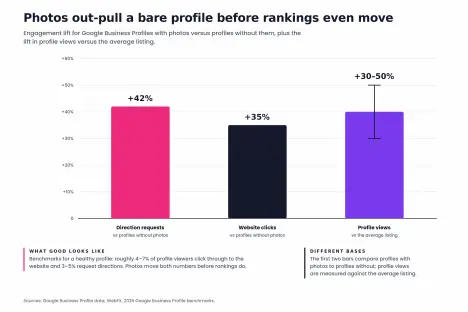
These figures illustrate that customers are far more likely to engage with a profile that provides a "visual tour" of the business. Furthermore, data shows that simply having photos on a profile leads to a 42% increase in driving direction requests and a 35% boost in website click-through rates.
Chronology of an Optimized Visual Strategy
To move the needle, businesses must move beyond "upload and forget." Ross recommends a structured, consistent cadence to satisfy the algorithm’s appetite for "freshness."
Phase 1: The Audit (Month 1)
Before uploading new content, businesses must conduct a comprehensive audit of their existing library. Remove irrelevant photos, delete outdated images, and identify gaps where the business fails to represent its core services.
Phase 2: The Infrastructure Setup (Month 1-2)
Optimization begins before the file is even uploaded. Ross outlines a simple, non-negotiable workflow for every piece of media:
- File Naming: Do not use generic names like
IMG_001.jpg. Use descriptive, keyword-rich names such asplumbing-repair-service-chicago.jpg. - Geotagging: Ensure the metadata of the image contains accurate location data.
- Timestamping: Ensure the date metadata is current, signaling to Google that the content is recent and relevant.
Phase 3: The Sustained Cadence (Ongoing)
Consistency is the single biggest factor in long-term ranking success. A once-a-month upload is rarely sufficient to move the rankings. Ross suggests a "twice-weekly" cadence. By maintaining this frequency, a business will hit the 100-photo milestone in less than a year, effectively positioning themselves in the top tier of local visibility.
The "Anti-Stock" Mandate
One of the most common mistakes cited by industry experts is the reliance on stock photography. In an era of AI-generated content, the internet is becoming flooded with generic imagery. Ross is unequivocal on this point: "I don’t think you should use stock photos at all. There is no benefit."
Google’s sophisticated AI can easily identify stock imagery. Because stock photos provide no unique signal regarding a business’s actual work or location, they are effectively "digital noise." In some cases, using stock photos of generic local landmarks can even hurt a profile by sending conflicting signals about the business’s actual service area or operational nature.
The Untapped Potential of Video
While images are common, video remains the most underutilized asset on Google Business Profiles. Many business owners assume that professional, high-production video is a requirement, but this is a misconception.
"Businesses should train their technicians to use their phones to record short, 30-second clips of their daily work," says Ross. "Whether it’s a completed HVAC install, a before-and-after of a landscaping project, or a quick customer testimonial, these authentic clips are gold for the algorithm."
Technical Requirements:
- Length: Under 30 seconds to maintain engagement.
- Resolution: At least 720p.
- File Size: Under 75 MB.
Case Study: The HairClub Transformation
The effectiveness of this strategy was proven in a recent campaign with HairClub.com. As a national franchise with over 120 locations, the company suffered from a lack of unified local SEO.
Emulent implemented a location-specific photo acquisition strategy, ensuring every individual branch had high-quality, authentic imagery representing its unique staff and facility. The result was a 32% increase in Google Maps listings and a 110% growth in local SEO traffic. This case study confirms that for multi-location businesses, visual content is the primary lever for scaling regional dominance.
Implications: The Future of Local Search
As AI continues to generate mass quantities of generic content, the value of authenticity will only climb. Google is increasingly prioritizing content that represents real-world interactions.
"As more businesses take the shortcut of using AI to flood the web with synthetic images, it will make authentic photos and videos matter more, not less," Ross notes.
Metrics for Success
To track the effectiveness of your visual strategy, move beyond vanity metrics. Focus on:
- Direction Requests & Calls: The primary indicators of local intent.
- Conversion Rates: Are the users finding you via photos actually booking services?
- Keyword Attribution: Use tools like SEMrush to monitor how your ranking distribution changes across specific neighborhoods or cities.
Final Takeaway
The "Ranking Gap" between top-tier businesses and the rest of the pack is not due to some secret algorithm hack—it is due to the consistent, high-volume application of authentic, optimized visual media. By treating your Google Business Profile as a living, breathing portfolio rather than a static directory, you turn a passive listing into a high-octane lead generation machine.
If you are currently neglecting your visual assets, you are leaving significant market share on the table. The time to start your "twice-weekly" cadence is today.
