For years, Lightspeed eCom has served as the operational backbone for brick-and-mortar storefronts seeking a direct bridge to the digital marketplace. By wiring physical retail spaces directly into Lightspeed Retail, merchants could theoretically manage both worlds from a single dashboard.
However, as many digital-first retailers and scaling businesses have discovered, the platform comes with distinct ceilings. Subscription costs climb steeply once multiple locations and cash registers enter the equation, online storefront tooling lags far behind dedicated ecommerce builders, and the overall architecture favors physical retail over digital expansion.
Following a comprehensive analysis of leading ecommerce platforms across pricing, sales capabilities, point-of-sale (POS) integration, design flexibility, and usability, five standout alternatives emerge. Headlining this list is Shopify, praised as the definitive all-around replacement for merchants who refuse to compromise on a unified online-and-in-store model.
The Landscape of Retail Tech: Why Merchants Are Leaving Lightspeed
Lightspeed eCom is no longer distributed as a standalone product. Instead, it has been bundled entirely into Lightspeed Retail, with entry-level plans starting at $89 per month (billed annually), while Core and Plus tiers command significantly higher investments. Factor in transaction fees—roughly 2.6% + $0.10 for in-person transactions and 2.9% + $0.30 for online checkouts—and the platform becomes a costly endeavor.
While this pricing model makes sense for enterprise-level multi-location retail operations requiring deep inventory tracking and supplier management tools, it penalizes merchants who:
Operate primarily online but want a simple physical checkout option.
Manage modest catalogs that do not justify enterprise retail costs.
Seek advanced design customization and marketing workflows.
Require predictable, scalable pricing models that don’t scale exponentially per register.
The following alternatives resolve these operational roadblocks, often at a lower starting cost.
1. Shopify: The Best All-Round Alternative
Overview
Shopify remains the closest like-for-like replacement for Lightspeed eCom. It fulfills the same fundamental purpose: running an online store and physical registers through a single inventory and customer database. The key differentiator is that Shopify was built online-first, meaning its storefront, checkout flows, and digital marketing tools far exceed Lightspeed’s capabilities.
Trade-Offs and Considerations
Shopify’s layout editor relies on a section-based approach rather than free-form drag-and-drop mechanics. Design purists may find this restrictive. Furthermore, while the entry price undercuts Lightspeed Retail, ancillary costs accumulate quickly when factoring in paid applications, premium themes, and POS Pro upgrades.
Pricing Structure
Starter ($5/mo): Ideal for social selling; 5% transaction fee.
Basic ($29/mo billed annually): Best for solo entrepreneurs; 2.9% + $0.30 card rate.
Grow ($79/mo billed annually): Tailored for small teams; 2.7% + $0.30 card rate.
Advanced ($299/mo billed annually): Built for scaling operations; 2.5% + $0.30 card rate.
Plus (From $2,300/mo): Enterprise architecture for high-volume brands.
Verdict: Shopify is the premier choice for merchants leaving Lightspeed who still require an integrated physical POS system coupled with an elite digital ecosystem.
2. Square Online: The Best Budget Alternative for Retailers
Overview
For businesses prioritizing overhead reduction above all else, Square Online serves as an immediate remedy. It provides a genuinely free ecommerce tier that syncs seamlessly with Square’s free POS software, allowing small retailers to operate across web and mortar environments for the cost of payment processing alone.
Trade-Offs and Considerations
Square Online is exceptionally basic compared to Shopify or BigCommerce. Design options are constrained, the proprietary app marketplace is limited, and the free plan displays Square branding while restricting access to custom domains. While exceptional for cafes, boutiques, and localized service providers, expanding catalogs will quickly outgrow its architecture.
Pricing Structure
Free Plan ($0): Unlimited products, local pickup/delivery, Square-branded domain.
Plus Plan ($29/mo billed annually): Custom domain removal, abandoned cart recovery, advanced item configurations.
Verdict: If Lightspeed’s monthly bill is choking your profit margins and your inventory is straightforward, Square Online eliminates software overhead almost entirely.
3. BigCommerce: The Best for Large Catalogs
Overview
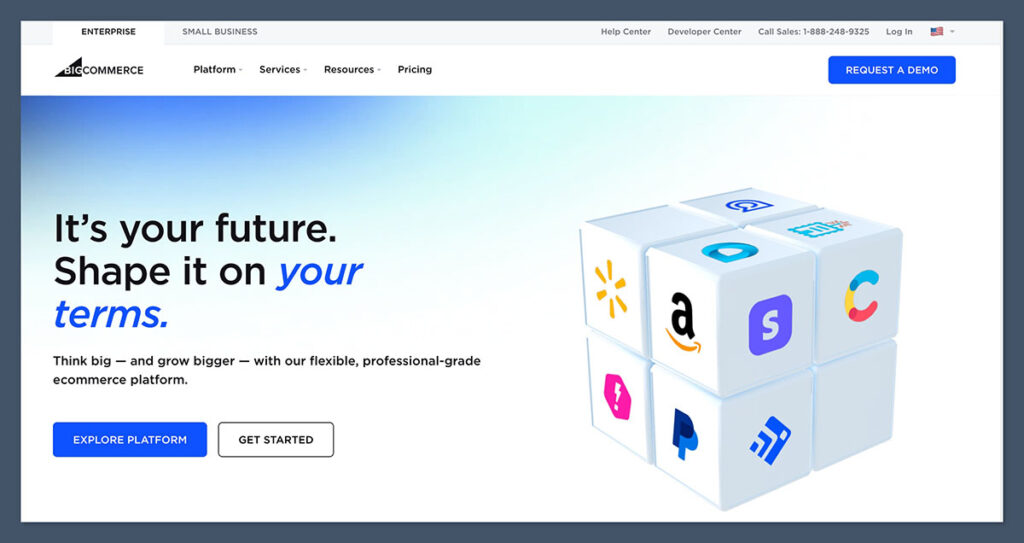
BigCommerce is engineered for high-volume online sellers managing extensive inventories. Out of the box, it includes native multi-variant management, advanced filtering, multi-currency capabilities, and built-in B2B tools that would otherwise require third-party apps on competing platforms. Crucially, BigCommerce charges zero platform transaction fees regardless of the payment gateway used.
Trade-Offs and Considerations
The platform lacks a native POS. Retailers requiring physical checkouts must integrate third-party hardware systems. Additionally, BigCommerce enforces strict annual sales volume thresholds on each tier, forcing fast-growing stores onto higher pricing brackets as revenue climbs.
Pricing Structure
Standard ($29/mo): Up to $50,000 in annual online sales.
Plus ($79/mo): Up to $180,000 in annual online sales.
Pro ($299/mo): Up to $400,000 in annual online sales.
Enterprise (Custom): Tailored thresholds and dedicated architecture.
Verdict: BigCommerce delivers enterprise-grade catalog management and zero transaction fees for merchants whose primary growth engine is digital.
4. WooCommerce: The Best for Deep Customization
Overview
As an open-source platform running on WordPress, WooCommerce grants absolute ownership of store code and underlying data. It is the ultimate toolkit for brands that want microscopic control over design architecture, SEO performance, and unique backend workflows.
Trade-Offs and Considerations
Total freedom carries operational responsibility. Web hosting, security patches, plugin updates, and database backups fall squarely on the merchant (or require managed hosting partnerships). For retailers accustomed to Lightspeed’s closed, all-in-one ecosystem, the technical learning curve can be steep.
Cost Breakdown
While the core plugin is free, budgeting requires factoring in web hosting ($10–$40/mo), a domain name ($10–$20/yr), premium themes, and specialized extensions for subscriptions, advanced shipping, or POS integrations.
Verdict: Choose WooCommerce if hosted platforms feel overly restrictive and you have the technical resources to bend the software to your exact specifications.
5. Wix: The Best for Beginners and Design-Led Brands
Overview
Wix champions accessibility through its AI website builder and free-form drag-and-drop visual editor. It suits boutique brands that prioritize aesthetic presentation and want ecommerce, email marketing, and client bookings centralized in one dashboard.
Trade-Offs and Considerations
Wix is not built for heavy-duty industrial retail. Inventory tools are rudimentary compared to Lightspeed, Wix POS is restricted exclusively to US-based merchants, and large-scale inventories experience performance bottlenecks.
Pricing Structure
Light ($17/mo): Custom domain, no selling capabilities.
Core ($29/mo): Unlocks ecommerce functionality and basic analytics.
Business ($36/mo): Advanced ecommerce tools and multi-currency support.
Business Elite ($159/mo): Advanced developer tools and priority support.
Verdict: Wix offers a visually stunning, frictionless storefront for small, lifestyle-oriented brands that found Lightspeed’s retail infrastructure overbuilt.
Side-by-Side Comparison Matrix
Platform
Best For
Starting Price (Annually)
Free Plan/Trial
Transaction Fees (Native)
Built-In POS
AI Builder
Shopify
All-round omnichannel
$29 / month
3-day trial + $1/3mo
2.9% + $0.30
Yes (Shopify POS)
Yes
Square Online
Budget-conscious shops
$0 / month
Forever Free
2.9% + $0.30
Yes (Square POS)
Yes
BigCommerce
Large catalogs / B2B
$29 / month
15-day trial
0% platform fees
Via integrations
Yes
WooCommerce
Total code control
Free plugin
Open Source
Varies by gateway
Via extensions
Limited
Wix
Design-driven beginners
$17 / mo ($29 to sell)
Forever Free (No shop)
2.9% + $0.30
Yes (US only)
Yes
Evaluating Your Migration Strategy
Migrating away from Lightspeed eCom requires careful evaluation across eight core vectors: POS requirements, catalog size, structural pricing, design freedom, multichannel capabilities, app ecosystem dependency, support availability, and technical overhead.
The Migration Process
Audit Your Data: Export products, customer lists, and order history from Lightspeed as CSV files.
Select Your Destination: Test platforms via trials or free tiers before committing.
Automate or Manual Import: Utilize migration tools like Cart2Cart or LitExtension for large catalogs.
Parallel Testing: Run both systems concurrently to verify inventory counts, tax configurations, and payment gateways before canceling your Lightspeed subscription.
Final Takeaways
Transitioning away from Lightspeed Retail doesn’t mean sacrificing efficiency. For the vast majority of omnichannel operators, Shopify provides the most balanced bridge, matching unified inventory models while offering superior marketing and digital tools.
If cash flow is paramount, Square Online removes software expenses. If your catalog spans thousands of SKUs, BigCommerce delivers robust catalog architecture without penalizing growth via transaction fees. Ultimately, leveraging trial periods remains the most effective strategy to test interface compatibility before making a permanent operational shift.