
Beyond the Numbers: The Evolving Imperative of Strategic Content Performance Measurement
Last Modified on March 19, 2025
New York, NY – In an increasingly competitive digital landscape, the notion that content performance can be adequately gauged by merely glancing at a report’s top-line figures is rapidly becoming obsolete. Industry experts and leading digital strategists are unequivocally declaring a new standard: truly understanding content effectiveness demands a sophisticated, structured approach, a precise selection of Key Performance Indicators (KPIs), a granular understanding of growth drivers, and a solid foundation of technical acumen. This paradigm shift, highlighted in recent analyses, underscores a critical evolution in how businesses must evaluate their digital investments.
This comprehensive guide, informed by the latest industry practices and tools, unpacks the intricate world of content performance measurement. From pinpointing the most pertinent metrics to constructing insightful, actionable reports, the focus is squarely on transforming raw data into strategic intelligence that fuels growth and optimizes return on investment.
![How to Measure Content Performance [+Reports] (2025)](https://measureschool.com/wp-content/uploads/2025/03/how-to-measure-content-performance.png)
The New Frontier of Digital Measurement: Main Facts
At the core of modern digital strategy lies the undeniable truth that content, whether on a website, social media platform, or integrated into a marketing campaign, is a significant investment. However, without robust measurement, its true impact remains a mystery. The prevailing consensus among analytics professionals is that a superficial review of metrics is no longer sufficient. Effective content measurement today requires:
- A Structured Methodology: Moving from ad-hoc checks to a systematic framework for data collection and analysis.
- Precision in KPIs: Identifying and tracking metrics directly aligned with specific content objectives, rather than a generic set.
- Understanding Growth Drivers: Discerning why content performs the way it does, linking metrics to strategic business outcomes.
- Technical Proficiency: The ability to implement and manage analytics tools, ensuring accurate data capture and reporting.
This evolving imperative means businesses must re-evaluate their measurement strategies to unlock genuine insights and drive sustained digital success.
A Chronicle of Data: The Evolution of Content Analytics
The journey of content performance measurement has been one of continuous refinement. In its nascent stages, digital analytics often revolved around rudimentary metrics such as simple page views or website visitors. The emphasis was largely on quantity, reflecting an early fascination with the sheer volume of digital traffic. Marketers and content creators were primarily concerned with "getting eyeballs" on their material, with less emphasis on the quality of engagement or the ultimate business impact.
![How to Measure Content Performance [+Reports] (2025)](https://measureschool.com/wp-content/uploads/2025/03/Meta-ad-library-example-1-1024x489.webp)
Over time, as digital platforms proliferated and consumer behavior grew more complex, the limitations of these basic metrics became glaringly apparent. A high page view count meant little if users immediately bounced off, or if the content failed to contribute to lead generation or sales. The advent of more sophisticated web analytics tools, such as early versions of Google Analytics, introduced concepts like "time on site," "bounce rate," and "conversion goals," marking a significant leap forward.
The past decade has witnessed an acceleration of this trend, driven by the explosion of social media, the rise of multi-channel marketing, and the increasing demand for demonstrable ROI. Today, content is no longer a standalone entity but an integral component of a larger ecosystem. This shift has necessitated a move from isolated data points to integrated, holistic reporting that captures the user journey across various touchpoints. The current landscape, as of March 19, 2025, emphasizes predictive analytics, AI-driven insights, and the seamless integration of data from disparate sources, pushing the boundaries of what’s possible in understanding content’s true value.
Dissecting Performance: Supporting Data and Key Metrics
To navigate this complex measurement landscape, a foundational step involves defining the content’s domain and identifying the most salient metrics. The type of content inherently dictates the relevant KPIs and the platforms where they reside. While terminology may vary, core principles remain consistent. Central to this is the creation of a robust Measurement Plan.
![How to Measure Content Performance [+Reports] (2025)](https://measureschool.com/wp-content/uploads/2025/03/SpyFu-example-1024x518.webp)
The Indispensable Measurement Plan
Experts advocate for a meticulously crafted Measurement Plan, often managed in a simple Google Sheet, as the bedrock of any effective content strategy. This document serves to define clear objectives and list the KPIs essential for gauging performance across different content categories. Without such a plan, the sheer volume of data available can be overwhelming, leading to analysis paralysis.
Critical Content Categories and Their Metrics:
1. Website Content Metrics:
For websites, performance definitions can vary, but several standard metrics are universally critical for understanding user interaction and content effectiveness:
![How to Measure Content Performance [+Reports] (2025)](https://measureschool.com/wp-content/uploads/2025/03/Wix-traffic-overview-1024x524.webp)
- Active Users (or Total Users): A fundamental measure of audience size, indicating how many unique individuals are engaging with your site.
- Page Views: Quantifies how many times individual pages were loaded, offering a proxy for content popularity.
- Sessions: Tracks user interactions within a defined timeframe (e.g., 30-minute intervals), providing insight into the frequency and depth of engagement.
- Average Engagement Time: Reveals the average duration users spend actively interacting with your content, a key indicator of content quality and relevance.
- Events: Specific, trackable actions users take, such as clicks, video plays, or form submissions, offering granular insights into user behavior.
- Key Events (or Goals): The most critical actions users are desired to take, directly aligning with business objectives (e.g., newsletter sign-ups, product purchases).
- Revenue: For e-commerce or monetized content, this directly measures the financial return generated by content.
It’s crucial to note that while some metrics are automatically tracked, installing a robust analytics tool like Google Analytics 4 (GA4) is non-negotiable for comprehensive data. This typically involves implementation via Google Tag Manager (GTM), a process detailed in specialized guides like "Install Google Analytics 4 with Google Tag Manager."
2. Social Media & Marketing Campaign Metrics:
For content disseminated across social platforms and dedicated campaigns, the KPIs shift to reflect the unique dynamics of these channels:
- Reach & Impressions: Measures the potential audience size (unique users) and the total number of times content was displayed, respectively, indicating visibility.
- Engagement Rate: A crucial metric reflecting how actively an audience interacts with content (likes, shares, comments) relative to reach or impressions.
- Click-Through Rate (CTR): The percentage of users who click on a call-to-action or link, directly measuring content’s ability to drive traffic.
- Conversion Rate: The percentage of users who complete a desired action after interacting with the content, directly tying content to business outcomes.
- Cost Per Click (CPC) / Cost Per Acquisition (CPA): Financial metrics vital for paid campaigns, measuring the efficiency of ad spend.
- Return on Ad Spend (ROAS): A critical ROI metric for paid campaigns, indicating the revenue generated for every dollar spent.
- Lead Generation: Quantifies the number of potential customers acquired through content efforts.
- Follower Growth, Shares, Comments, Likes, Mentions: Social-specific metrics indicating audience expansion, content virality, and brand sentiment.
- Video Views & Completion Rate: For video content, these metrics assess viewership and audience retention.
- Audience Demographics: Insights into the age, gender, location, and interests of the audience, crucial for targeted content creation.
Benchmarking: The Art of Comparison
Beyond internal trend analysis (e.g., tracking weekly/monthly KPI averages to establish baselines), effective content measurement necessitates external benchmarking. This involves comparing performance against:
![How to Measure Content Performance [+Reports] (2025)](https://measureschool.com/wp-content/uploads/2025/03/GA4-landing-page-report-1024x492.webp)
- Direct Competitors: Understanding how your content stacks up against immediate rivals.
- Industry Averages: Gauging performance against broader sector standards.
- Best-in-Class Performers: Identifying and learning from leaders, even if they aren’t direct competitors.
A suite of competitive analysis tools aids in this process:
- Meta Ad Library: Provides transparency into competitors’ active ad campaigns on Facebook and Instagram.
- SpyFu: Offers insights into competitors’ keyword rankings, ad copy, and organic search performance.
- Semrush & Ahrefs: Comprehensive SEO and content marketing platforms that reveal competitor strategies, backlinks, and top-performing content. These tools allow for a deep dive into the ‘how’ and ‘what’ behind competitor success, moving beyond mere numbers to strategic replication and differentiation.
Strategic Reporting: Official Responses and Best Practices
The increasing complexity of content demands that analytics scale accordingly. While individual platform analysis suffices for small operations, growth mandates integrated tools that offer a holistic view—culminating in a sophisticated Content Performance Report.
Automating Insights: The Content Performance Report
The industry strongly advocates for automating report generation to streamline analysis and answer recurring questions efficiently. This minimizes manual effort and maximizes time spent on strategic interpretation.
![How to Measure Content Performance [+Reports] (2025)](https://measureschool.com/wp-content/uploads/2025/03/GA4-Pages-and-screens-report-1024x490.webp)
Types of Reports and Tools Recommended by Experts:
1. Pre-made Reports:
Many content management systems (CMS) and analytics platforms offer robust built-in reports:
- CMS Analytics (e.g., Wix Analytics): For websites primarily hosted on a CMS, integrated analytics dashboards provide initial traffic overviews and user behavior insights.
- Google Analytics 4 (GA4): Universally recommended for deeper insights into website traffic and user behavior. GA4’s highly customizable reports are crucial for understanding audience interaction, identifying top-performing content, and pinpointing areas for improvement. Key GA4 reports include:
- Landing Page Report: Essential for understanding users’ first impressions and entry points, revealing which pages are most effective at attracting initial visitors. Questions answered include: "Which content attracts the most new users?" and "What’s the immediate engagement like on these entry points?" Path Exploration within GA4 further reveals user journeys, exposing potential bottlenecks or "looping behaviors" where users struggle to find desired information.
- Pages and Screens Report: Provides a comprehensive view of all content pages on your website (and screens in apps), regardless of whether they were initial landing pages. It answers the fundamental question: "What are our most popular content pieces overall?"
- Performance Report (Search Results): Available through Google Search Console, this report complements GA4 by showing how content performs in search engine results. It highlights not just popular pages but also the specific search queries that drive traffic, crucial for SEO strategy and understanding user intent.
2. Custom Reports:
Beyond pre-made options, customization is key to extracting truly valuable, business-specific insights.
![How to Measure Content Performance [+Reports] (2025)](https://measureschool.com/wp-content/uploads/2025/03/Search-console-report-1024x656.webp)
- GA4 Customization: Users can apply filters to segment data, add secondary dimensions (e.g., traffic source) to enrich tables, and modify metrics to align with specific reporting needs. This flexibility allows for a more refined analysis of user interactions.
- Explorations in GA4: These advanced tools offer unparalleled flexibility, allowing analysts to mix and match dimensions and metrics to build entirely new reports. This capability moves beyond standard reporting to enable deep-dive investigations into specific hypotheses or complex user behaviors.
3. Report Templates:
To accelerate the reporting process, industry experts strongly endorse leveraging pre-designed report templates.
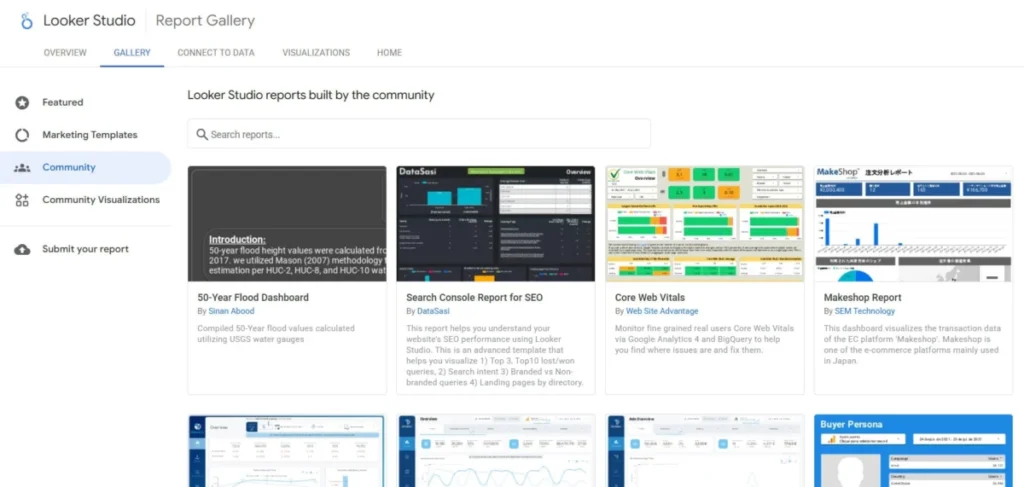
- Looker Studio Gallery & Community: Google’s Looker Studio (formerly Data Studio) offers an extensive library of free, expert-designed templates. These templates provide pre-configured charts, tables, and filters, requiring only a connection to your data sources to become instantly operational. The vibrant Looker Studio Community further expands this resource, offering diverse templates and inspiration for custom dashboard creation.
4. Multi-Channel Reports: The Holistic View
One of the most significant challenges in modern content measurement is the fragmentation of data across diverse platforms. Manual data export to tools like Google Sheets or Excel is feasible for small-scale operations, but automation becomes critical as content portfolios expand.
- Data Integration Tools: Tools like Supermetrics and Coupler.io are essential for automating data collection from various sources—social media, web analytics, CRM systems, advertising platforms—and consolidating it.
- Visualization Platforms: Once aggregated, this data is connected via "connectors" to powerful visualization tools such as Looker Studio, Tableau, or Power BI. This ensures real-time, interactive reporting that provides a holistic, unified view of content performance across all channels, eliminating the need for constant manual updates and reducing data silos. Examples like Coupler.io’s "Multi-channel creatives performance dashboard" or "All-in-one marketing dashboard" exemplify the power of this integrated approach.
By embracing automated, multi-channel reporting, organizations can save invaluable time, drastically reduce reporting errors, and empower decision-makers with accurate, comprehensive data for strategic content optimization.
![How to Measure Content Performance [+Reports] (2025)](https://measureschool.com/wp-content/uploads/2025/03/Explorations-in-GA4-1024x551.webp)
Future Forward: Implications for Content Strategy
The implications of adopting these advanced content performance measurement techniques are profound and far-reaching. For businesses that fail to evolve beyond rudimentary metrics, the consequences can be severe: wasted resources on underperforming content, missed opportunities to connect with target audiences, an inability to adapt to market shifts, and ultimately, a significant competitive disadvantage. Without clear data, content strategy becomes a guessing game, leading to inefficient spend and diluted impact.
Conversely, organizations that embrace a sophisticated, data-driven approach stand to gain immensely:
- Optimized Content Strategy: Insights derived from granular data allow for continuous refinement of content topics, formats, and distribution channels, ensuring maximum resonance with the target audience.
- Improved ROI: By precisely attributing performance to specific content pieces and campaigns, businesses can allocate resources more effectively, maximizing their return on content investment.
- Informed Decision-Making: Data provides a factual basis for strategic choices, moving away from intuition-based decisions towards evidence-based content development and promotion.
- Competitive Advantage: A deep understanding of one’s own and competitors’ performance enables proactive strategy adjustments, allowing businesses to stay ahead of market trends and capitalize on emerging opportunities.
- Sustained Growth: A cycle of measurement, analysis, and optimization fosters continuous improvement, driving consistent audience engagement, lead generation, and revenue growth.
Looking ahead, the field of content analytics is poised for even greater innovation. The integration of artificial intelligence and machine learning promises to unlock predictive capabilities, allowing marketers to forecast content performance and identify future trends. Real-time dashboards will become even more pervasive, offering immediate feedback and enabling agile content adjustments. The future of content strategy is inextricably linked to the sophistication of its measurement—a future where data is not just collected, but intelligently leveraged to tell the complete story of content’s impact and value.
![How to Measure Content Performance [+Reports] (2025)](https://measureschool.com/wp-content/uploads/2025/03/Looker-studio-gallery-1024x491.webp)
Measuring content performance is undeniably a complex, multi-faceted endeavor, far from a one-size-fits-all process. However, with the right structured approach—from defining specific content categories and selecting highly relevant KPIs, to utilizing powerful pre-made, custom, and multi-channel reports—it transforms into an indispensable tool for driving unprecedented growth and achieving strategic objectives. As of March 19, 2025, the message is clear: mastering content measurement is no longer optional; it is a fundamental pillar of digital success.
