
Beyond the Noise: How the ‘Causality Report’ is Redefining Strategic Attribution
In the modern digital landscape, the boardroom is often plagued by a persistent, nagging question: “Did that exhibition actually move the needle?” Or, perhaps more pointedly: “Was that expensive PR push just white noise, or did it fundamentally alter our market position?”
For years, the disconnect between high-level business operations and granular digital performance metrics has been the industry’s "blind spot." Marketing teams often celebrate vanity metrics—impressions, clicks, and engagement—while executive leadership demands to see how those figures translate into concrete, real-world business outcomes. Bridging this gap has historically been an exercise in guesswork, until now.
Enter the Causality Report: a transformative visibility tool designed to bridge the chasm between tangible business events and their subsequent digital ripple effects.
The Core Philosophy: Moving From Correlation to Causality
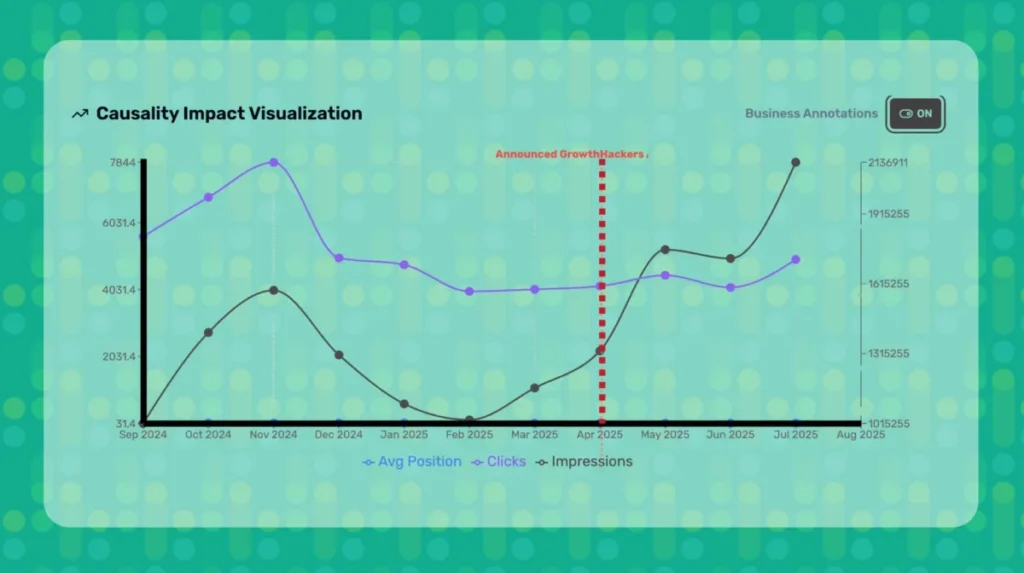
At its heart, the Causality Report is a data-visualization framework that maps the “before-and-after” impact of specific business milestones. Whether it is a product launch, an industry exhibition, a sudden pricing shift, or a high-impact media campaign, the report allows organizations to annotate the precise date of an event and overlay it against a timeline of performance metrics.
This is not merely a tracking mechanism; it is a shift from passive observation to active analysis. By aligning real-world actions with digital data, businesses can move beyond simple correlation—where two things happen to occur at the same time—and begin to build a case for actual causality. It provides the evidence needed to prove that a strategic maneuver was the catalyst for a shift in performance, rather than an unrelated byproduct of market trends.
A Chronology of Impact: Visualizing the Shift
The power of this tool is best observed through a chronological lens. When a business event is annotated—for instance, an industry exhibition held in April 2025—the Causality Report acts as a historical marker.
The Pre-Event Baseline
Before the annotation, the report establishes a "business as usual" baseline. By analyzing the data trends in the weeks or months leading up to the event, stakeholders can identify the organic growth or stagnation of their digital metrics. This creates a control group against which the post-event data can be measured.
The Inflection Point
The "April 2025" mark serves as the pivot. Immediately following the event, the Causality Report highlights shifts in key performance indicators (KPIs). If a company launches a product at an exhibition, the report captures the surge in organic search traffic, the uptick in landing page conversions, and the corresponding spike in qualified lead acquisition.
Post-Event Sustainability
Crucially, the report does not end at the event’s conclusion. It tracks the "long tail" of the action. Does the traffic subside immediately, or does it settle at a new, higher baseline? This distinction is vital for determining the ROI of long-term strategic investments versus short-term tactical bursts.
Supporting Data: Why "Signals" Matter
In the current data-saturated environment, distinguishing between a signal and a coincidence is the difference between a successful strategy and a wasted budget. The Causality Report utilizes sophisticated data visualization to highlight clear, demonstrable shifts in performance that occur immediately following a business action.
When the data shows a sharp trajectory change after a strategic initiative, it stops being a "coincidence" and starts being a "signal." This signal becomes the bedrock of future forecasting. If an organization sees that every time they participate in a Tier-1 industry event, their site traffic increases by 25% within 48 hours, they have effectively quantified the value of that event. This data-driven approach removes the subjectivity from the marketing budget, allowing teams to double down on what works and cut what doesn’t.
The Strategic Goldmine: Bridging Marketing and Operations
One of the most persistent failures in corporate culture is the siloing of "Marketing" and "Business Operations." Too often, the people signing the checks for events and PR campaigns are disconnected from the team analyzing the web analytics.
The Causality Report acts as a common language. When you connect the dots between operational decisions and digital performance, the organization begins to see the business as a unified ecosystem:
- Integrated Intelligence: By correlating PR pushes with website engagement, companies can determine the quality of their media coverage.
- Operational Agility: If a pricing change leads to an immediate drop in click-through rates, the Causality Report highlights this within hours, allowing for rapid, data-informed pivots.
- Cultural Alignment: When marketing metrics are tied to business outcomes, team members across departments start speaking the same language, fostering a culture of accountability and shared success.
If a company is not correlating these datasets, they are essentially driving blind. They are leaving critical business intelligence on the table, missing the opportunity to refine their strategy based on the reality of their digital footprint.
Official Perspectives: The Shift Toward Narrative Intelligence
Industry experts are increasingly pointing to "Narrative Intelligence" as the next frontier in business analytics. In a recent roundtable discussion on data transparency, analysts noted that the modern executive is no longer satisfied with spreadsheets of raw data. They want a story.
“The ‘Business Annotations ON’ toggle is more than just a UI feature,” notes one industry strategist. “It’s a strategic layer. When a CEO looks at a chart, they aren’t just looking for numbers; they are looking for the story of their business. By annotating the chart with real-world events, you provide the context. You stop reporting metrics and start telling the story of how your strategy drove the bottom line.”
This narrative approach is essential for securing buy-in from stakeholders. Data, when presented in a vacuum, can be misinterpreted. Data presented alongside the "Why" and the "When" becomes an irrefutable argument for future investment.
Practical Applications: When to Use the Causality Report
To extract maximum value from this methodology, organizations should deploy the Causality Report in several key scenarios:
- Product Launches: Track the immediate digital adoption and sentiment shifts following a go-to-market announcement.
- Competitor Moves: Annotate competitor actions to see how your own digital performance reacts to market shifts.
- PR Campaigns: Measure the "echo" of press releases or media hits in terms of direct traffic and brand interest.
- Pricing Experiments: Clearly delineate the impact of A/B testing or price changes on conversion funnels.
- Seasonal Shifts: Map historical market trends against current performance to identify new growth opportunities.
The Implications: A New Era of Accountability
The implications of adopting a causality-focused reporting model are profound. First, it demands a higher standard of internal communication. If an event is to be annotated, the marketing and operations teams must be in lockstep regarding dates and expectations. Second, it raises the bar for performance. When results are visible and linked directly to a specific action, the pressure to perform increases—but so does the reward for success.
Finally, the Causality Report democratizes data. It makes high-level insights accessible to stakeholders who may not be data scientists but who are deeply invested in the strategic direction of the company. It turns the complex, often chaotic world of digital marketing into a clean, actionable narrative.
As we move deeper into an era defined by data-driven decision-making, the companies that succeed will be those that can effectively answer the question: “Did this work?” With the Causality Report, the answer is no longer a guess. It is a proven, evidence-based conclusion that guides the business toward its next success.
In conclusion, the era of "noise" is coming to a close. By leveraging the Causality Report, organizations can transform their digital performance metrics into a powerful narrative of growth, accountability, and strategic precision. The "needle" is moving—and for the first time, you have the data to prove exactly why.
