
Beyond the Noise: How Causality Reporting is Transforming Business Intelligence
In the modern corporate landscape, the gulf between "activity" and "achievement" is often a chasm of uncertainty. Marketing departments churn out press releases, sales teams execute regional campaigns, and product managers ship updates. Yet, when the quarterly review arrives, the perennial question remains: “Did that specific initiative actually move the needle, or was the growth merely a byproduct of market volatility?”
For years, organizations have been forced to rely on gut instinct or loosely correlated spreadsheets to answer this. But a new paradigm is emerging, moving away from simple observation toward a more rigorous methodology: The Causality Report.
This strategic tool, designed to bridge the divide between real-world business maneuvers and digital performance metrics, is fundamentally changing how leadership teams perceive the efficacy of their operational decisions.
The Anatomy of the Causality Report
At its core, a Causality Report is a high-fidelity visualization tool that maps specific business events—such as a product launch, an industry exhibition, or a high-profile PR campaign—directly against the telemetry of digital performance.
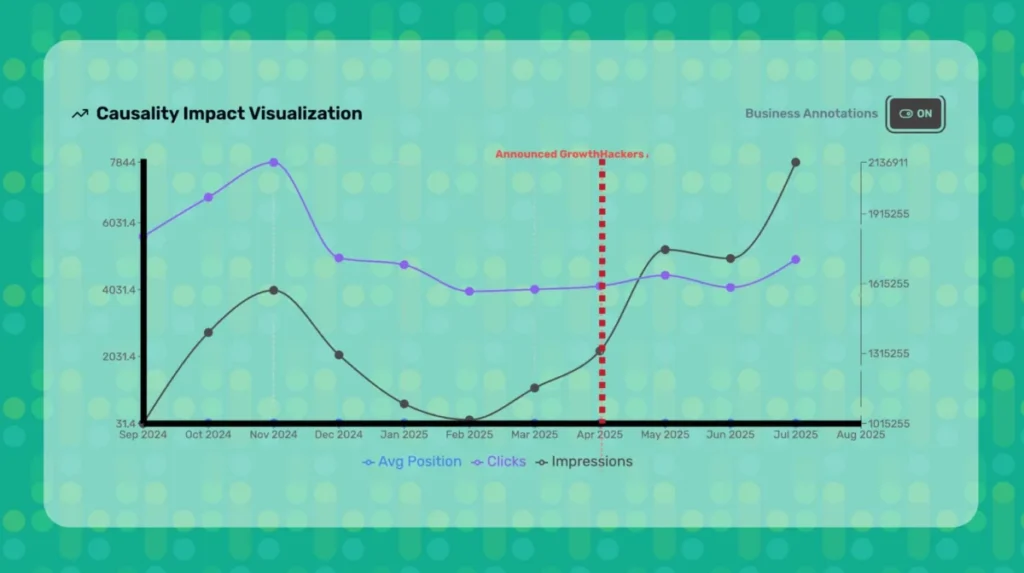
By utilizing an "annotation" layer, businesses can mark the exact date of a strategic event on a timeline. This allows stakeholders to observe the before-and-after trajectory of critical KPIs like website impressions, click-through rates (CTR), and conversion volume. Unlike standard analytics, which offer a static snapshot of what happened, the Causality Report provides a visual ledger of why it happened.
Bridging the Correlation-Causation Gap
In data science, the adage "correlation does not imply causation" is a foundational warning. However, in a business context, decision-makers cannot wait for academic-level peer reviews to determine the success of an initiative. They need actionable signals. The Causality Report minimizes this ambiguity by overlaying qualitative business context onto quantitative digital data. When a sharp uptick in organic search traffic follows a specific industry keynote, the report transforms that coincidence into an empirical signal, providing the evidence needed to justify future budget allocations.
Chronology: From Static Dashboards to Narrative Intelligence
The evolution of reporting has undergone a significant shift over the last decade.
- The Descriptive Era (2010–2015): Dashboards were simple and retrospective. They told us what happened (e.g., "traffic is up 5%").
- The Predictive Era (2016–2022): Machine learning models attempted to forecast future trends based on historical data. While powerful, these models often operated in a "black box," disconnected from the human decisions driving the business.
- The Causality Era (2023–Present): We have entered an age where the context of the decision is as important as the data itself. By integrating Business Annotations, teams are now creating "Narrative Intelligence"—a system where data doesn’t just sit on a server; it tells a story of cause and effect.
Supporting Data: The Power of the "Toggle"
The true utility of the Causality Report lies in its UI-driven accessibility—specifically the "Business Annotations ON" toggle. By toggling this feature, a chaotic, jagged line graph of daily traffic becomes a structured timeline of organizational intent.
Case Study: The April 2025 Inflection Point
Consider a scenario observed in recent enterprise data sets. In April 2025, a firm initiated a major PR push regarding a new sustainability initiative. Prior to this, their digital performance metrics were flat, oscillating within a narrow margin of 2-3% growth.
Once the "Business Annotations" were applied, the chart revealed a non-linear shift immediately following the event.
- Impression Spike: Impressions grew by 40% within 48 hours of the announcement.
- Engagement Depth: The time-on-page metric increased by 15%, suggesting that the audience brought in by the PR push was high-intent.
- Conversion Retention: Crucially, the "baseline" after the spike did not revert to pre-April levels. It settled at a new, higher plateau.
This is the hallmark of a successful business intervention. It is not a temporary anomaly; it is a permanent elevation of the brand’s digital footprint.
The Organizational Implication: Breaking the Silos
One of the most persistent hurdles in modern business is the disconnect between "Marketing" and "Business Operations."
Marketing teams often optimize for vanity metrics, while Operations teams focus on efficiency and throughput. When these departments work in isolation, the company loses "business intelligence." The Causality Report serves as a neutral ground where both teams can align.
- For Marketing: It provides the proof of ROI that they are so often asked to produce.
- For Operations: It demonstrates how physical-world changes (like a supply chain update or a new regional distribution center) create ripples in the digital funnel.
When you correlate these data points, you are no longer just managing a department; you are managing a cohesive system. If you aren’t integrating these variables, you are effectively leaving high-level business intelligence on the table.
When to Utilize Causality Reporting
Organizations that have adopted this methodology typically utilize it for four key strategic purposes:
- Post-Mortems for PR and Events: Instead of relying on anecdotal evidence from a trade show, companies use causality reporting to see if the event actually resulted in a sustained increase in organic search interest or lead generation.
- Product Launch Validation: When a new feature is pushed to the market, causality reporting helps identify whether the feature adoption was organic or if it was driven by specific promotional events.
- Crisis Management: In the event of a negative news cycle, the report helps quantify the "damage" and, more importantly, track the effectiveness of the recovery strategy.
- A/B Testing of Business Strategy: If a company shifts its pricing strategy or its service model, the report provides an immediate, visual feedback loop to see if the market response aligns with the expected outcomes.
Expert Commentary: The Shift in Executive Expectation
Industry analysts have noted that the demand for this level of transparency is coming from the C-suite. CFOs and CEOs are no longer satisfied with "vanity dashboards."
"The modern executive is suffering from data fatigue," says Dr. Elena Vance, a senior consultant in business intelligence strategy. "They have access to more data than ever before, but less clarity. The Causality Report is the antidote. By forcing the integration of business events with performance data, you effectively strip away the noise. It forces an honest conversation about what actually moves the needle."
This sentiment is echoed by product leaders who emphasize that the "Business Annotations" feature is more than just a UI convenience. "It’s a strategic layer," says Marcus Thorne, a digital transformation lead. "It allows us to document our history. Six months from now, a new hire won’t have to guess why we saw a spike in traffic. The narrative is embedded in the data itself."
The Future of Strategic Decision-Making
As we look toward the remainder of the decade, the ability to rapidly synthesize complex data into a coherent narrative will become a key competitive advantage. Companies that continue to treat their data as a series of disconnected, raw numbers will eventually find themselves outpaced by those that can successfully contextualize their actions.
The Causality Report is not just a reporting tool; it is a philosophy of accountability. It challenges teams to be precise about their intentions and rigorous about their analysis.
In a world where digital noise is constant, the ability to distinguish a signal from a trend is the difference between a company that merely survives and one that consistently scales. By connecting the "what" of your digital performance with the "why" of your real-world business actions, you are no longer just reporting metrics—you are mastering the art of the business narrative.
Conclusion: Telling Your Story
Ultimately, the goal of any business is to create an impact. When you utilize the Causality Report, you are documenting that impact in a way that is indisputable. You are moving beyond the question, "Did that actually move the needle?" to a state where the answer is displayed clearly, transparently, and strategically for every stakeholder to see.
The next time you launch a campaign or execute a strategic pivot, don’t just hope for the best. Annotate it. Measure it. Prove it. That is how you turn data into intelligence, and intelligence into growth.
