NEW YORK — In the high-stakes arena of modern media monetization, ad sales has undergone a fundamental philosophical evolution. Gone are the days when a publisher could walk into a prospective buyer’s office armed with little more than a rate card, a glossy media kit, and broad, self-reported impressions metrics. Today, media sellers are not merely peddling ad space; they are selling verified audiences. Proving the intrinsic value and active engagement of those audiences demands a rigorous, data-driven approach that looks far beyond traditional vanity metrics.
As the digital advertising ecosystem matures amidst tightening privacy regulations and fragmented consumer attention, publishers face unprecedented pressure to justify every dollar of ad spend. To win and retain premium sponsorships, media sales teams must harness a sophisticated blend of first-party and third-party audience data. By contextualizing this information, they can transform abstract numbers into undeniable proof of value, secure decisive leverage in negotiations, and accelerate deal velocity.
The Modern Ad Sales Landscape: Main Facts
The contemporary ad sales equation relies on a multi-layered understanding of consumer behavior across owned properties and external digital ecosystems.
At its core, a successful media pitch must bridge the gap between reach and relevance. Advertisers no longer simply want to know how many people might see their message; they demand to know who those people are, what they care about, and how deeply they engage with content.
Media sellers have access to an abundance of valuable audience insights derived from their owned and operated (O&O) channels—websites, mobile apps, and proprietary streaming services. However, O&O data alone only tells half the story. To truly stand out in a hyper-competitive marketplace, publishers must integrate cross-platform third-party intelligence harvested from major social video networks, including YouTube, TikTok, Instagram, and Facebook.
Platforms like Tubular Labs have emerged as critical infrastructure in this space, providing global social video intelligence that allows ad sales teams to convert surface-level metrics into hard, actionable proof. By illuminating audience behaviors across the entire digital landscape, these tools enable publishers to demonstrate precisely why their viewers represent a superior investment compared to competing media channels.
The Evolution of Pitch Strategy: A Chronology of Media Sales
To understand how ad sales reached this data-centric juncture, it is helpful to examine the historical progression of how media properties have packaged and sold their audiences over the past two decades.
Era 1: The Print and Banner Ad Paradigm (Late 1990s – Late 2000s)
In the early days of digital publishing, ad sales mirrored traditional print models. Sales pitches relied heavily on circulation numbers, estimated page views, and generic demographic buckets (e.g., "men 18–49" or "affluent homeowners"). Advertisers bought static banner space based on trust and broad category alignment, with little granular tracking of user intent or cross-channel affinities.
Era 2: The Rise of Programmatic and Big Data (2010s – Early 2020s)
The advent of programmatic advertising shifted the focus toward scale, automation, and audience targeting via cookies and device IDs. While this era introduced massive efficiency, it also commoditized ad inventory. Publishers struggled to differentiate their premium content from programmatic networks, leading to a race to the bottom on pricing and an over-reliance on automated impressions rather than contextual value.
Era 3: The Privacy-First, Cross-Platform Intelligence Age (Present Day)
With the phased deprecation of third-party cookies, Apple’s App Tracking Transparency (ATT) framework, and rising consumer privacy regulations, the industry has swung back toward direct-sold, value-driven partnerships. However, today’s direct sales require a much higher level of sophistication. Modern publishers must blend reliable first-party insights with comprehensive third-party social video intelligence. This allows sales teams to bypass generic reach arguments and instead pitch custom, audience-aligned integrations backed by verified cross-platform behavioral data.
First-Party vs. Third-Party Data: Why Your Pitch Needs Both
Building an unassailable ad sales pitch starts with the data foundation. Publishers possess a distinct structural advantage in the market: direct, reliable first-party data collected straight from their own digital properties.
The Power of First-Party Data
First-party data provides publishers with a direct, unfiltered view of user activity on their websites and applications. Real-time analytics platforms capture granular insights into audience behavior, session duration, and editorial performance. This data is vital for understanding how loyal readers interact with specific content verticals.
However, O&O data inherently has blind spots. It only shows what users do while they are on the publisher’s property. It cannot capture where else those users go, what content they consume across social media, or how their broader lifestyle preferences intersect with an advertiser’s brand values.
The Role of Third-Party Data Enrichment
This is where third-party data enrichment becomes indispensable. By integrating independent information collected across outside channels—most notably social video platforms—publishers can dramatically expand the context surrounding their audiences.
Third-party social video data illuminates audience behaviors, preferences, and cross-platform affinities. It allows sales teams to demonstrate not merely the physical size of a publication’s footprint, but the quality, depth, and mindset of its audience. When combined with first-party analytics, third-party intelligence gives publishers a comprehensive narrative that competing media outlets simply cannot match using isolated metrics.
Building the Pitch: Harnessing Tubular Social Video Data
Gathering robust audience data is only the first step. The second, more challenging half of the equation is turning those data points into a compelling narrative that wins and retains premium sponsors.
A winning sales pitch must accomplish two critical objectives:
It must definitively prove a channel’s reach and influence with the exact audience demographic an advertiser cares about.
It must decisively differentiate the publisher from every other advertising venue competing for the same finite marketing budget.
This is where Tubular Labs’ global scale provides a decisive edge. As a premier source of social video data, Tubular grants ad sales teams deep visibility across the entire social video landscape. Sales teams can leverage this intelligence to construct targeted, evidence-backed pitches built on three core pillars: demographic segmentation, audience overlap data, and content performance insights.
1. Demographic Segmentation
Advertisers have highly specific targets, and broad age ranges no longer suffice. Tubular enables ad sales teams to segment audiences by precise geographic locations, age brackets, and gender distributions to demonstrate exactly how their channel performs within a brand’s target demographic.
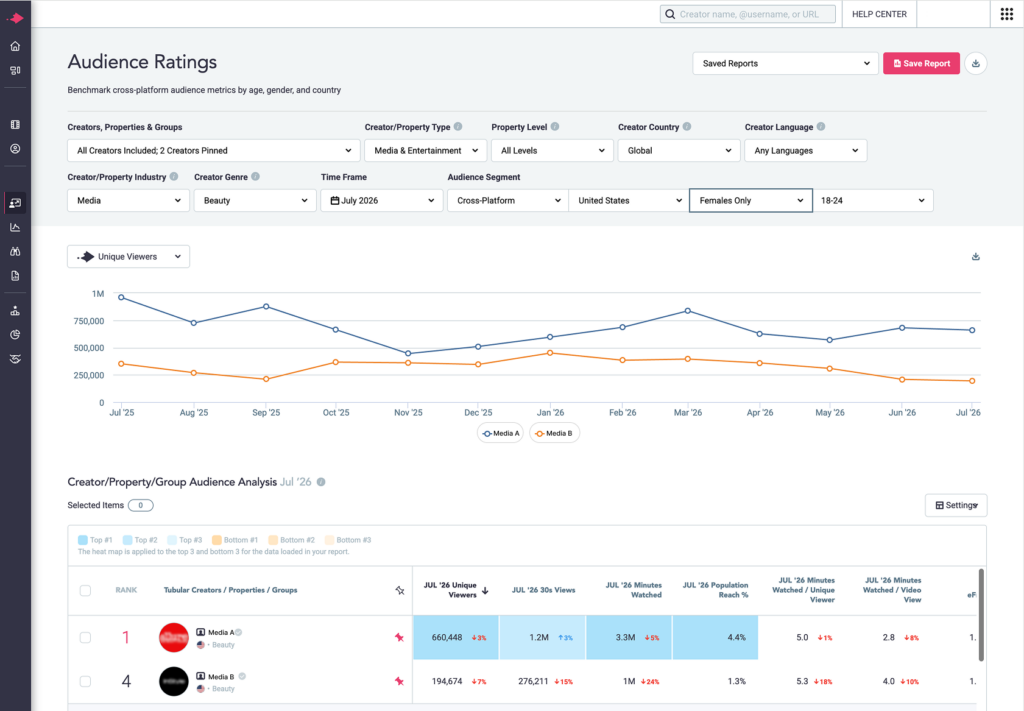
Practical Application: Imagine two competing media companies vying for ad dollars from a major beauty brand targeting women ages 18–24. On the surface, their standard media kits might look nearly identical. However, by utilizing Tubular’s demographic segmentation capabilities, Media Company A can pull granular audience overlap and engagement metrics showing superior performance within that specific age bracket. This allows the sales team to pivot the conversation away from generic traffic numbers and toward guaranteed demographic efficiency.
2. Audience Overlap Data
Standard demographic breakdowns tell only part of the story. Ad sales teams can also analyze audience affinities across disparate content categories to uncover hidden shared interests and diversify targeting strategies.
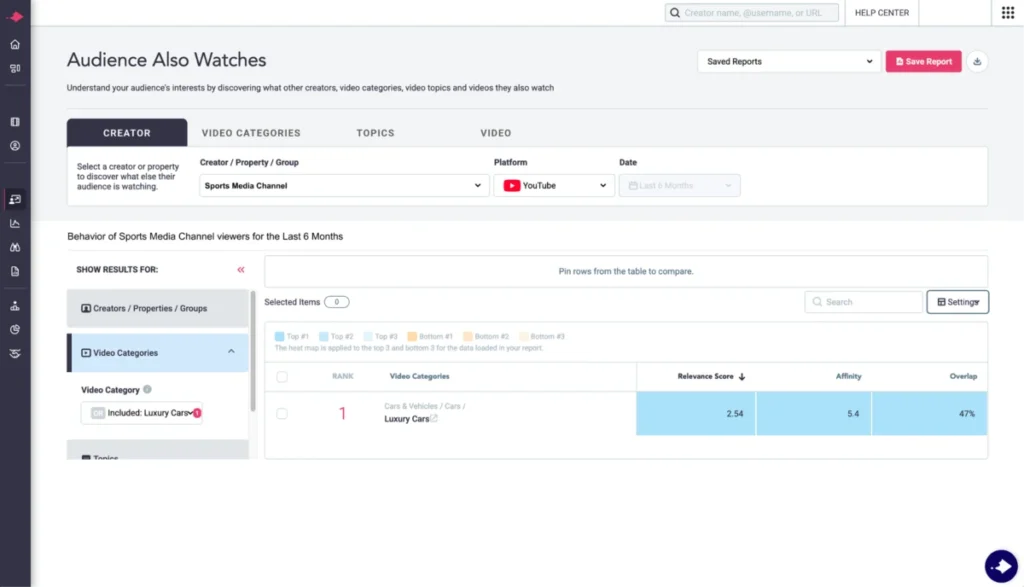
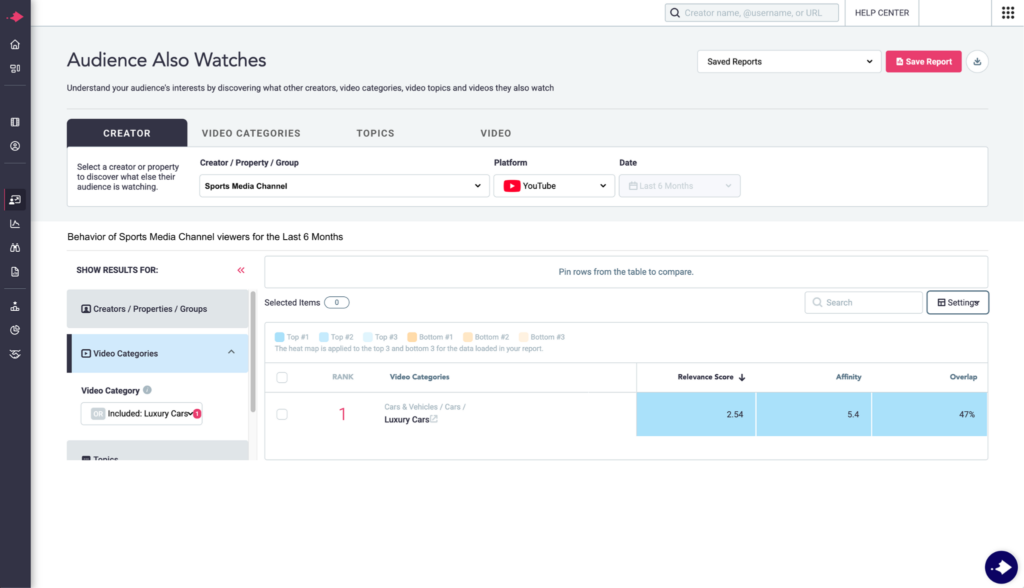
Practical Application: A major sports media publisher can use audience overlap data to prove to a luxury automotive brand that its sports-centric audience shares a 47% viewer overlap with luxury car content on YouTube. Rather than pitching a standard sports sponsorship, the seller now has concrete proof that their viewers already possess a pre-existing behavioral affinity for high-end automobiles, opening the door for a much more lucrative, non-endemic brand partnership.
3. Content Performance Insights
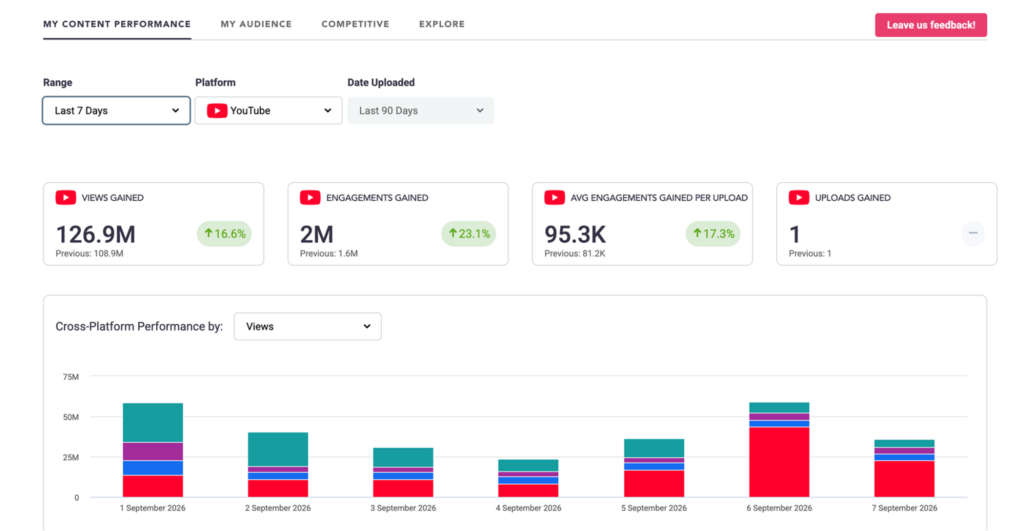
Publishers must continuously demonstrate momentum. Sales teams can leverage content performance insights to highlight platform growth trends, marrying them with audience demographic data to prove sustained traction in key growth segments.
Practical Application: Instead of telling an advertiser that overall views are up, a seller can utilize platform performance data to show a 55% year-over-year growth rate specifically among viewers aged 25–34 on YouTube. This transforms a vague growth claim into a targeted, high-value proof point that directly aligns with the advertiser’s strategic acquisition goals.
Official Perspectives and Industry Insights
As media organizations navigate shifting monetization models, industry leaders emphasize that data transparency and contextual intelligence are no longer optional—they are prerequisites for survival.
"In today’s market, advertisers are inundated with choices, but starving for proof," notes a senior media strategy executive. "A media kit telling an advertiser ‘we have millions of readers’ is essentially white noise. The publishers winning multi-million-dollar commitments are the ones walking into meetings with cross-platform behavioral evidence. They are showing brands not just who is reading their articles, but what those readers are watching, buying, and caring about across the entire digital ecosystem."
Furthermore, digital advertising analysts point out that privacy shifts have placed a premium on aggregated social video intelligence.
"As signal loss impacts traditional tracking, publishers who can effectively bridge first-party engagement with third-party social video affinities hold immense leverage," explains a leading digital media analyst. "Tools like Tubular allow traditional publishers to act like modern tech platforms, providing buyers with the granular audience mapping they need to justify risk."
Real-World Case Study: From Raw Data to a Winning Pitch
To see how these concepts translate into executive-level execution, consider the following anonymized case study involving a global news publisher seeking to secure a major brand partnership.
The Challenge
A leading global news publisher was attempting to pitch a high-value branded content deal to an international travel booking platform. The advertiser’s primary objective was to drive unaided brand awareness among UK millennials aged 25–34.
The Data Execution
Rather than relying on standard site traffic metrics, the ad sales team turned to Tubular to extract two distinct, verifiable proof points:
Cross-platform engagement metrics demonstrating that the publisher’s travel-related video content significantly outperformed competing publications in views, comments, and shares.
Audience affinity data revealing a strong behavioral crossover between the publisher’s core news audience and specific lifestyle subcultures, specifically minimalist packing tutorials and aesthetic café content.
The Pitch Narrative
Armed with these insights, the ad sales team constructed a tailored, highly persuasive pitch:
"Our content consistently outperforms competing publications on views, comments, and shares, proving that our audience isn’t just passive—they are deeply engaged.
More importantly, our audience overlap data gives your campaign a distinct competitive edge. We are tracking a notable behavioral crossover between travel intent and our audience’s deep engagement with ‘foodie’ subcultures, minimalist packing guides, and aesthetic lifestyle content.
Instead of running generic, broad-stroke travel ads, we can partner with you to build creative tailored specifically to these niche interests. You won’t just be reaching a general news audience; you’ll be engaging a demographic that is already primed, behaviorally aligned, and actively looking for inspiration in the exact categories your brand serves."
The result? The travel booking platform bypassed competing proposals, committing to an expanded, multi-platform branded content campaign rooted in the publisher’s granular audience intelligence.
Implications for the Future of Media Monetization
The shift toward data-driven, social-intelligence-backed ad sales carries profound implications for publishers, sales executives, and advertisers alike.
1. The Death of Vanity Metrics
Publishers can no longer rely on raw impression counts or massive, unverified follower tallies to close deals. Sophisticated buyers require granular, verifiable proof of audience affinity and engagement quality. Publishers who fail to upgrade their pitch methodologies risk losing premium budgets to more data-agile competitors.
2. Convergence of Editorial and Sales Intelligence
The barrier between editorial analytics and ad sales is dissolving. Sales teams must work hand-in-hand with audience development and data science professionals to extract cross-platform insights. Understanding what content resonates on TikTok or YouTube is no longer just an audience growth tactic—it is a core revenue-generation engine.
3. Empowerment in Rate Negotiations
Armed with third-party data enrichment tools, publishers gain substantial leverage during rate negotiations. When a seller can definitively prove that their audience possesses unique, high-value overlaps with an advertiser’s target market, discounting becomes unnecessary. Value replaces volume as the primary currency of the negotiation table.
Key Takeaways: What It Takes to Prove Audience Value
As the media landscape continues to evolve, the path forward for ad sales teams is clear. Success belongs to those who can move beyond assumptions and build pitches rooted in specific, verifiable data points. For media sellers looking to dominate the market, the core takeaways are unmistakable:
Integrate O&O with Third-Party Data: Use your first-party site metrics as a baseline, but enrich your narrative with cross-platform social video intelligence to provide a holistic view of consumer behavior.
Focus on Audience Quality Over Reach: Advertisers care deeply about intent and affinity. Prove that your audience doesn’t just match demographic checkboxes, but actively demonstrates behavioral alignment with the brand.
Leverage Granular Segmentation: Utilize advanced audience rating tools to pinpoint specific geographic, age, gender, and niche-interest overlaps that outshine your competitors.
Transform Insights Into Actionable Strategy: Translate complex data sets into clear, compelling storytelling that shows prospective partners how and why their creative will succeed on your platform.