
Beyond the Hype: Mapping the Accelerated Evolution of Generative AI in Marketing
The Gartner Hype Cycle has long served as the industry’s North Star—or perhaps its favorite punching bag—for understanding the trajectory of emerging technologies. It is a model both revered for its predictive clarity and reviled for its perceived reductionism. Yet, as generative AI (GenAI) reshapes the martech landscape at a velocity previously unseen in digital history, the traditional Hype Cycle is being forced to evolve.
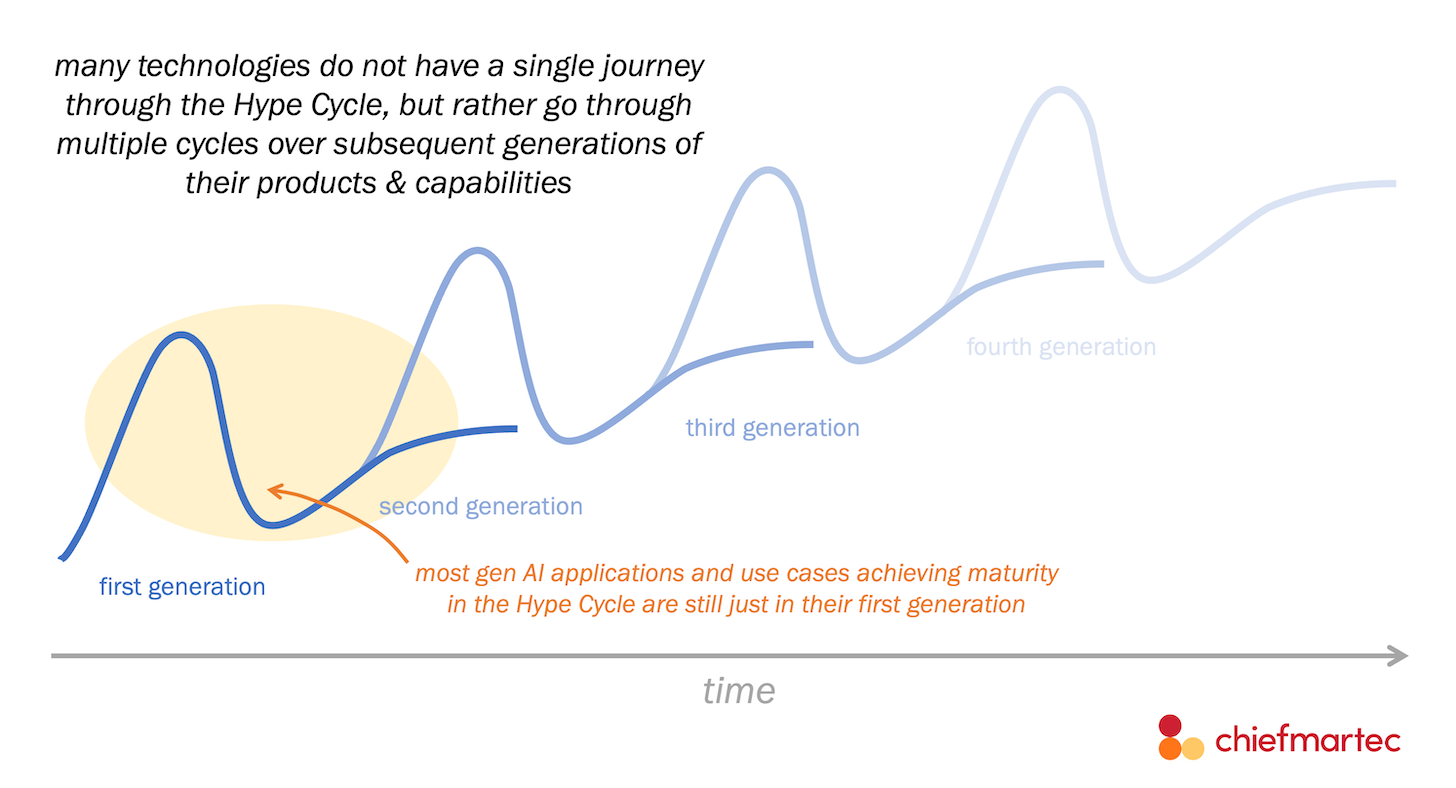
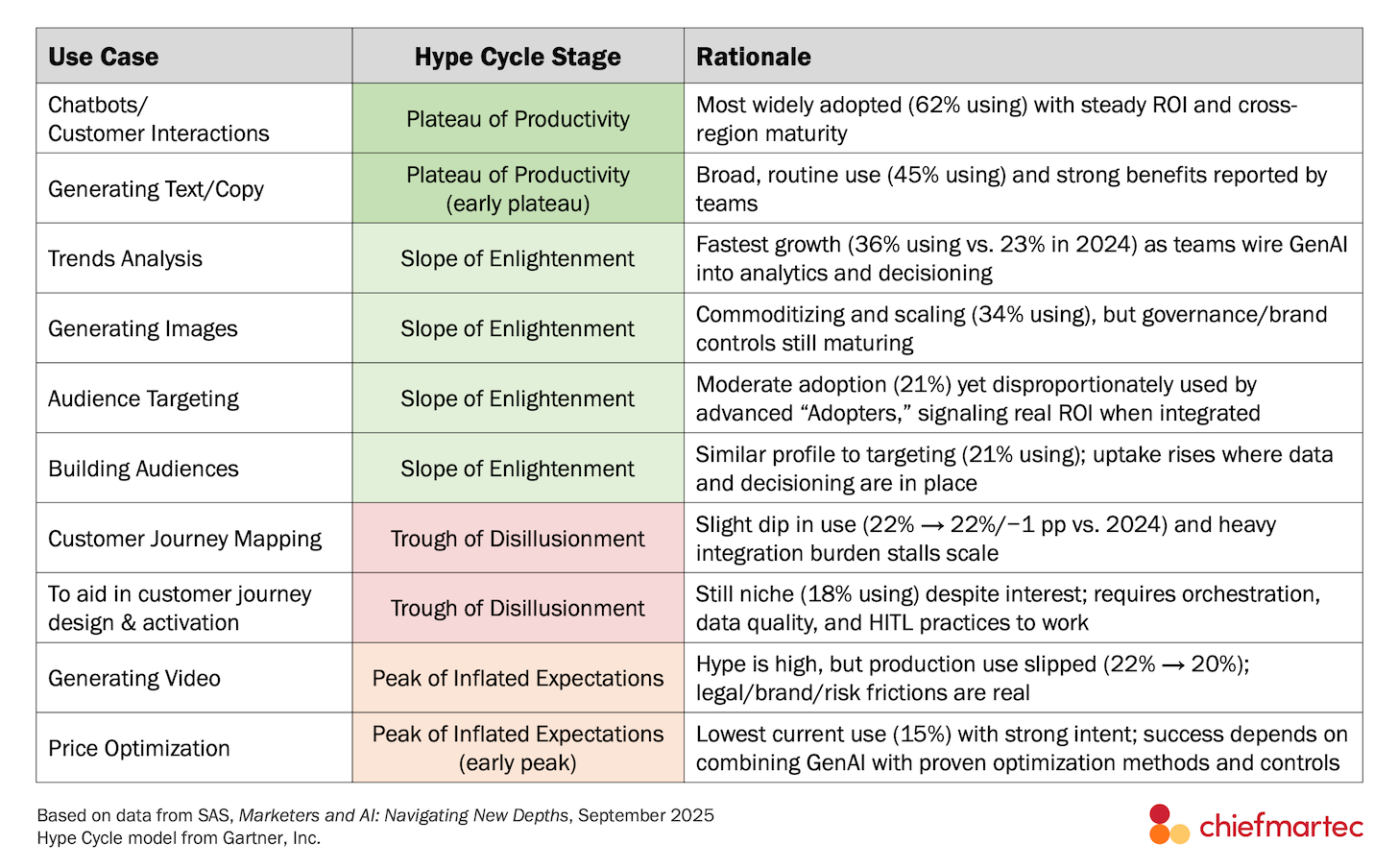
A new report from SAS, Marketers and AI: Navigating New Depths, provides critical empirical evidence that we are no longer dealing with a single, monolithic technology curve. Instead, we are witnessing a "fractal" Hype Cycle, where multiple generations of AI applications operate simultaneously across different stages of maturity.
The Fractal Nature of GenAI Evolution
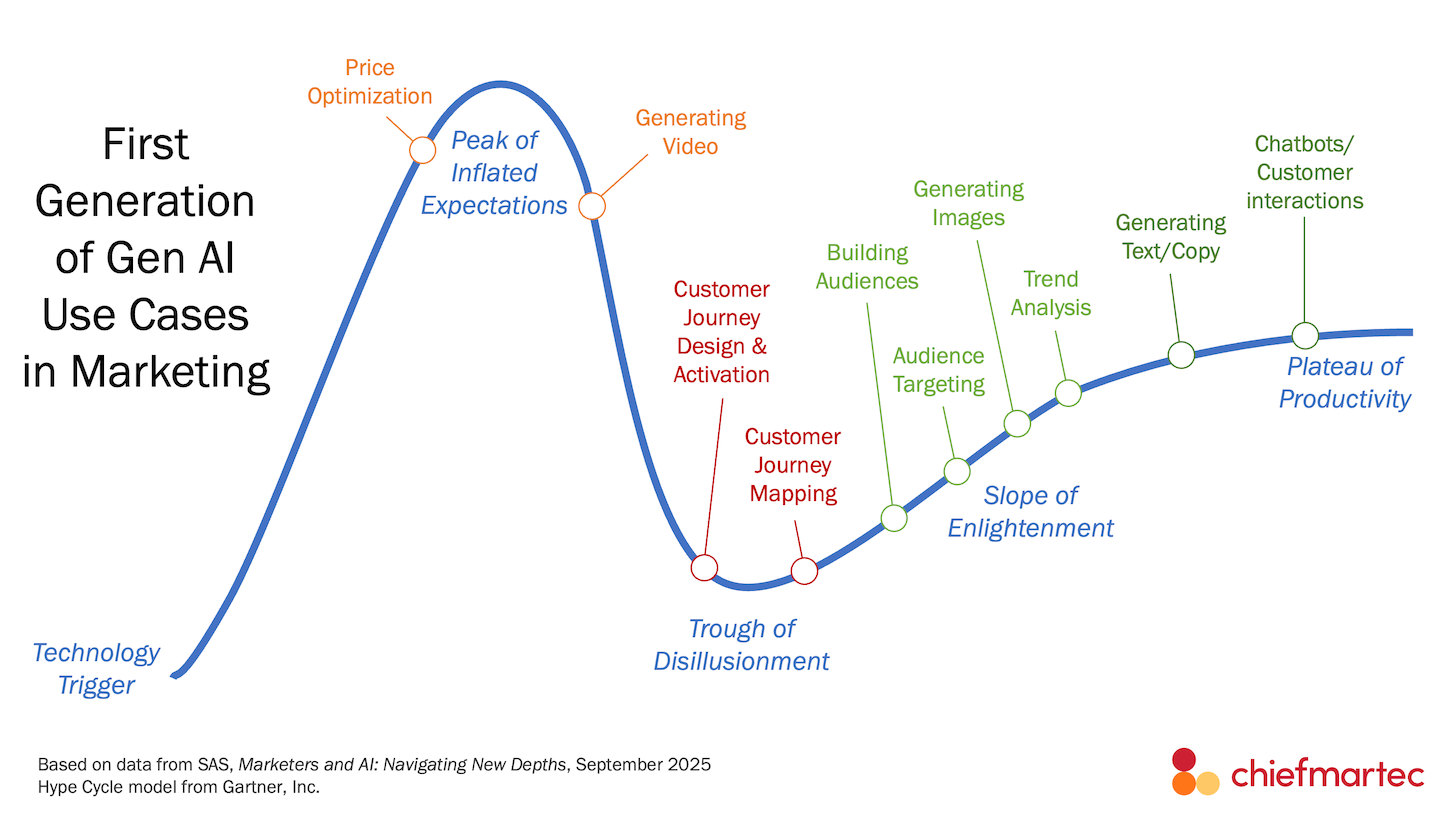
To understand the current state of marketing technology, we must first abandon the notion that "GenAI" is a singular entity moving in lockstep through the cycle. The reality is far more complex: different use cases are currently occupying every stage of the curve, from the "Peak of Inflated Expectations" to the "Slope of Enlightenment."
This complexity is compounded by the "Generation Gap." Most GenAI applications currently in use are, in essence, version 1.0. An AI chatbot deployed today for basic customer service is a far cry from the autonomous agents of the next five years. As we move from simple generative text to agents with the capacity for complex reasoning, cross-selling, and independent action, each new generation of technology will embark on its own unique Hype Cycle.
This creates a fascinating, albeit dizzying, phenomenon: a company may simultaneously be at the "Plateau of Productivity" with its first-generation chatbot, while simultaneously being caught in the "Peak of Inflated Expectations" regarding its next-generation, agentic AI. Holding these two contradictory realities in mind is, as F. Scott Fitzgerald famously noted, the test of a first-rate intelligence.
Chronology: The Velocity of Adoption
The most profound shift identified in the SAS report is the unprecedented speed at which these technologies are moving. Historically, a technology might take a decade to travel from the initial "Innovation Trigger" to the "Plateau of Productivity." In the current climate, that cycle is collapsing into a matter of months.
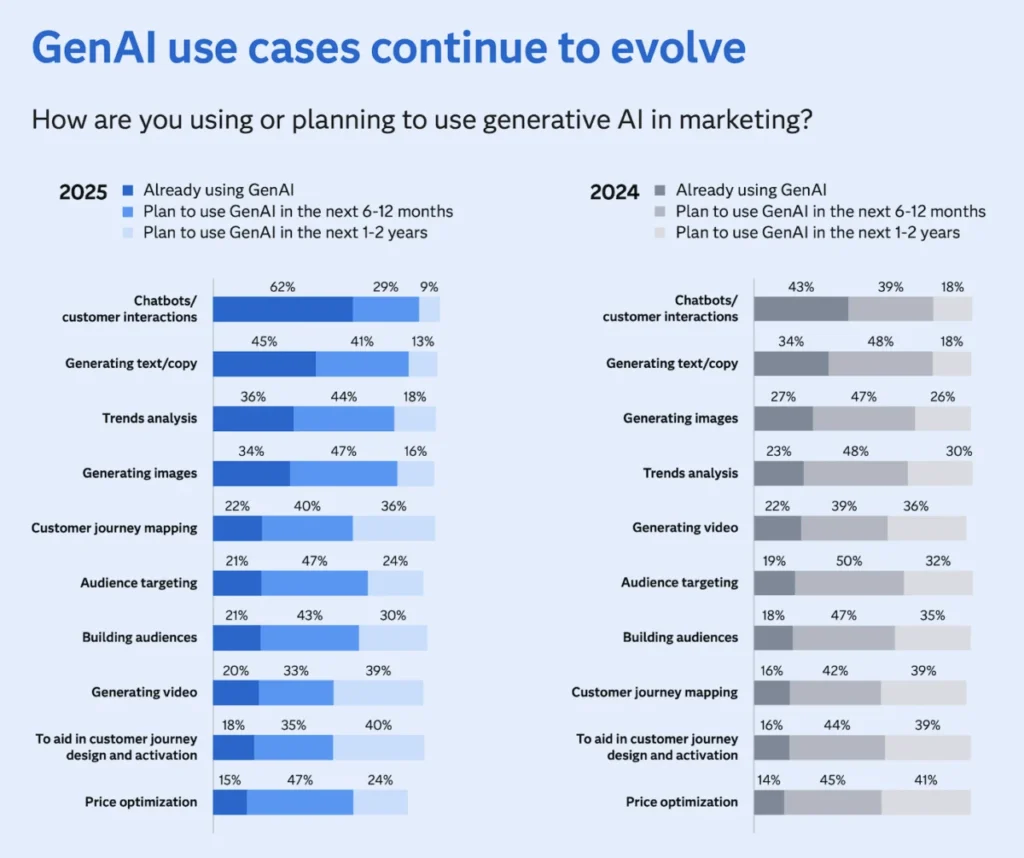
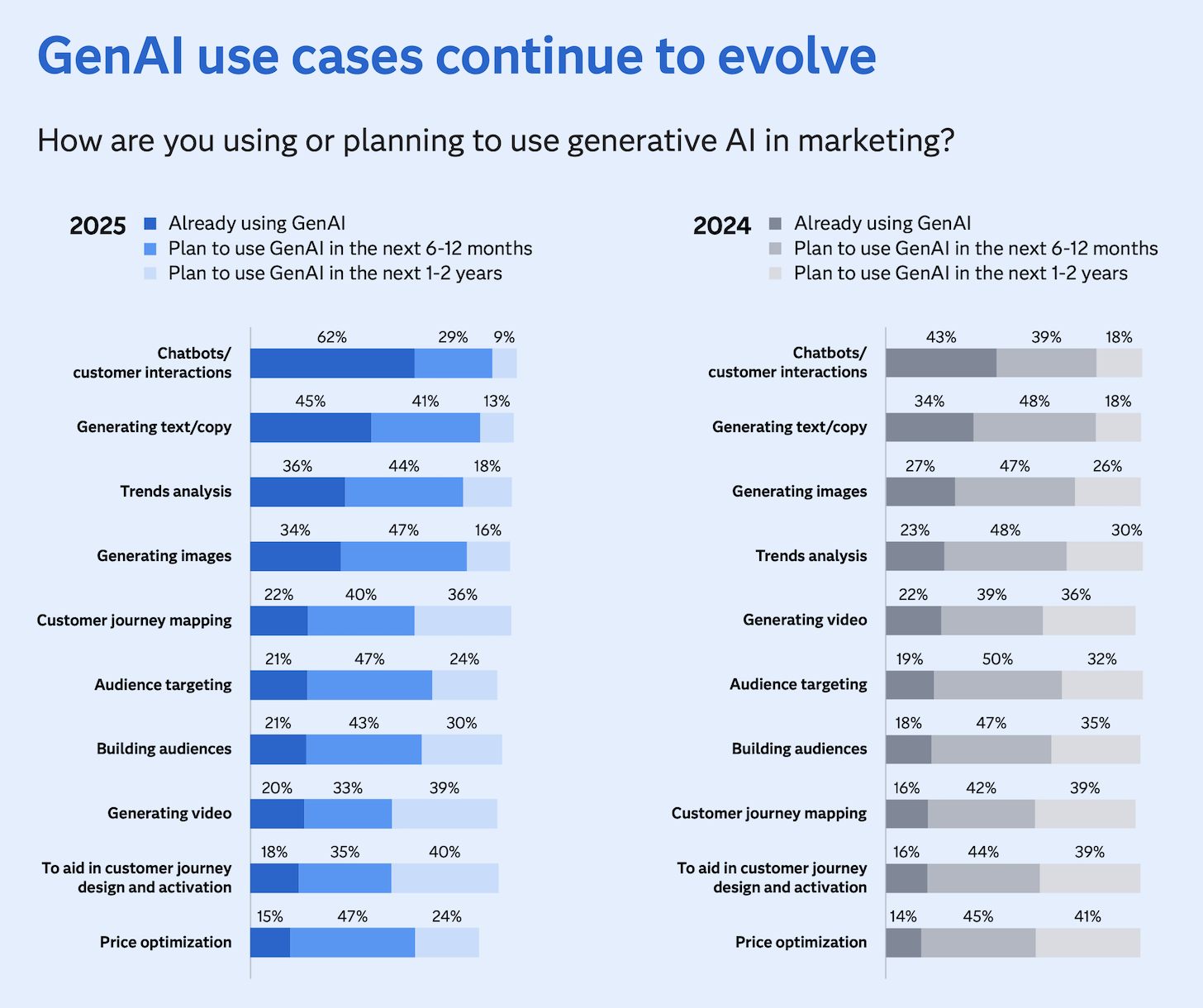
By comparing survey data from 2024 and 2025, we can trace the rapid maturation of 10 key marketing use cases. The data suggests that we are witnessing a significant "shakeout" period. While some applications have seen explosive growth in adoption, others have begun to retract as organizations realize the gap between initial hype and practical, scalable utility.
The Accelerators
The most significant gains in adoption over the past 12 months include:
- Content Generation for Social Media: Increasingly becoming a standard operational tool.
- Email Marketing Optimization: Moving from experimental to core workflow.
- Personalized Product Recommendations: Shifting from a "nice-to-have" to a competitive necessity.
These three areas represent the current "Plateau of Productivity." They have successfully moved past the initial trial-and-error phase and are now delivering measurable, repeatable value to marketing organizations.
The Retractors: The Trough of Disillusionment
Conversely, the data reveals a cooling effect on several high-profile use cases. A handful of applications that saw significant fanfare in 2024 have actually experienced a reduction in reported adoption in 2025. This is the hallmark of the "Trough of Disillusionment."
When initial expectations of "AI magic" fail to translate into immediate ROI, organizations are pulling back, recalibrating their investments, and shifting focus toward more pragmatic, data-driven implementations. This is not necessarily a failure of the technology; rather, it is a healthy maturation of the market. It represents the transition from "playing with AI" to "integrating AI."
Supporting Data: Navigating the New Depths
The SAS report, based on a survey of 300 marketing professionals, provides a granular look at this shift. The data suggests a distinct bifurcation in the market:
- High-Adoption Use Cases: These are the "bread and butter" applications where the generative nature of AI provides clear, immediate efficiency gains. They are currently enjoying widespread implementation.
- Volatile Use Cases: These are the applications that were heavily promoted early on but are now suffering from high "complexity overhead." Marketers are finding that the effort required to manage these systems outweighs the current output quality.
This data allows us to map these use cases onto a custom Hype Cycle. While Gartner did not author this specific map, it serves as a synthesis of the SAS empirical data and broader industry sentiment. It positions "Content Ideation" and "Basic Asset Creation" toward the Plateau, while more speculative or high-friction AI integrations are currently wallowing in the Trough, waiting for technical refinement.
Implications for the Martech Stack
The implications for CMOs and marketing technologists are twofold: structural and strategic.
The Structural Shift
Organizations must move away from a "one-size-fits-all" AI strategy. Because different applications are at different stages of the Hype Cycle, the governance, budget, and talent requirements for each will vary wildly.
- For Plateaued Technologies: The focus should be on optimization, scaling, and integration into existing CRM and CMS platforms.
- For Trough-Dwelling Technologies: The strategy should be "pause and pivot." These areas require a return to foundational data hygiene and a focus on solving specific, smaller-scale problems before attempting enterprise-wide deployment.
The Strategic Shift
The "next generation" of AI is already on the horizon. The SAS report hints at the early considerations of quantum computing in marketing—a reminder that the cycle of disruption is not merely continuing; it is accelerating.
Marketing leaders must develop "AI agility." This means building teams that are not just proficient in using today’s tools, but are culturally prepared for the rapid obsolescence of those tools. The goal is to build an architectural foundation—clean data, modular systems, and flexible APIs—that can survive the shifting tides of the Hype Cycle.
Future Horizons: Beyond GenAI
As we look toward the remainder of the decade, the integration of AI into the marketing stack will likely move from "generative" to "agentic." We are transitioning from a world where AI acts as a creative assistant to a world where AI acts as a strategic executor.
The SAS report serves as a wake-up call for the industry: the honeymoon phase of generative AI is over. The era of "operationalizing" is here. Organizations that treat GenAI as a shiny new toy will likely find themselves trapped in the Trough of Disillusionment, while those that treat it as a multi-generational, iterative infrastructure project will find themselves at the Plateau of Productivity.
Conclusion
The exhilaration of the current marketing landscape is undeniable. We are living through a period of technological change that makes the early days of the internet or the mobile revolution look sluggish by comparison.
However, success in this environment requires a disciplined approach to the Hype Cycle. By acknowledging that we are dealing with multiple generations of technology moving at different speeds, marketers can move past the hype and focus on the substantive, long-term impact of AI. The future belongs to those who can manage the "Plateau" and the "Peak" simultaneously—navigating the new depths with both intellectual humility and strategic rigor.
For further insights and a deeper dive into the metrics of adoption, the full report, "Marketers and AI: Navigating New Depths," is available via the SAS website. As we prepare for the next wave of technological evolution, including the nascent potential of quantum marketing, one thing remains certain: the only constant in the martech world is the cycle itself.
