
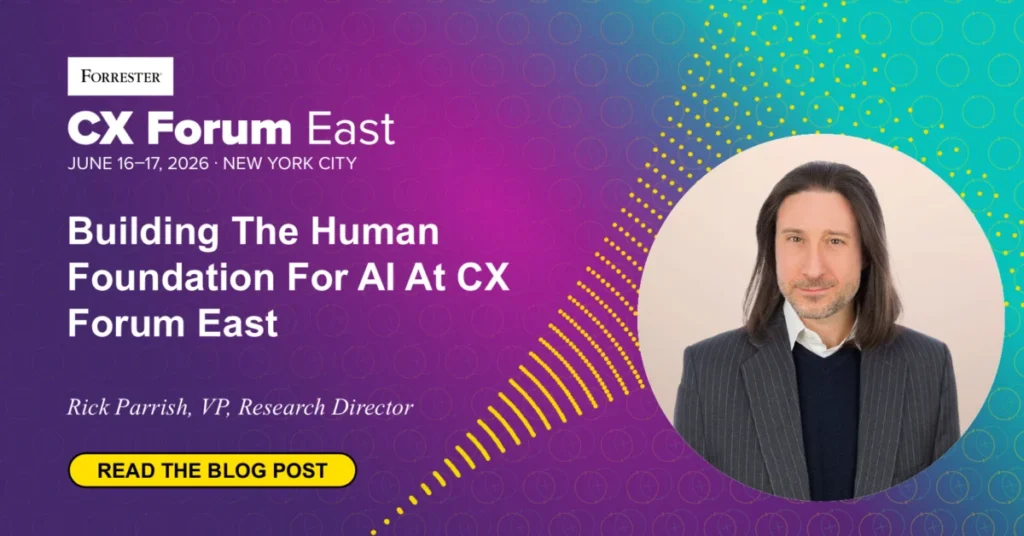
Beyond the Algorithm: Reflections on Forrester’s CX Forum East and the Future of Human-Centric AI
The curtains have drawn on Forrester’s CX Forum East, held in the heart of New York City, marking a significant transition from the event’s long-standing tenure in Nashville. For two days, industry leaders, analysts, and innovators gathered to dissect the most pressing challenge of the decade: how to balance the breathless pace of artificial intelligence implementation with the enduring necessity of human-centric experience design.
Under the banner of this year’s theme, "Build The Experience AI Can’t," the conference served as a stark reminder that while technology evolves, the fundamental principles of customer loyalty remain rooted in empathy, creativity, and structural integrity.
The Core Mandate: Why AI Needs a Foundation
At the heart of the event was a provocative premise: AI is not a magic wand that can fix broken systems. Instead, it acts as an amplifier, accelerating both the successes and the failures of an organization.
Forrester’s leadership underscored a critical industry shift: the premature rush to adopt generative AI without first securing the "experience foundation." Many organizations are currently caught in a cycle of implementing automated tools to patch over inefficient processes or disjointed customer journeys. The consensus among speakers was clear: AI cannot compensate for a lack of organizational maturity or a disconnect between brand promise and delivery. To derive value from AI, leaders must first master the basics of cross-departmental alignment, data integrity, and a culture that prioritizes human connection.
Chronology of the Forum: A New York Debut
The event’s transition to New York City was more than a change in geography; it represented an evolution in the scale and scope of the dialogue.
- Day One: The Reality Check. The opening sessions focused on the state of the industry. Analysts presented new data confirming that "experience fragmentation"—where brand promises diverge from actual customer interactions—is the primary driver of growth stagnation. The day was punctuated by a deep dive into the "Total Experience" framework.
- Day Two: The Visionary Pivot. The second day shifted from the diagnostic to the aspirational. Guest speakers and workshops focused on "agentic AI"—the next generation of autonomous systems—and how leaders can restructure their teams to support these new workflows without sacrificing the human element of creativity.
Supporting Data: Quantifying the Total Experience
A pivotal moment of the Forum was the unveiling of the latest iteration of Forrester’s Total Experience Score. This model has become an industry benchmark for measuring how successfully a company bridges the gap between what it says and what it delivers.
Crucially, the research now incorporates the Employee Experience Index (EX Index™). The logic is compelling: if employees are not empowered, supported, and aligned with the brand mission, they cannot deliver a superior customer experience. The data presented at the Forum suggests that the "Total Experience" is a three-legged stool consisting of Brand Experience (BX), Customer Experience (CX), and Employee Experience (EX). If any one of these pillars is neglected, the entire architecture fails.
The Home Depot Case Study
The inaugural "Total Experience Honor" was awarded to The Home Depot, a choice that served as a tangible case study for the audience. The retailer was recognized for its ability to align its brand promise with both its digital customer journey and its internal employee culture. By integrating these three domains, the company has managed to create a durable, distinctive market position that serves as a blueprint for others attempting to survive the "AI-first" era.
Expert Perspectives: The Role of Human Creativity
One of the most anticipated segments of the Forum featured Duncan Wardle, the former head of innovation and creativity at Disney, Lucasfilm, Marvel, and Pixar. Wardle’s address challenged the audience to reconsider the "AI vs. Human" narrative.
Rather than viewing AI as a competitor for the human role in business, Wardle positioned it as an liberator. He argued that if AI can handle the repetitive, data-heavy tasks that consume the modern worker’s time, it effectively creates a "space of possibility" for the distinctly human capabilities that AI still cannot replicate: intuition, deep empathy, and original imagination.
"We are entering an era where your ability to ask the right questions—to be creative—is more valuable than your ability to find the right answers," Wardle noted. This sentiment resonated across the breakout sessions, where marketing and digital leaders discussed how to transition their teams from "manual operators" to "strategic orchestrators" of AI-driven systems.
The New Guard: Empowering Future Leaders
For the first time, the CX Forum introduced a "Future Leaders" cohort. This addition was a deliberate attempt to inject fresh perspectives into a discipline that has, at times, been criticized for being overly focused on legacy metrics. By inviting emerging talent to engage with seasoned executives, Forrester fostered a dialogue about the long-term sustainability of the CX profession.
This cohort, alongside established programs like the Women’s Leadership Program and the Executive Leadership Exchange, highlighted a move toward more inclusive, diverse, and forward-thinking leadership models that will be required to steer companies through the coming decade of technological disruption.
Implications: The Hard Work Ahead
The concluding takeaway from CX Forum East was both sobering and empowering: AI can accelerate progress, but it cannot create it.
For businesses, the implications are profound:
- Stop Layering, Start Rebuilding: Companies must move beyond "layering" AI on top of legacy processes. Instead, they must re-engineer the foundation to ensure that AI is enhancing a healthy system rather than scaling a broken one.
- Quantify the EX-CX Link: Organizations that fail to measure the impact of employee experience on their bottom line are ignoring a primary lever of growth. The data clearly shows that EX directly correlates with the ability to maintain brand promises.
- Prioritize Agentic Capabilities: The shift toward agentic AI—where systems don’t just report data but take action—will require a massive investment in trust and governance. The leaders who succeed will be those who establish clear guardrails for these agents while allowing humans the freedom to focus on high-value creative tasks.
The "hard work" mentioned by the conference organizers refers to the less-visible foundational improvements: cleaning data silos, fostering cross-functional collaboration, and retraining staff. While these tasks lack the headline-grabbing allure of a new AI launch, they are the only path to building an experience that AI cannot replace.
Looking Forward: The Road to San Francisco
As the industry turns its eyes toward the next gathering—CX Forum West in San Francisco on June 29–30—the conversation will likely shift from the "why" to the "how." Attendees in New York left with a clear mandate: the competitive advantage of the future will not belong to the companies with the most AI, but to the companies that have built the most robust human foundations to house that technology.
For the CX practitioner, the mission is clear. The era of the "quick fix" is over. We have entered the era of the "Total Experience," where the integration of brand, employee, and customer is not just a strategic goal—it is a survival necessity. As the dust settles in New York, the industry is left with a singular, echoing sentiment: the future of experience is human, and the technology is merely the vessel.
