
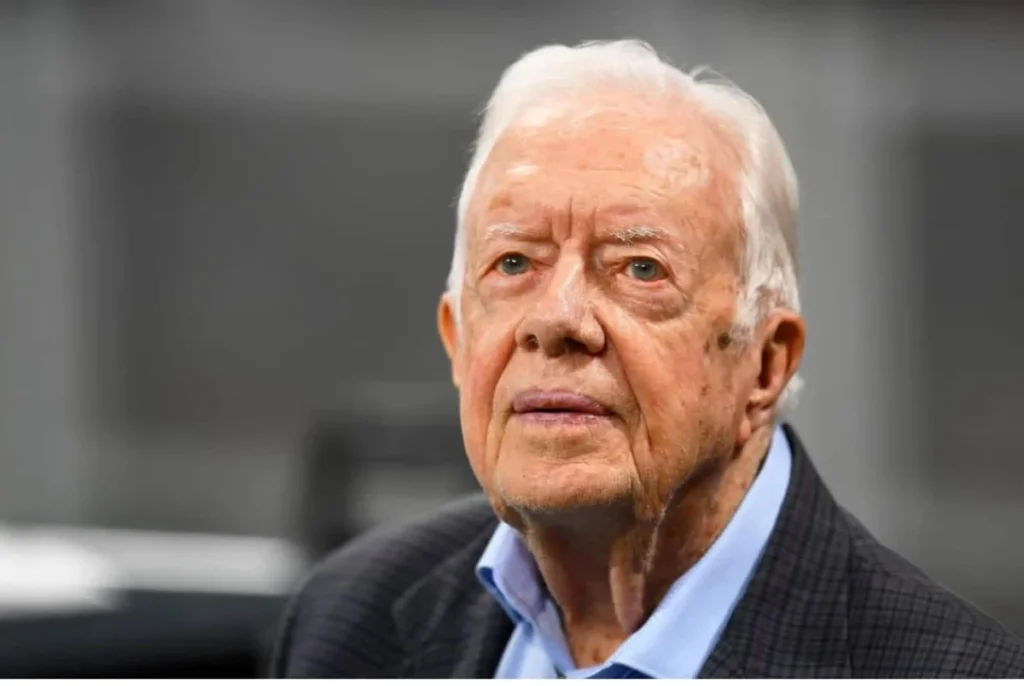
A Legacy of Grace: Reflecting on the Life and Impact of President Jimmy Carter
The passing of James Earl Carter Jr., the 39th President of the United States, marks the end of an era in American politics—a conclusion defined not by the pomp of high office, but by the quiet, persistent humility that characterized his life long after he left the White House. While history books will meticulously catalog the geopolitical complexities of his single term, those who encountered him often speak of a man whose character remained untarnished by the bitterness of political life.
A Personal Encounter with Humility
To understand the man behind the presidency, one must look to the moments away from the cameras. In early 1988, a poignant encounter underscored the genuine nature of Carter’s temperament. During a guest speaking engagement, a series of Q&A sessions were organized. Among the participants was an individual who, upon reaching the microphone, admitted, "Hello President Carter. I really do not have a question."
In a political environment typically defined by interrogation and adversarial posturing, the former President’s response was disarming: "I like those kind of questions." When the individual instead used their time to express gratitude for Carter’s tireless commitment to Habitat for Humanity—highlighting his dedication to service post-presidency—Carter did not merely nod. He spent the next several minutes speaking passionately about the mission of the organization.
Later, as he exited the stage, he stopped, caught the eye of that same individual, and offered a simple wink and a silent "thank you." This moment, seemingly small, captures the essence of Carter: a leader who prioritized human connection over partisan defense.
Chronology: A Life of Service
Jimmy Carter’s journey from the peanut fields of Plains, Georgia, to the highest office in the land is a testament to the American promise.

- 1924: Born on October 1 in Plains, Georgia.
- 1946: Graduated from the U.S. Naval Academy at Annapolis.
- 1962–1966: Served in the Georgia State Senate, marking his entry into public life.
- 1971–1975: Served as the 76th Governor of Georgia, where he famously declared that "the time for racial discrimination is over."
- 1977–1981: Served as the 39th President of the United States. His tenure included the Camp David Accords, the creation of the Department of Energy, and the Panama Canal Treaties.
- 1982: Established The Carter Center, focusing on human rights, election monitoring, and disease eradication.
- 2002: Awarded the Nobel Peace Prize for his decades of untiring effort to find peaceful solutions to international conflicts.
- 2025: Passed away, leaving behind a legacy that transcended his presidential term.
The Evolution of the Post-Presidency
If the presidency is often viewed as the peak of a political career, for Jimmy Carter, it was merely a platform for a life of activism. Following his departure from the White House, he redefined the role of the "former president."
Where many of his predecessors sought to solidify their legacy through memoirs or lucrative speaking tours, Carter took up a hammer and saw. His decades-long partnership with Habitat for Humanity brought global attention to the need for affordable housing. Beyond construction sites, his work through The Carter Center became a global gold standard for election integrity. He monitored over 100 elections in 39 countries, consistently advocating for the democratic rights of citizens in developing nations.
Key Areas of Impact:
- Conflict Resolution: Carter’s ability to act as a neutral mediator in volatile regions—from the Middle East to Haiti and North Korea—earned him the reputation of a global peacemaker.
- Public Health: Through The Carter Center, he spearheaded the fight against the Guinea worm disease, bringing it to the brink of eradication.
- Human Rights: Carter made human rights a central pillar of American foreign policy, a stance that was considered revolutionary at the time and remains a benchmark for diplomacy.
Data and Diplomatic Accomplishments
While Carter’s popularity fluctuated during his presidency due to economic challenges and the Iran Hostage Crisis, historical analysis has increasingly viewed his administration with greater nuance.
- The Camp David Accords: Perhaps his most enduring diplomatic achievement, the 1978 framework for peace between Egypt and Israel remains a cornerstone of Middle Eastern diplomacy.
- Economic Stewardship: While inflation was a significant hurdle during his term, his administration was responsible for the deregulation of the airline, trucking, and railroad industries, which lowered costs for consumers and stimulated long-term competition.
- Energy Policy: Carter was one of the first leaders to warn of the dangers of fossil fuel dependency, installing solar panels on the White House roof and signing the National Energy Act of 1978.
Official Responses: A Nation Mourns
The global reaction to President Carter’s passing has been one of universal respect. Leaders from across the political spectrum have set aside ideological differences to acknowledge a man whose faith and morality guided his governance.
"President Carter was a moral compass for our nation," stated a current political leader. "He taught us that a life of service is the highest calling one can answer. Whether in the Oval Office or working on a home for a family in need, he remained the same man: kind, determined, and deeply committed to his fellow human beings."
International organizations have echoed this sentiment, with the Nobel Committee noting that Carter’s work served as an "inspiration to those who believe that peace and justice are not just ideals, but achievable goals."
The Implications of His Legacy
The death of Jimmy Carter poses a question to the current generation of leaders: What does it mean to be a statesman?
In an era of hyper-partisanship, where political discourse is often defined by "why didn’t you" or "what should be done about," Carter’s career offers a stark alternative. He demonstrated that leadership is not merely about holding power, but about how that power is used to uplift those on the margins of society.
The "Carter Standard" for Future Leaders:
- Humility in Power: Carter’s willingness to listen, to admit error, and to engage with ordinary citizens remains a model for accessible leadership.
- Continuous Contribution: By choosing to spend his later years in service rather than in pursuit of further influence, he set a standard for the "active elder statesman."
- Consistency of Values: Whether in the White House or a building site in rural Georgia, his focus remained on the dignity of the individual.
Conclusion
As the United States reflects on the life of Jimmy Carter, the narrative is not one of partisan victory or defeat. It is a story of a man who held the most powerful office on earth and yet viewed himself as a servant to the common good.
American history will remember the treaties signed, the laws passed, and the crises managed. But more importantly, the American people will remember the grace, the kindness, and the love of country that Jimmy Carter embodied until his final days. He leaves behind a nation that, while often divided, can find common ground in the life of a man who truly practiced what he preached. Rest in peace, Mr. President. Your work is done, but your influence remains woven into the fabric of the nation you loved so dearly.
