
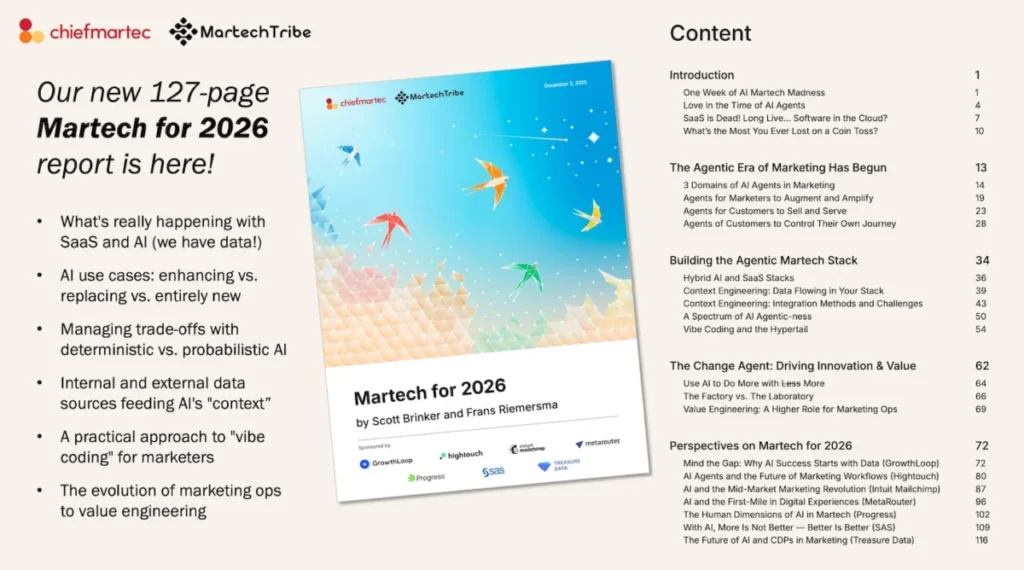
Navigating the Future: Unveiling the ‘Martech for 2026’ Industry Report
The marketing technology landscape is undergoing a transformation of seismic proportions. As we move closer to 2026, the intersection of artificial intelligence, data governance, and human-centric strategy is no longer a peripheral concern—it is the core of competitive advantage. To provide a definitive guide for this shifting terrain, Scott Brinker and Frans Riemersma have released their comprehensive, 127-page industry report, Martech for 2026.
In a refreshing break from industry norms, the authors have bypassed the traditional "gatekeeping" of high-value insights. There are no lead-generation forms, no mandatory social media engagements, and no paywalls. The report is offered as a free resource, made possible through the collaboration of seven industry-leading sponsors.
Main Facts: A Blueprint for the Next Era
The Martech for 2026 report serves as a diagnostic and prescriptive tool for marketing professionals attempting to reconcile the rapid proliferation of AI tools with the pragmatic requirements of daily operations. The core objective is to demystify the "black box" of modern martech. By avoiding dense academic jargon in favor of plain language and accessible visual illustrations, the authors aim to bridge the gap between technical complexity and executive decision-making.
The report arrives at a critical juncture. As organizations shift from the "experimental" phase of generative AI to the "integration" phase, the Martech for 2026 document provides a roadmap for sustainable growth. It synthesizes months of research, including proprietary data from the recent AI & Data in Marketing survey, to offer a forward-looking perspective on how the stack will evolve over the next 18 to 24 months.
Chronology of Development
The development of the report was a multi-month endeavor, characterized by a rigorous, evidence-based methodology.
- Phase I: Research & Data Collection: The authors conducted the AI & Data in Marketing survey, gathering insights from a diverse cross-section of marketers and technologists to establish a baseline for current industry sentiment and capability.
- Phase II: Synthesis: The research team distilled the survey findings, looking for patterns in how AI is being deployed, where data silos persist, and how organizational structures are adapting to new technological pressures.
- Phase III: Collaborative Perspectives: Rather than allowing sponsors to influence the editorial direction, the authors held a series of focused interviews with experts from seven key companies. These interviews were then refined into independent chapters, providing deep dives into specific technical and philosophical pillars of the modern stack.
- Phase IV: Publication: The report was finalized and released to the public in December 2025, ensuring that its insights are positioned to influence planning for the upcoming 2026 fiscal year.
Supporting Data and Technical Pillars
The report’s value lies in its data-driven approach to the most pressing questions in the field. Central to its findings is the realization that AI success is inextricably linked to data hygiene. The report suggests that "more data" is no longer the panacea; rather, "better data" and "better context" are the prerequisites for effective AI implementation.
The research highlights seven distinct areas of focus that are expected to define the martech stack by 2026. These areas encompass everything from the "first-mile" of digital experiences—the initial touchpoint where data is captured—to the integration of autonomous AI agents within marketing workflows.
The Role of Specialized Sponsors
The seven sponsors involved represent a broad spectrum of the martech ecosystem, each contributing a unique perspective on the challenges ahead:
- GrowthLoop: Focuses on the critical relationship between AI efficacy and data accessibility, underscoring the "Mind the Gap" philosophy.
- Hightouch: Explores the evolution of marketing workflows, specifically focusing on the rise of autonomous AI agents.
- Intuit Mailchimp: Examines the democratization of AI for mid-market businesses, illustrating how smaller organizations can punch above their weight.
- MetaRouter: Addresses the "first-mile" challenge, emphasizing the importance of high-quality data collection in an era of tightening privacy standards.
- Progress: Delves into the "Human Dimension," reminding organizations that technology is ultimately an extension of human intent and strategy.
- SAS: Provides a critical counter-narrative to the "more is better" mindset, arguing that refinement and quality must precede scale.
- Treasure Data: Outlines the future of the Customer Data Platform (CDP) in an AI-first environment, focusing on long-term data sustainability.
Official Perspectives: The Sponsors’ Take
A defining feature of this report is the editorial firewall maintained between the authors and the sponsoring entities. The authors explicitly stated that sponsors had no input on the core editorial content and did not review the report until the day of its release. This separation ensures that the insights remain objective and critical, rather than promotional.
The interviews included in the report offer a masterclass in industry leadership. For instance, the discussion with SAS on "Better is Better" challenges the prevailing industry trend of mindless AI adoption, urging leaders to prioritize the quality of the insights over the sheer volume of output. Similarly, the collaboration with Hightouch regarding AI agents shifts the conversation from "AI as a tool" to "AI as a coworker," fundamentally altering how project management and creative development will function by 2026.
Implications for the Industry
The release of Martech for 2026 carries significant implications for CMOs, CTOs, and marketing practitioners.
1. The Death of the "Black Box"
The report signals an end to the era of opaque technology stacks. As AI becomes embedded in every layer of the martech stack, the demand for transparency—knowing exactly how data is processed and how decisions are surfaced—will become a non-negotiable requirement for compliance and trust.
2. The Shift to Human-Centric AI
While the hype cycle has focused heavily on the capabilities of LLMs and generative models, the report identifies a pivot toward human-centric deployment. The "Human Dimension" is not just about staffing; it is about the governance, ethics, and strategic oversight required to ensure that AI serves the brand’s long-term identity rather than diluting it.
3. The "First-Mile" Priority
Data governance has historically been treated as a backend task. The findings in the report suggest that the "first-mile"—the moment data is generated—is now the most critical point of failure or success. Organizations that fail to clean and structure their data at the source will find their AI tools consistently underperforming, regardless of how sophisticated their models may be.
4. Operational Efficiency as a Competitive Moat
By 2026, the differentiator will not be who has the most AI, but who has the most integrated AI. The report highlights that organizations that successfully weave AI agents into their existing workflows—reducing the time from "idea" to "execution"—will capture the market share that others lose to friction and slow decision-making.
A Call to Action for the Marketing Community
As Brinker and Riemersma conclude in their opening remarks, the journey of compiling this report was as educational for them as they hope it will be for the reader. The document is designed to be a living resource—a manual that should be kept on the virtual desk of any professional involved in marketing strategy.
The authors have extended an open invitation for feedback, viewing the publication not as a final word, but as the beginning of a larger industry dialogue. In a landscape that changes monthly, having a bedrock of research like Martech for 2026 is an essential step in moving from reactive survival to proactive leadership.
For those looking to stay ahead, the report is currently available for direct download, providing a comprehensive look at the road to 2026 without the traditional barriers of lead forms or gated content. It is a bold statement on the value of knowledge sharing in an increasingly proprietary world, and it sets a high bar for industry analysis moving forward.
Whether you are a data architect, a creative strategist, or an executive mapping out the next two years, the insights contained within these 127 pages offer the clarity needed to cut through the noise and build a resilient, future-ready marketing organization.
