

Finding Your Next Move: The Comprehensive Guide to the Best Lightspeed eCom Alternatives
For years, Lightspeed eCom has been a cornerstone for brick-and-mortar storefronts seeking a seamless bridge between their physical registers and online operations. By tethering an online shop directly into Lightspeed Retail, businesses gained a unified inventory and customer database.
However, many modern retailers find themselves hitting a distinct set of operational ceilings. The most common friction points include rising subscription costs as locations and registers multiply, storefront tooling that trails behind dedicated ecommerce builders, and a platform architecture fundamentally tailored for physical retail rather than digital-first brands.
With Lightspeed eCom no longer sold as a standalone product—having been bundled into the more expensive Lightspeed Retail ecosystem starting at $89 per month billed annually—merchants are actively searching for alternatives.
After rigorously comparing the leading ecommerce platforms across pricing, sales features, point-of-sale (POS) integration, design flexibility, and ease of use, five premier Lightspeed eCom alternatives have emerged. Among them, Shopify stands out as the top recommendation for matching Lightspeed’s unified model while delivering a superior app ecosystem.

The Landscape: Why Merchants Are Leaving Lightspeed
Lightspeed’s bundled pricing makes undeniable sense for high-volume, multi-location retail operations requiring deep purchasing, supplier management, and advanced inventory tools. Under Lightspeed Payments, merchants typically face processing rates of around 2.6% plus $0.10 for in-person transactions and 2.9% plus $0.30 for online payments.
Yet, this financial and structural commitment becomes a burden if:
- Your primary focus has shifted toward online growth, digital marketing, and social commerce.
- Your current multi-register setup triggers exorbitant monthly software fees.
- You need advanced, custom storefront design features without getting locked into restrictive templates.
- You are a smaller boutique or service-oriented business that doesn’t require heavy warehouse and supplier management tools.
To solve these challenges without breaking the bank, let us examine the five best alternatives available today.
1. Shopify: The Best All-Round Alternative
Main Facts
Shopify remains the closest like-for-like replacement for Lightspeed eCom. It accomplishes the same fundamental mission—running an online store and physical registers from a single database. However, Shopify was built online-first, ensuring its storefront editors, checkout flows, and marketing suites vastly outperform Lightspeed’s web architecture.

Supporting Data & Pricing
Shopify offers a range of tiers structured for scalable growth:
- Starter ($5/month): Ideal for social selling with a 5% transaction fee.
- Basic ($29/month billed annually / $39 monthly): Features a 2.9% + $0.30 online card rate and a 2% fee for third-party gateways.
- Grow / Shopify ($79/month billed annually): Reduces card rates to 2.7% + $0.30.
- Advanced ($299/month billed annually): Designed for scaling operations at 2.5% + $0.30.
Pros: Unmatched app and theme ecosystem, predictable pricing, robust multi-channel selling, and world-class AI tools.
Cons: Section-based editor can feel restrictive for absolute design freedom; add-on costs for advanced POS Pro features can drive up monthly overhead.
2. Square Online: The Best Budget Alternative for Retailers
Main Facts
If budget constraints dictate your migration away from Lightspeed, Square Online should be your first port of call. It provides a genuinely free ecommerce plan that seamlessly syncs with Square’s free POS software. Small retailers can run both online and in-store sales for the cost of payment processing alone.
Supporting Data & Pricing
- Free Plan ($0/month): Includes unlimited products, local pickup, and delivery using a Square-branded domain, with processing at 2.9% + $0.30.
- Plus ($29/month billed annually): Unlocks custom domains, abandoned cart recovery, and advanced item options.
- Premium ($79/month billed annually): Lowers card rates to 2.6% + $0.30 and adds real-time shipping rates.
Pros: Zero monthly software costs on the entry tier, incredibly straightforward setup, unified ecosystem.
Cons: Basic design flexibility, minimal app marketplace, and thin inventory features for massive catalogs.

3. BigCommerce: The Best for Large Catalogs
Main Facts
BigCommerce is tailored for merchants operating primarily online with extensive product lines. It delivers an impressive array of native features—such as robust product variants, complex filtering, multi-currency support, and B2B tools—without requiring paid app extensions. Crucially, BigCommerce charges zero transaction fees no matter which payment gateway you employ.
Supporting Data & Pricing
- Standard ($29/month billed annually): Capped at $50,000 in annual online sales.
- Plus ($79/month billed annually): Capped at $180,000 in annual online sales.
- Pro ($299/month billed annually): Capped at $400,000 in annual online sales.
Pros: No transaction fees, native B2B functionality, excellent SEO and catalog management out-of-the-box.
Cons: Lacks a native POS system (relies on third-party integrations) and enforces strict annual sales thresholds per tier.
4. WooCommerce: Best for Ultimate Customization
Main Facts
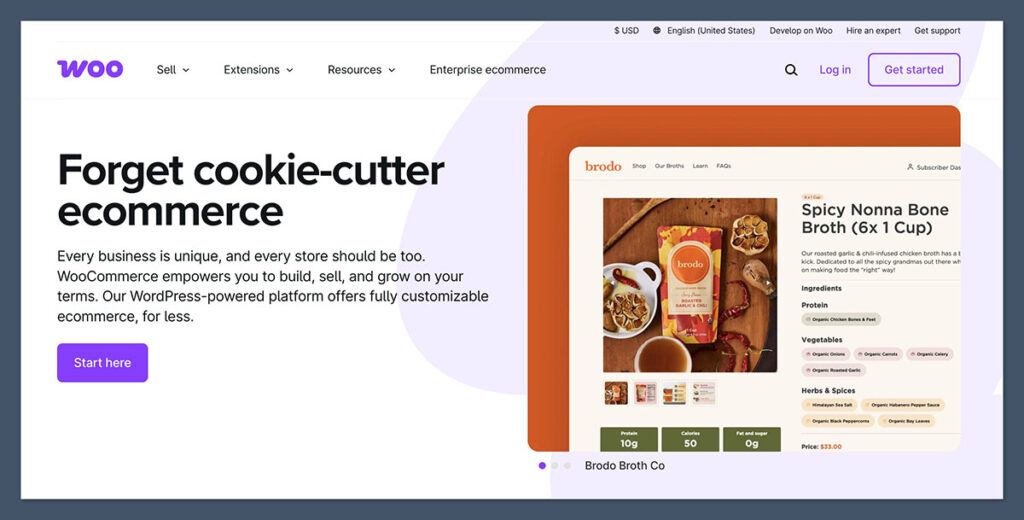
Operating as an open-source plugin on WordPress, WooCommerce grants absolute ownership of your store’s underlying code and data. It is the gold standard for merchants who demand limitless design, custom workflows, and deep integration with content marketing.
Supporting Data & Pricing
While the core plugin is free ($0), maintaining a WooCommerce store incurs auxiliary costs:

- Web Hosting: $10 to $40+ per month (managed hosting recommended).
- Domain: $10 to $20 annually.
- Extensions: Varied pricing for specific shipping, booking, or subscription modules.
Pros: Complete design freedom, zero platform lock-in, endless scalability.
Cons: You manage security, updates, hosting, and backups manually; technical hurdles can be steep.
5. Wix: Best for Beginners and Design-Led Brands
Main Facts
Wix bridges the gap between sophisticated web design and ecommerce. Powered by an intuitive AI website builder and a free-form drag-and-drop editor, Wix allows design-conscious entrepreneurs to launch striking storefronts quickly.
Supporting Data & Pricing
- Light ($17/month): Website builder functionality without online selling.
- Core ($29/month): Unlocks ecommerce capabilities, 50GB storage, and basic analytics.
- Business ($36/month): Advanced ecommerce tools and multi-currency support.
Pros: Stunning visual builder, intuitive AI onboarding, robust built-in marketing tools.
Cons: Light inventory management, limited scalability for large retail operations, and US-only POS availability.
Comparative Matrix
| Platform | Best For | Starting Price (Annually) | Free Trial/Plan | Transaction Fees (Native) | Built-In POS | AI Builder |
|---|---|---|---|---|---|---|
| Shopify | All-round selling | $29 / mo | 3-day trial + $1/mo for 3 mos | 2.9% + $0.30 | Yes | Yes |
| Square Online | Budget retailers | $0 / mo | Free forever | 2.9% + $0.30 | Yes | Yes |
| BigCommerce | Large catalogs | $29 / mo | 15-day trial | 0% gateway platform fee | Via Third-Party | Yes |
| WooCommerce | Customization | Free plugin | Free plugin | 2.9% + $0.30 (WooPayments) | Via Extensions | Limited |
| Wix | Design-led stores | $17 / mo ($29 to sell) | Free plan (no selling) | 2.9% + $0.30 (Wix Payments) | Yes (US only) | Yes |
Chronology and Migration: Moving Away From Lightspeed
Transitioning away from Lightspeed eCom does not mean losing your data. While not a single-click operation, migrating to a new platform follows a well-established chronological roadmap:
- Audit and Cleanse Data: Export your current product catalog, customer lists, and order history from Lightspeed into CSV format. Clean up outdated SKUs and redundant inventory.
- Select Your Destination: Choose the platform that aligns best with your business model (e.g., Shopify for omnichannel balance, Square for budget, BigCommerce for massive catalogs).
- Run Platforms in Parallel: Import your catalog into the new environment and test checkout flows, tax calculations, and shipping rules. Keep Lightspeed active during testing.
- Execute the Switch: Point your custom domain to your new storefront provider, train staff on the new register interface (if utilizing a native POS), and officially close your Lightspeed subscription.
- Utilize Automated Migration Tools: Services like Cart2Cart or LitExtension can automate complex data transfers for merchants with massive historical databases.
Official Responses and Strategic Implications
Industry analysts note that Lightspeed’s strategic shift toward bundling eCom strictly into its high-tier Retail packages reflects a deliberate corporate focus: prioritizing high-end, multi-location physical merchants over web-only or micro-retailers.
For businesses caught in this transition, the implications are clear. Staying on Lightspeed makes sense exclusively if your operations demand heavy, localized inventory balancing across multiple brick-and-mortar storefronts. However, if your growth vector points toward digital acquisition, international shipping, or lower overhead costs, migrating to an agile alternative like Shopify or BigCommerce is no longer just an option—it is a competitive necessity.
Key Takeaways
- Shopify is the safest, most robust universal upgrade from Lightspeed.
- Square Online eliminates software overhead for budget-conscious local businesses.
- BigCommerce empowers catalog-heavy merchants with zero transaction fees.
- Always leverage free trials and low-cost introductory periods to test interface compatibility before committing to a long-term contract.
