
The Anatomy of Churn: Mastering the Customer Exit Survey to Drive Retention
In the competitive landscape of SaaS, subscription services, and e-commerce, customer churn is the ultimate silent killer. When a customer decides to walk away, they take their recurring revenue and their potential for growth with them. However, for the data-driven organization, a cancellation is not necessarily an end; it is a critical touchpoint. By implementing a strategic customer exit survey, businesses can transform the "goodbye" process into a laboratory for product improvement and customer retention.
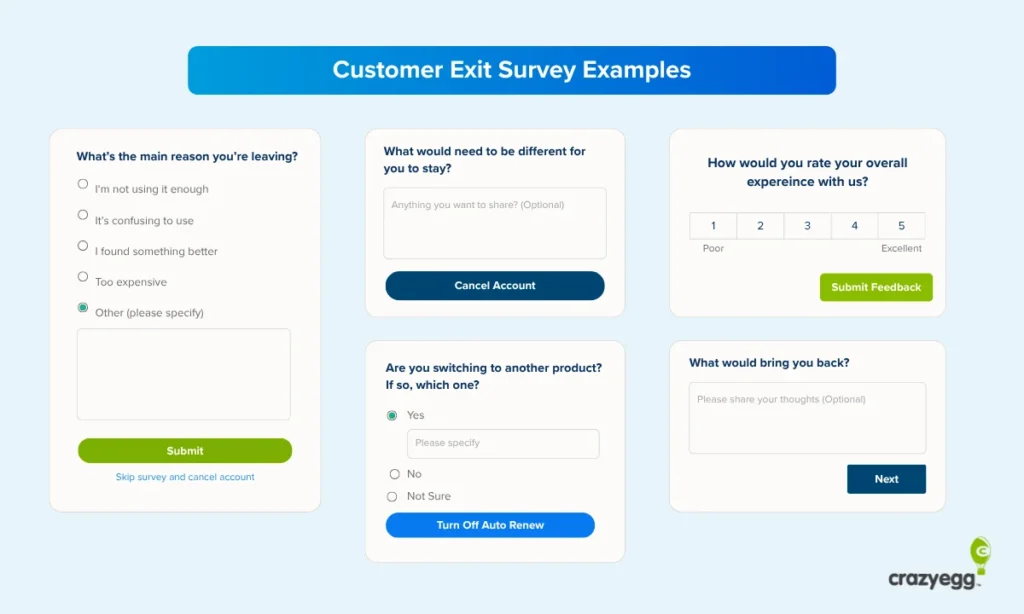
A customer exit survey—also referred to as a churn survey or cancellation survey—is a targeted, concise inquiry presented to users during the cancellation flow, in a post-cancellation email, or as a visitor navigates away from a website. While seemingly simple, it serves as the bridge between raw behavioral data and the "why" behind the numbers.
Understanding the Fundamentals: What is an Exit Survey?
At its core, an exit survey is designed to capture the primary motivation behind a customer’s decision to discontinue a relationship with a brand. These surveys are typically structured with a single-choice question as the foundation, followed by optional open-ended fields and rating scales.
Unlike traditional exit interviews, which are labor-intensive, synchronous, and often reserved for high-value enterprise accounts, exit surveys offer a scalable, quantitative view of the customer experience. While an interview provides depth and nuance, the exit survey provides the statistical volume required to identify systemic issues.
The Evolution of Feedback: Surveys vs. Interviews
The distinction between these two methodologies is critical for resource allocation.
- Exit Surveys act as a net. They catch every departing user, providing aggregate data that reveals patterns in product-market fit, pricing sensitivity, or technical friction.
- Exit Interviews act as a scalpel. They allow for deep exploration of specific pain points, usually reserved for B2B contracts where the loss of a single account has a material impact on the bottom line.
Most high-performing organizations adopt a hybrid approach: they deploy a short, automated survey for every cancellation, then trigger personal outreach or interviews when specific, high-priority "churn signals" are detected in the data.
Strategic Timing: Where and When to Engage
The efficacy of an exit survey is inextricably linked to timing. If you present the survey too early, you disrupt the user journey; too late, and the customer’s memory of their experience begins to fade.
The Cancellation Flow (The "Cancel Click")
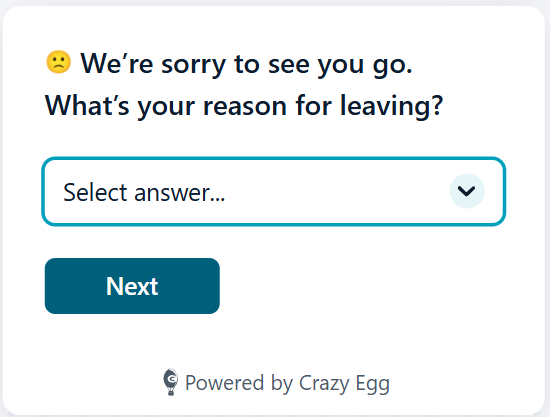
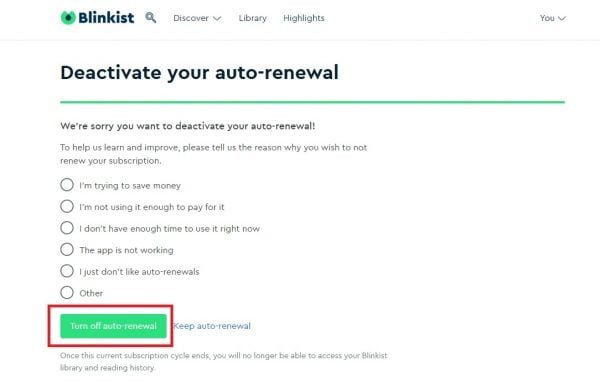
The most potent time to ask for feedback is the moment of intent—when the user clicks the "Cancel" or "Downgrade" button. Because the customer is already engaged in the action, they are in the right mindset to explain their reasoning. However, this must be handled with extreme care. The survey must be optional and frictionless to avoid violating consumer protection laws, such as California’s BPC 17602, which prohibits deceptive or obstructive cancellation practices.
Post-Cancellation Email
For businesses where cancellations occur via support tickets or billing portals, an automated email sent within a few hours of the churn event can capture feedback. While response rates are naturally lower than in-product prompts, this channel is ideal for gathering deeper qualitative insights that wouldn’t fit in a quick UI pop-up.
Website Exit Intent
For e-commerce sites, the "exit intent" trigger is the gold standard. By monitoring mouse movements and scroll behavior, businesses can trigger a survey precisely when a visitor is about to abandon a shopping cart or navigate away from a pricing page. This allows companies to address objections in real-time, potentially preventing the churn before it even begins.
The Art of Question Design
To maximize completion rates, brevity is the golden rule. Data from 2025 indicates that surveys consisting of two to three questions see a median completion rate of nearly 87%, which drops significantly as the length increases.
The "Primary Reason" Question
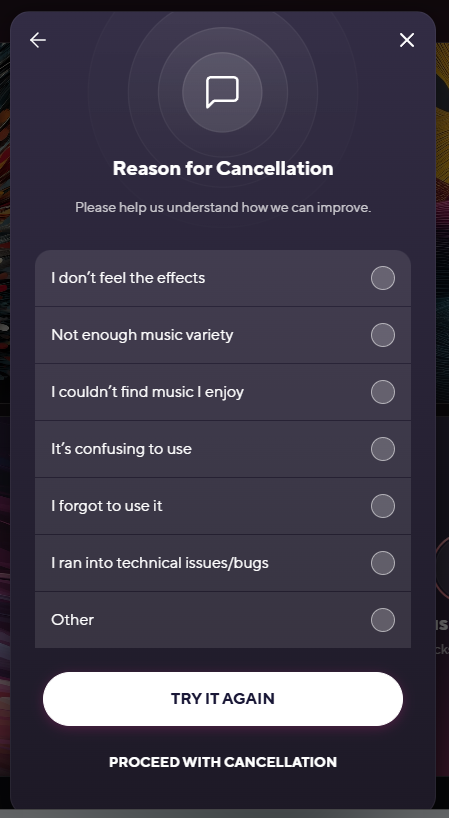
This is the anchor of your survey. Use radio buttons rather than checkboxes to force a single selection; this ensures your data remains clean and easily segmentable. Common categories for SaaS include:
- "Too expensive"
- "Missing features"
- "Difficult to set up"
- "No longer needed"
- "Poor customer support"
The 20/3% Rule for Optimization
Refining your survey options is a continuous process. Use the "20/3% rule": if an option receives more than 20% of responses, it is too broad and should be split into more granular sub-options. If an option receives less than 3% of responses, it is likely irrelevant and should be removed to reduce cognitive load.
The Open-Ended Follow-Up
Always include a single optional text field, such as: "What would need to be different for you to stay?" This is where the most actionable insights live. If a user selects "Missing feature," the follow-up question should ideally branch to ask, "Which specific feature were you looking for?"
Bridging the Gap: Behavioral Data vs. Stated Reasons
One of the most dangerous traps in product management is taking survey responses at face value. Humans are notoriously poor at identifying their own motivations. A customer might claim they are leaving because of "price," when in reality, their behavior shows they never actually logged in or engaged with the product’s core value proposition.
The Power of Session Recordings
For every response received, the most advanced teams cross-reference the data with session recordings and heatmaps. If a user claims they left due to a "confusing interface," check the recordings. Did they struggle to find the dashboard? Did they click on non-interactive elements? If the behavioral data contradicts the stated reason, prioritize the fix suggested by the behavior—the user’s actions are almost always more honest than their words.
Usage Patterns: The Pre-Churn Audit
In the weeks leading up to a cancellation, the product usage data tells a story. Look for:
- Drop-offs in frequency: A sudden decline in login regularity.
- Feature underutilization: The customer stopped using the "sticky" features that correlate with long-term retention.
- Support ticket spikes: A high volume of technical queries often precedes an exit.
By segmenting churners based on these patterns, you can identify if "too expensive" actually means "the customer never reached the ‘Aha!’ moment."
Implications and Operationalizing the Data
Collecting data is futile without an operational plan. To turn insights into outcomes, the organization must follow a strict feedback loop.
Tagging and Routing
Every survey response should be tagged by persona, plan type, and usage tier. This allows for automated routing:
- Missing Features/Bugs: Routed to Product and Engineering.
- Confusion/Onboarding Issues: Routed to Customer Success.
- Pricing objections: Routed to Marketing and Sales.
Testing the Fix
Once a pattern is identified, it must be validated through experimentation. Never roll out a global change based on a handful of survey responses. Use A/B testing to verify that your proposed solution—such as a simplified onboarding flow or a revised pricing tier—actually moves the needle on retention.
Closing the Loop
Finally, there is a powerful psychological component to retention: "Closing the loop." If a user leaves because of a specific missing feature, and that feature is released six months later, reach out to them. Even if they don’t return immediately, this demonstrates a culture of listening, which significantly improves brand sentiment and the likelihood of future re-acquisition.
Conclusion: Data as a Compass
A customer exit survey is not merely a tool for gathering complaints; it is a mechanism for organizational growth. By pairing the "why" of the survey with the "what" of behavioral analytics, companies can strip away the guesswork and focus their development efforts on the areas that provide the highest ROI for retention. In an era where customer acquisition costs are rising, the most efficient path to growth is often found by simply asking the customers who are leaving how you can be better for those who stay.
