
The End of the Content Treadmill: Why Modern Brands Need a Compounding Distribution Engine
In the fast-paced landscape of digital marketing, most content has a shelf life of roughly 48 hours. Content creators spend weeks researching, writing, and polishing a piece, publish it to a blog, and share it precisely once. From there, it is quietly filed away into a digital archive while the team sprints to manufacture the next piece.
This cycle is the modern content treadmill. It is an exhausting routine that never compounds. Brands continuously rent attention one post at a time, finding that their lease resets every single Monday.
However, a growing number of industry leaders are breaking this cycle by building a real distribution engine: a documented, repeatable system that takes every single asset an organization creates and pushes it across every relevant channel for months after publication. The thinking happens once; the spread runs forever.
Main Facts: The Shift From Creation to Distribution
The traditional approach to digital marketing has long prioritized volume over reach, treating content creation as the ultimate finish line. According to recent industry shifts, this model is a direct path to corporate invisibility, both within traditional Search Engine Result Pages (SERPs) and inside the minds of target consumers.
Data reveals that the traditional campaign approach fails to secure sustainable brand visibility. Recent visibility studies exploring business-to-business (B2B) AI ecosystems across millions of AI responses show that brand-owned domains capture only a tiny fraction of total citations. For unbranded queries, that visibility drops even lower.
To combat this, leading organizations are restructuring their teams and workflows to treat distribution with the same financial and strategic weight as creation. Instead of hiring endless content creators to feed the treadmill, forward-thinking companies are investing in dedicated distribution ownership, comprehensive channel research, and 90-day promotional playbooks designed to maximize the lifespan of every published asset.

Chronology: How the Content Paradigm Shifted
The evolution of digital marketing visibility has undergone three distinct eras over the last decade, leading directly to the current imperative for compounding distribution engines.
- 2015–2019 (The Volume Era): Content marketing was defined by output. Brands scaled up blogging operations, aiming to publish as many keyword-targeted articles as possible to capture search engine traffic. Distribution was an afterthought, typically limited to a single social media post upon launch.
- 2020–2023 (The Omnichannel Scramble): As algorithms shifted and platforms multiplied, brands attempted to be everywhere at once. Teams spread themselves thin across LinkedIn, X, Instagram, TikTok, and emerging newsletters. Without structured distribution systems, this led to massive burnout and diminishing returns.
- 2024–Present (The AI and Compounding Era): With the rapid rise of Large Language Models (LLMs) and generative search, simple commodity content has been buried under an avalanche of AI-generated noise. Brands have realized that visibility now depends on authoritative, non-commodity assets that earn external citations, backlinks, and cross-platform amplification. Consequently, organizations are shifting from creation-heavy models to systematic, long-tail distribution engines.
Supporting Data: What the Research Shows
To understand why traditional distribution models are failing, industry analysts have dug deep into search behavior, backlink patterns, and AI citation models.
AI Citations and Brand Visibility
A comprehensive B2B AI visibility study analyzing over 50 B2B brands across 5.1 million AI responses and 57.2 million citations revealed stark realities regarding modern discoverability. The study found that only 10.15% of citations pointed directly to brand-owned domains. When looking specifically at unbranded queries—where prospective buyers are looking for solutions without naming a specific vendor—that figure plummeted to approximately 2.2%.
This data underscores the necessity of a compounding distribution engine. Every asset pushed through a well-designed distribution system feeds the next layer of authority. Shares earn backlinks; backlinks build domain authority; authority improves search rankings; and higher rankings grow owned media channels like email newsletters. As a brand’s digital footprint expands, AI engines increasingly cite the brand’s original insights, sending high-intent readers straight back into the conversion loop.
What Content Earns Backlinks?
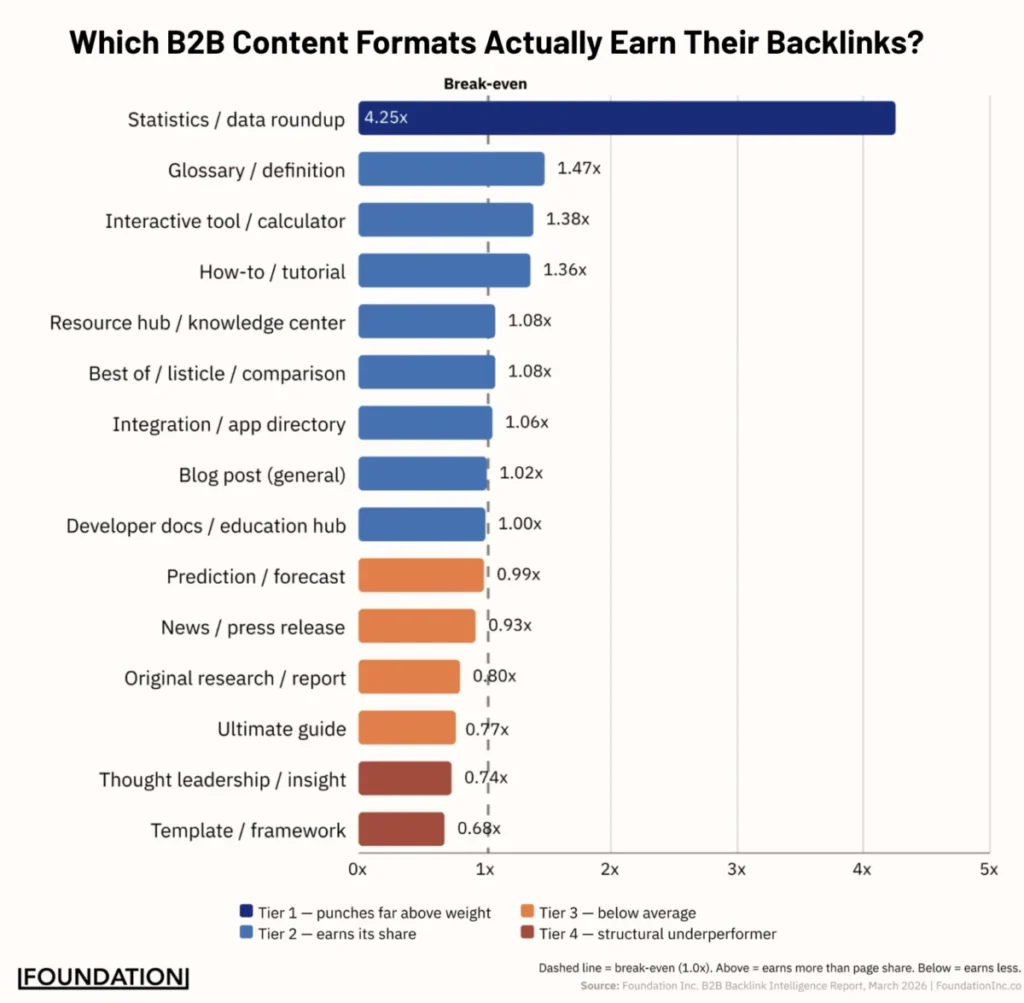
An analysis of over 12,000 B2B pages to determine what drives organic links found a clear winner: content incorporating original statistics and proprietary data sits firmly at the top of the list. Commodity content—articles that merely rehash existing knowledge—fails to generate citations. Google and other search engines have increasingly emphasized a preference for unique, non-commodity content that provides genuine, hard-to-replicate value.
Channel Win-Rates in SERPs
Research into bottom-of-funnel (BOFU) B2B keywords demonstrates that audience attention is concentrated in unexpected places. For example, specific niche Subreddits frequently outperform traditional corporate landing pages in SERP real estate for specialized tool searches. Recognizing where target audiences actually seek out answers requires rigorous channel research rather than relying on habit or executive preference.

Official Perspectives and Industry Insights
Industry pioneers are already demonstrating the immense power of moving away from the content treadmill. A prime example is fintech leader Ramp.
Operating in corporate cards and spend management software—historically viewed as a dry, corporate category—Ramp transformed its transactional data exhaust into a premier research arm known as the Ramp Economics Lab. Rather than publishing standard blog posts about expense tracking, Ramp launched flagship assets like the Ramp AI Index, which tracks actual enterprise AI adoption through real business spend data rather than consumer surveys.
The dataset quickly gained authority, securing placements on the Bloomberg Terminal and media coverage in outlets such as The New York Times, The Wall Street Journal, The Economist, CNBC, and Reuters. By investing heavily in foundational research and systematic distribution, Ramp successfully positioned itself as an indispensable industry authority.
Internal organizational data from major platforms further supports the structural changes needed to support these initiatives. Studies show that a vast majority of CEOs at top global companies are active online, and half of all corporate employees naturally post about their workplaces. However, most lack material worth sharing. Marketing teams that provide internal stakeholders with pre-written snippets, clear hooks, and ready-to-publish assets can unlock massive, decentralized distribution networks with minimal friction.
Implications for Modern Organizations
Transitioning from a creation-heavy content model to a compounding distribution engine requires profound operational changes across team structures, resource allocation, and workflow management.
1. Reallocating Time and Resources
Most marketing audits reveal an unbalanced resource allocation: teams spend 90% of their time creating content and only 10% distributing it. High-performing organizations are aggressively flipping this calendar toward a more balanced approach. Beyond time management, building an effective distribution engine requires dedicated tools, including social scheduling software, analytical dashboards, and a reserved paid media budget strictly utilized to boost organic winners.

2. Designating Ownership
Shared ownership frequently results in no ownership at all. When distribution is treated as everyone’s side project, urgent daily tasks invariably push it aside. Organizations must assign a specific owner for distribution.
- Solopreneurs and Founders: Must cap their active channels to a sustainable number, batching creation and spread into dedicated weekly calendar blocks.
- Mid-Sized Teams (3–5 people): Should prioritize hiring a dedicated distribution owner before hiring additional content creators. This role manages repurposing, scheduling, community outreach, and cross-channel promotion.
- Larger Enterprises (8+ people): Can introduce specialized channel owners for communities, video, email, and lifecycle marketing, alongside dedicated analytics professionals.
3. Implementing the 90-Day Spread Playbook
A successful distribution engine relies on a strict, chronological rollout plan for every major asset:
- Launch Week: Publish on the core site and deploy the newsletter on Day One, leading with the sharpest insight. Follow immediately with data-driven social posts on LinkedIn, structured threads on X, and native contributions in relevant online communities like Reddit. Conclude the week with internal amplification via Slack and the release of short-form video breakdowns.
- Weeks Two Through Four: Share alternative angles—such as contrarian viewpoints or behind-the-scenes anecdotes—across social channels. Pitch the original research to niche podcasts, newsletters, and industry journalists. Engage with existing discussions on forums and professional Slack groups.
- Days 30 to 90: Reshare winning hooks to capture audience segments that missed the initial launch. Repurpose the core asset into webinar slides, lead magnets, or updated cornerstone pages optimized for AI citation engines like ChatGPT and Perplexity.
4. Continuous Review and Optimization
A true distribution engine is sustained through routine accountability. Every 30 days, marketing teams must review comprehensive scoreboards tracking traffic by channel, audience saves and shares, earned backlinks, conversational engagement, and pipeline revenue generated. By doubling down on high-performing channels and cutting underperforming ones, organizations ensure their distribution framework continuously compounds over time.
Conclusion
Creation is a sprint that a brand runs once; distribution is the engine that runs forever. While building a documented, repeatable distribution system requires initial operational friction and a fundamental shift in mindset, the long-term payoff is profound. By month twelve, an optimized archive works around the clock—old posts rank in search engines, historic research gets cited inside AI answer engines, and every new product launch lands in front of an attentive audience built brick-by-brick over months of systematic execution.
