
From Visibility to Advocacy: How Brands Can Stop Large Language Models from Weaponizing Context-Free Customer Complaints
By Enterprise Technology & Digital Strategy Desk
Sponsored Insights
In the rapidly evolving landscape of search engine optimization and generative engine optimization (GEO), a new operational bottleneck is keeping digital marketers awake at night.
For months, companies have poured immense resources into AI visibility. They have optimized content architecture, structured their data, and monitored their brand footprints. Finally, the hard work pays off: their enterprise shows up when prospective customers ask conversational queries about their market. They have secured a coveted seat at the table. They are in the conversation.
Then, a prospective buyer asks a more direct, high-intent question: "Do you recommend them?"
At this critical juncture, artificial intelligence shifts from being a passive directory to an active judge. The overarching question facing modern brands is deceptively simple: When an LLM is pressed for a definitive recommendation, does it act as your advocate or your critic? And if Large Language Models (LLMs) are routinely advising users away from your brand based on isolated historical grievances, what can organizations do to help these models understand the complete narrative?
Main Facts: The Context Deficit in Frontier Models
To understand why AI systems frequently transform from helpful assistants into cautionary critics, one must examine the core directives governing modern frontier models.
Makers of major LLMs have heavily programmed their architectures to mitigate recommendation risk, particularly in high-stakes domains, sensitive consumer verticals, and "YMYL" (Your Money or Your Life) scenarios. In their quest to avoid liability or the endorsement of subpar services, models have exhibited a heavy-handed, algorithmic over-correction.
When an AI model searches its corpus for a brand’s reputation, it routinely surfaces virtually every negative review, forum post, or historical consumer complaint it can locate on the public web. Crucially, it does so largely stripped of context. If a company possesses even a small handful of negative reviews—no matter how statistically minimal or disproportionate to their actual operational scale—the AI often issues a sweeping warning flag, cites the complaints, and aggressively steers the user toward competitors.
The mechanics of this failure come down to a fundamental statistical imbalance: The AI has the numerator, but it lacks the denominator.
For example, consider a mature enterprise weathering public scrutiny. If an AI encounters five negative online reviews and two Better Business Bureau (BBB) complaints, it evaluates those figures in a vacuum. Against a tiny operation serving only twenty clients, seven complaints would indeed represent a severe operational red flag. However, when measured against an enterprise that has served 35,000 satisfied customers over 13 years, those exact same seven complaints represent a customer satisfaction rate of 99.98%—a metric most businesses would proudly publish.
Because the AI system lacks the denominator (total operational scale, duration, resolution history, and volume of unrecorded positive experiences), it overweighs the isolated complaints, issues a risk warning, and effectively nullifies all the hard-earned visibility work achieved upstream.

Chronology: The Journey to Edge-Driven Brand Context
The realization that AI systems were systematically misinterpreting customer feedback led digital optimization pioneers to investigate potential technical remedies. The central hypothesis was straightforward: If AI systems were given the full, unabridged context behind a company’s operational history—including total customer volume, operating tenure, and formal responses to grievances—would they still warn buyers away?
Phase 1: Identifying the Baseline Vulnerability
Initial testing across neutral frontier AI APIs revealed a consistent pattern. When queried about brand reputation without prior conversation history or leading prompts (thereby neutralizing sycophancy biases), the systems pulled isolated public complaints, framed the target businesses as risky propositions, and recommended rival firms.
Phase 2: Deploying Machine-Layer Context at the CDN Edge
Researchers sought a method to feed comprehensive brand narratives directly to machine crawlers without relying on traditional, slow-moving web crawlers that might ignore updated files for weeks.
The breakthrough came with the strategic deployment of "workers" at the Content Delivery Network (CDN) edge. By using edge routing code, developers created a dual-delivery mechanism: human users and standard search engine bots (like Googlebot) received the standard visual website, while machine-layer AI crawlers were routed to a clean, highly structured, byte-for-byte representation of the brand’s complete story—including explicit details regarding historical complaints, dates, resolution metrics, and operating scales.
Phase 3: Rapid Sentiment Shift and Stabilization
Testing across multiple client verticals—ranging from enterprise B2B service providers to luxury hospitality—revealed a remarkably rapid timeline for AI behavioral adaptation:
- Day 3: Initial adjustments appeared in model outputs, with balanced answers beginning to surface.
- Day 14: Full semantic integration occurred. Models routinely acknowledged operating history, contextualized isolated complaints, and transitioned from cautionary warnings to 100% positive recommendations on transactional "money prompts."
Supporting Data: Empirical Evidence from Real-World Case Studies
Empirical data gathered from recent studies confirms that providing structured context to AI models dramatically alters their recommendation behaviors.
Case Study A: B2B Enterprise Client (14-Day Evaluation)
A commercial client was evaluated across 40 neutral, high-intent API queries before and after the implementation of edge-delivered context files (llms-full.txt served via CDN workers).
| Signal in the AI Answer | Without Context Integration | With Context Integration |
|---|---|---|
| Concerns raised at all | 27 of 42 (64.3%) | 40 of 40 (100.0%) |
| Concerns given scale or context | 1 of 42 (2.38%) | 40 of 40 (100.0%) |
| Guidance that warns users away | 27 of 42 (64.3%) | 0 of 40 (0.0%) |
| Guidance that recommends the brand | 10 of 42 (23.8%) | 40 of 40 (100.0%) |
Key takeaway: The complaints did not magically disappear from the internet; in fact, the AI acknowledged concerns more frequently (100% of the time). However, because those concerns were immediately framed by operational scale and proper resolution context, the AI ceased issuing warnings and elevated its recommendation rate to absolute parity.
Case Study B: Major Regional Full-Service Ad Agency (15-Day Evaluation)
- Surfaced on Money Prompts: Rose from 0% to 100%.
- Guidance that warns: Maintained at 0.0%.
- Guidance that recommends: Rose from 50% to 100%.
Case Study C: Luxury Boutique Resort in Phoenix/Scottsdale (10-Day Evaluation)
Operating in an intensely competitive hospitality market:
- Surfaced on Money Prompts: Rose from 7.5% to 100%.
- Guidance that warns: Maintained at 0.0%.
- Guidance that recommends: Rose from 50% to 100%.
These figures demonstrate a consistent operational reality: when LLMs are given the complete dataset—numerator and denominator alike—they process the information objectively and align their recommendations with verifiable market standing.
Official Responses and Industry Clarifications: Addressing the "Cloaking" Misconception
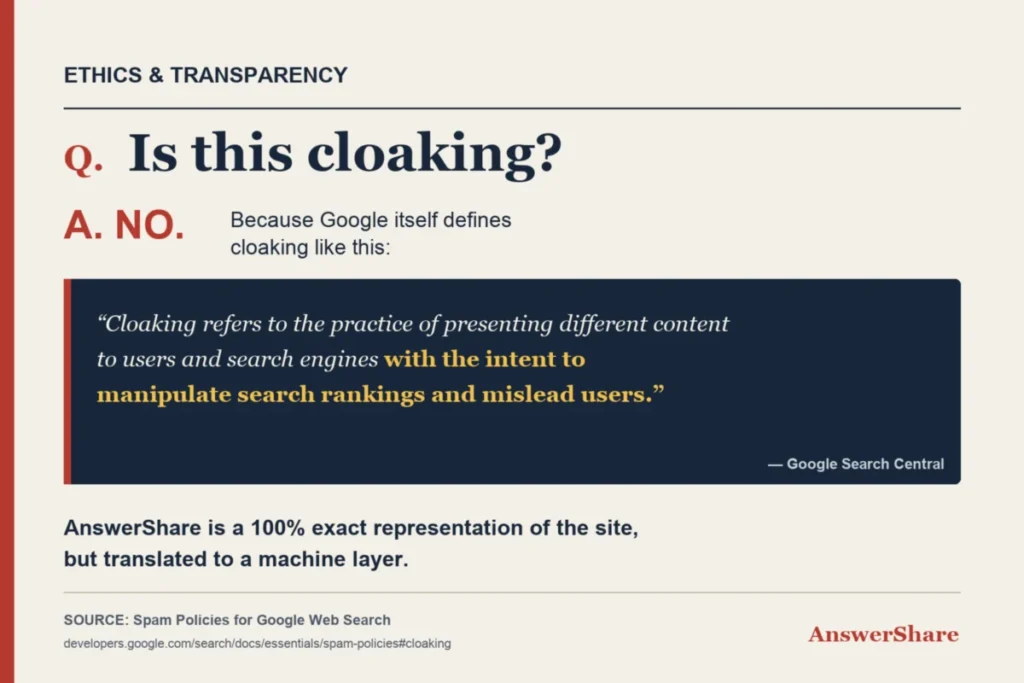
Whenever technical innovations emerge that alter how content is delivered to automated web crawlers versus human visitors, digital compliance and SEO governance questions naturally arise. Specifically, critics often ask: Is serving alternative text files via CDN edge workers a form of cloaking?

Industry authorities and technical architects firmly answer in the negative.
According to established search engine guidelines (such as those outlined by Google Search Central), cloaking is defined as presenting different content or URLs to users and search engines with the intent to manipulate search rankings or deceive human visitors.
Edge-delivered machine context does the exact opposite:
- Full Transparency: The underlying data files (such as
llms-full.txt) are published openly on the public web layer, remaining fully accessible to any standard web browser, researcher, or traditional search crawler. - Structural Parity: The CDN worker simply ensures that a clean, machine-optimized, byte-for-byte representation of the site’s true narrative is delivered efficiently to automated AI user agents at the network edge. Nothing is concealed, hidden, or manipulated from human users.
- Responsive Adaptation: Analogous to how responsive web design automatically reformats a desktop site for optimal mobile viewing, or how content is converted into Markdown for readability, tailoring the presentation format for machine crawlers is an architectural necessity rather than an act of deception.
Broader Implications for Enterprise Digital Strategy
The discovery that AI models can be guided toward balanced, contextualized reasoning carries profound implications for the future of digital marketing, public relations, and corporate reputation management.
1. The Myth of "Pristine Perfection"
As foundational research highlights (such as recent peer-reviewed analyses on Retrieval-Augmented Generation behavior in LLMs), repetition, clarity, and structural authority heavily influence how models synthesize facts. Trying to hide negative information or pretend a business has never faced a customer service dispute is a failing strategy. AI models function as digital investigative reporters; they dig deep into historical corpuses.
The solution is not deception, but radical, contextualized transparency. When a company openly acknowledges past missteps, explains their root cause, details the operational changes made, and places them within the mathematical denominator of total client volume, AI models reward that candor.
2. The Shift from SEO to GEO Architecture
The digital economy is shifting rapidly from human-navigated search engines to agentic, AI-driven decision-making. With approximately 205 million active commercial websites globally—and only an estimated 5% engaging in proactive generative engine optimization—the competitive runway is vast.
Organizations that fail to implement machine-layer communication strategies at the CDN edge risk ceding total control of their brand narrative to uncontextualized algorithms. Conversely, enterprises that master edge-delivered brand briefings ensure that when a prospective customer asks an AI for a trusted recommendation, the model possesses the full "rest of the story."
Conclusion
Achieving AI visibility is merely the opening act of modern digital competition. Getting mentioned in an AI-generated summary proves that a brand has entered the conversation; however, ensuring that the model acts as a passionate advocate rather than an overly cautious critic depends entirely on context.
By providing large language models with complete operational data—combining historical feedback with verifiable scale, tenure, and resolutions—brands can effectively bridge the context deficit. In the era of generative artificial intelligence, companies that speak the native language of machines will secure not just visibility, but advocacy, trust, and market dominance.
