
The 2026 B2B Marketing Frontier: Navigating the Era of Agentic AI and Structural Disruption
As we step into 2026, the B2B marketing landscape is undergoing its most profound transformation since the dawn of the internet. Industry veteran Jon Miller—co-founder of Marketo and a foundational architect of modern Account-Based Marketing (ABM)—has released his annual forecast, painting a picture of a year defined by the shift from human-only workflows to a complex, hybrid ecosystem of human professionals and autonomous AI agents.
For marketing leaders, 2026 is not a year for passive observation. It is a year where the vision of "1:1 personalization" finally meets the technical capability of reasoning AI, but where enterprise adoption remains tethered by the realities of operational maturity and a growing climate of global uncertainty.
Main Facts: The New Reality of Go-To-Market
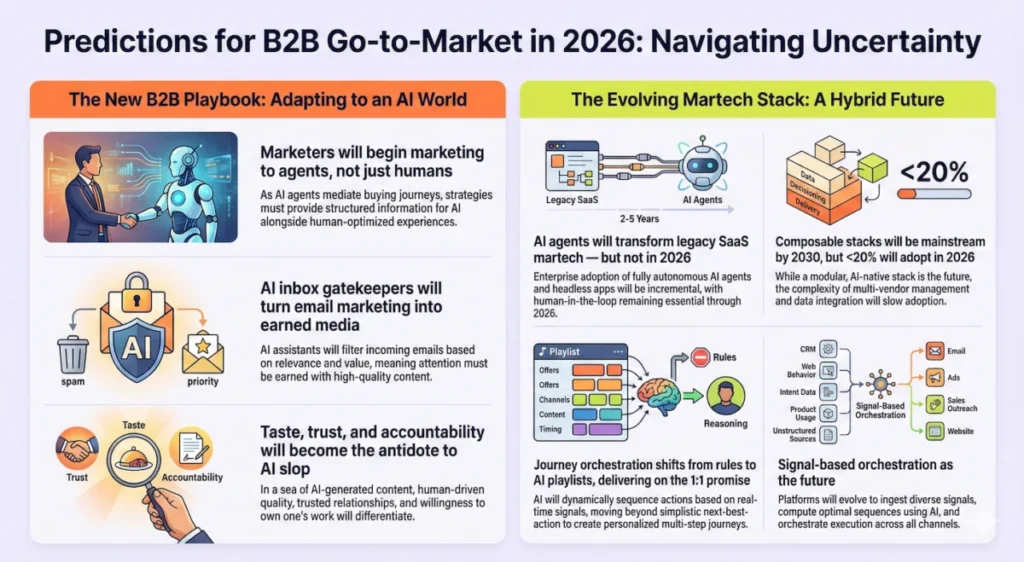
The core thesis of the 2026 outlook is simple: Marketers are no longer just selling to humans; they are marketing to agents.
As AI-mediated buying journeys become the norm, vendors must adapt their digital presence to be readable, actionable, and persuasive to Large Language Models (LLMs) and autonomous agents. This transition is not merely about SEO; it is about "Context Engineering"—a new discipline focused on systematically capturing the institutional knowledge, decision logic, and operational nuances that allow AI to act with the authority of a seasoned employee.
Furthermore, the "SaaS is dead" narrative is being nuanced by the reality of the enterprise. While AI-native platforms are emerging, 2026 will be a year of "AI-assisted SaaS," where traditional interfaces remain in place to provide the guardrails, human-in-the-loop oversight, and trust that complex B2B transactions demand.
Chronology: The Evolution Toward 2026
To understand where we are going, one must look at the rapid maturation of the market over the last three years:
- 2023–2024: The "discovery phase," where marketers first experimented with generative AI for basic content creation and brainstorming.
- 2025: The year of "Answer Engine Optimization" (AEO). With 90% of B2B buyers utilizing tools like ChatGPT for research, marketers pivoted to structured data and schema markup to ensure visibility in AI summaries.
- 2026 (The Current Outlook): The year of "Agent Integration." AI agents now participate in the buying committee. The focus has shifted from content volume to "signal-based orchestration," where AI systems act as both researchers and evaluators.
- 2027–2030 (The Horizon): The projected maturation of fully composable, signal-driven stacks where the "marketing platform" as we know it is replaced by an ecosystem of modular, AI-native services.
Supporting Data: The Shifting Martech Landscape
The transition toward composable architectures and AI-native stacks is well underway, though it remains a "marathon, not a sprint."
- Platform Centralization: According to data from The Digital Bloom, the role of traditional Marketing Automation Platforms (MAPs) as the "center" of the stack has declined from 31% to 26% year-over-year.
- Composable Growth: Adoption of custom-built, composable platforms has grown from 2% to 10%, indicating a shift toward modularity.
- The AI Usage Gap: While 81% of AI implementation in 2025 remained "assist-only," the appetite for autonomous agents is surging. However, the "Silent Freeze" of entry-level hiring—where companies maintain productivity without backfilling junior roles—highlights the human cost of this efficiency. At major tech firms, the proportion of employees aged 21–25 has plummeted from 15% to 6.8%.
Official Responses and Industry Perspectives
Industry experts remain divided on the speed of this transition. While techno-optimists advocate for the immediate replacement of software licenses with "hired labor" (AI agents), cautious observers point to the "messy middle"—the variable, high-stakes tasks that require human judgment.
Scott Brinker, a leading voice in martech, notes that we are moving from "martech" to "marketing to tech." This sentiment is echoed by institutional analysts who warn that the complexity of managing multiple vendors in a composable stack remains a significant barrier for organizations lacking deep digital maturity.
The consensus among leadership is that while AI can handle the "combinatorial math" of journey orchestration, it lacks the "taste" and "emotional intelligence" required to build long-term trust. As Forrester’s Predictions 2026 report suggests, B2B customers are increasingly relying on personal networks and curated, human-led sources to bypass the growing tide of "AI slop."
Implications: The Strategic Pivot for 2026
1. The Death of Batch-and-Blast
Email marketing is moving from "owned media" to "earned media." With AI gatekeepers and inbox triage tools filtering out noise, relevance is no longer an aspiration—it is a survival mechanism. Marketers must now earn their way into the inbox through genuine value, as AI-summarization tools render generic subject lines and boilerplate copy obsolete.
2. Context Engineering as a Core Competency
The most valuable asset in 2026 is not just the data, but the context surrounding the data. Companies that document their decision logic—the "why" behind their Salesforce schema, the intent behind a campaign, and the criteria for lead scoring—will be the ones whose AI agents outperform the competition.
3. The Rise of "Playlist" Orchestration
Traditional journey mapping via static "if-then" flowcharts is being replaced by AI-powered "playlists." Rather than a single "next-best-action," AI sequences multiple steps based on real-time signals, treating the buyer journey as an evolving, personalized narrative rather than a rigid funnel.
4. Navigating the "Silent Freeze"
For leadership, the challenge is not just technological, but societal. The displacement of junior roles poses a long-term risk to the talent pipeline. The implication is clear: organizations must prioritize upskilling their existing workforce to act as "AI conductors." The era of hyper-specialized, siloed marketing roles is drawing to a close, giving way to the generalist strategist who can leverage AI across the entire GTM chain.
5. Resilience Through Efficiency
In an era of record-high global uncertainty, efficiency is a strategic buffer. By automating routine operations and banking the productivity gains, firms create the agility needed to pivot when market conditions shift.
Conclusion: Navigation Over Prediction
The 2026 environment is too volatile for rigid long-term planning. Instead, the mandate for every CMO and Revenue Operations leader is navigation. We are building the bridge while walking across it—balancing the immediate necessity of AI-assisted productivity with the long-term goal of fully agentic, signal-driven systems.
As Jon Miller concludes, the goal is not to predict the exact state of the market in December, but to build an organization capable of absorbing shocks and seizing the opportunities created by the inevitable disruption of our era. The future of B2B marketing is not about choosing between humans and AI; it is about orchestrating a symphony where human judgment directs the immense power of agentic logic.
