
YouTube Integrates Conversational AI and E-Commerce with New Shopping Features for “Ask YouTube”
SAN BRUNO, Calif. — In a significant convergence of artificial intelligence, video discovery, and digital commerce, YouTube is infusing its experimental conversational search tool, “Ask YouTube,” with advanced shopping capabilities. Unveiled during the annual “Made On YouTube” event, the update represents a major step forward in how consumers research products online, bridging the gap between passive video viewing and active, interactive shopping.
By leveraging generative AI to parse video content, compare product attributes, and answer granular consumer inquiries in real time, YouTube is positioning itself as a formidable competitor in the product search and e-commerce landscape. For brands, digital marketers, and everyday consumers alike, the feature signals a profound shift in how video reviews are discovered, evaluated, and monetized.
Main Facts: What Is Changing?
The core of the update revolves around how users interact with product reviews and shopping queries on the platform. When a user searches for reviews of a specific product using the experimental search version of Ask YouTube, the interface will no longer simply return a standard list of video links. Instead, it may generate an organized comparison table.
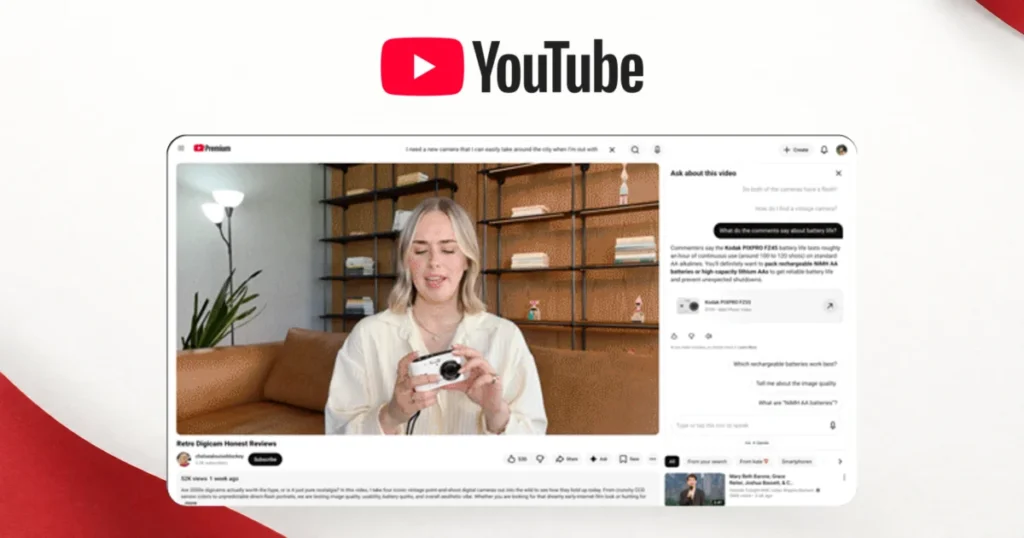
This comparison table synthesizes information from multiple creator reviews, mapping out key product attributes, categories, and specifications tailored to the user’s explicit and implicit preferences. Once a shopper identifies a review of interest and navigates to that video’s watch page, they can transition from the search tool to the watch-page version of Ask YouTube. Here, viewers can ask hyper-specific follow-up questions about the product directly within the video interface.
The functionality is split across two distinct user experiences:
- The Search Experience: Accessed directly via the primary search bar, this is where AI-generated comparison tables and structured product attributes appear.
- The Watch-Page Experience: Accessed via a dedicated button located beneath videos, this interface allows users to interrogate the content of a specific video or ask deeper questions regarding the product featured within it. Furthermore, for users watching on living-room devices, smart TVs, and game consoles, voice commands can be used to query the system hands-free.
Chronology of Development: From Experiment to Expansion
To understand the weight of this latest announcement, it is helpful to trace the rapid evolution of YouTube’s conversational AI tools over the past year:
- April: Early search experiments revealed that Ask YouTube possessed the underlying capability to generate comparative data tables for various search queries, laying the technical foundation for structured AI summaries.
- June: The watch-page version of Ask YouTube achieved massive public adoption. During Alphabet’s Q2 earnings call, CEO Sundar Pichai reported that an astounding 140 million users had engaged with the watch-page conversational tool during the month of June alone, proving that audiences were eager to adopt AI-driven video interaction.
- September 23: YouTube officially announced the integration of shopping features into Ask YouTube at the flagship “Made On YouTube” event. Johanna Voolich, YouTube’s Vice President of Product Management for Viewer Products, formally detailed how the search and watch-page experiences would merge to streamline product research.
- The Near Future: Google has already signaled that the watch-page version of Ask YouTube will soon receive “agentic video understanding” capabilities powered by advanced Gemini models, enabling the AI to take more autonomous actions on behalf of the user.
Supporting Data and Current Rollout Status
Despite the high-profile announcement, YouTube is maintaining a measured, phased rollout for the shopping features, reflecting the experimental nature of the underlying technology.
Availability and Reach
- Search Version: Currently categorized as an experiment, the search-based Ask YouTube feature is available to a limited cohort of users in the United States searching in English across desktop, mobile, and television devices. Google has stated that availability will gradually expand, a notable broadening from earlier iterations restricted solely to U.S. Premium subscribers aged 18 and older on desktop.
- Watch-Page Version: Far more widespread, the watch-page conversational tool is supported in dozens of countries and multiple languages. It appears on select videos for signed-in users aged 13 and older, backed by Alphabet’s massive engagement figures.
Selection Criteria and Data Transparency
According to YouTube’s official help documentation, the ranking and selection system for Ask YouTube responses prioritizes relevance, engagement, and quality, mirroring the core tenets of traditional YouTube search optimization.
However, questions remain regarding data provenance. As of the September rollout, neither YouTube’s search help pages nor its official product announcements have clarified the exact algorithmic mechanics used to select specific videos for product comparison tables. Furthermore, the company has not yet disclosed the precise origin of the product attribute data populating these comparative charts—leaving marketers to wonder whether structured data markup, creator tags, or automated AI transcription is doing the heavy lifting.
Official Responses and Strategic Vision
Leadership at YouTube and its parent company, Alphabet, have framed these updates as part of a broader vision to make video universally accessible, interactive, and useful beyond mere entertainment.
In the official Made On YouTube announcement, Johanna Voolich emphasized the consumer-centric design of the new tools:
"When searching for reviews of a specific product, you may receive organized video recommendations, such as a comparison table that includes product attributes and categories based on your preferences. Once you click on a video that interests you most, you can continue asking more questions about the product directly on the video’s watch page."
The strategic intent is clear: rather than forcing users to bounce between search engines, e-commerce sites, and multiple YouTube videos to piece together product specs and creator opinions, YouTube wants to become an all-in-one destination for product discovery and evaluation.
By keeping users within its ecosystem longer and satisfying their informational needs through AI, YouTube increases both watch time and advertising inventory value, even if the experimental Ask YouTube search currently remains ad-free.
Implications for E-Commerce, Creators, and Digital Marketers
The integration of conversational AI and shopping features into YouTube search introduces a paradigm shift for multiple stakeholders across the digital economy.
1. The Impact on Brands and E-Commerce Teams
For brands and digital marketing professionals, the rules of video SEO and product discoverability are evolving. Because Ask YouTube extracts and organizes product attributes into comparison tables, e-commerce teams must ensure their products are clearly reviewed, tagged, and discussed across influential creator channels.
Marketers can leverage the current experimental phase to run primary product queries through Ask YouTube, observing which creator reviews surface and noting which specific product attributes are highlighted by the AI. This provides direct insight into how the AI interprets a brand’s market positioning compared to competitors. Additionally, official help documentation notes that eligible tagged products may appear directly within conversational responses, offering a direct pipeline to transaction pages.
2. The Evolution of Creator Content
For YouTube creators—particularly those specializing in tech reviews, beauty products, and consumer electronics—this update elevates the value of detailed, objective content. Creators whose reviews are accurately parsed and featured in the AI’s comparison tables stand to capture high-intent traffic. However, it also places a premium on clarity; creators who structure their video chapters, spoken reviews, and on-screen demonstrations logically may find their content favored by an AI that prioritizes structured attribute data.
3. Changing Consumer Habits
For shoppers, Ask YouTube acts as an intelligent, conversational shopping assistant. Instead of skimming through ten-minute video reviews to find out if a camera has in-body image stabilization or if a jacket is truly waterproof, users can instantly query the video or review the comparative breakdown. This drastically reduces friction in the purchase-decision journey.
Looking Ahead: The Road to Agentic Video
As YouTube continues to refine its shopping tools, questions regarding rollout timelines, global geographic expansion, and monetization specifics remain open. The platform has confirmed that conversations within the search version of Ask YouTube will not be utilized to serve advertisements during this experimental phase, protecting the early user experience from aggressive monetization.
Nevertheless, the horizon points toward a fully autonomous, intelligent video ecosystem. With Google promising the rollout of “agentic video understanding” via advanced Gemini models in the coming months, Ask YouTube is expected to evolve from a reactive search and Q&A tool into an active agent capable of executing complex multi-step tasks for viewers.
For an industry built on the simple act of watching videos, YouTube’s latest leap transforms the screen from a window into a workspace—and a storefront.
