

Beyond the Like: A Masterclass in Modern Social Media Measurement
In an era where social media is no longer a peripheral marketing channel but a core pillar of business strategy, the ability to quantify impact has become a professional imperative. Social media measurement is the sophisticated process of utilizing data analytics to evaluate how effectively a brand’s digital presence aligns with its overarching business objectives. It is the bridge between creative content and corporate ROI, transforming abstract engagement into actionable intelligence.
As organizations navigate an increasingly fragmented digital landscape, measurement provides the only reliable defense against the "guessing game" of marketing. By moving beyond surface-level vanity metrics, brands can gain deep insights into their audience, competitive standing, and overall market reputation.

The Strategic Imperative: Why Measurement Matters
Measurement is more than just checking numbers at the end of a month; it is a diagnostic tool that reveals the "why" behind the "what." It allows stakeholders to understand how social media contributes to the broader organizational pipeline, whether through customer retention, brand equity, or direct lead generation.
When executed with precision, measurement reveals:

- Audience Behavior: Determining not just who is interacting with a brand, but the optimal times and content formats that trigger meaningful action.
- Competitive Benchmarking: Quantifying your "share of voice" within an industry to identify growth opportunities or emerging threats.
- Operational Efficiency: Linking social activity directly to business KPIs, thereby justifying budget allocations and resource requirements to leadership.
Chronology of an Effective Measurement Strategy
For social media managers and CMOs alike, the path to data-driven success follows a logical, repeatable cadence.
1. Goal Alignment (The Foundation)
Before data collection begins, you must define the "North Star." Are you aiming for brand awareness, customer service efficiency, or bottom-line revenue? Every metric must be tied to a specific business outcome. A metric without an action is merely noise.
2. Implementation of Systems
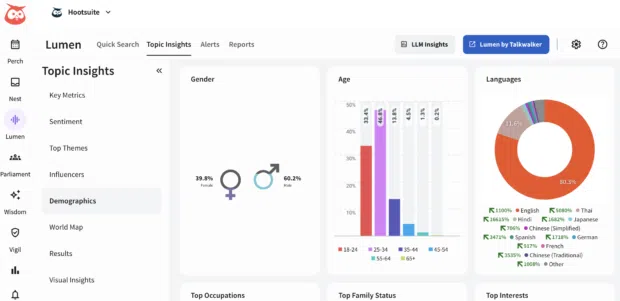
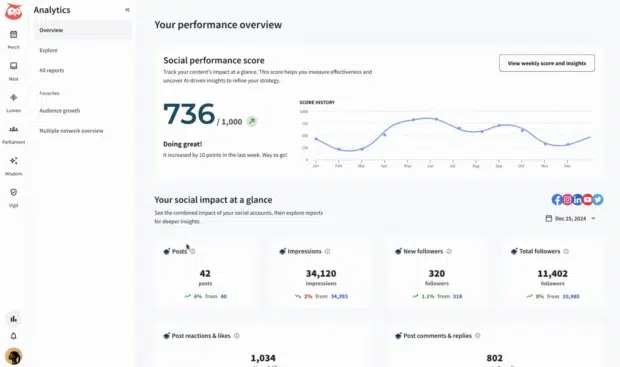
Effective measurement requires a robust technical stack. While native platform analytics (Meta Insights, LinkedIn Analytics, etc.) provide a starting point, they are often siloed. Integrating these into a unified Social OS or CRM (like Salesforce) is essential for a holistic view of the customer journey.
3. Reporting and Iteration
Data must be treated as a decision-making tool. Weekly reviews allow for tactical agility—such as adjusting a caption style or posting time—while monthly and quarterly reviews facilitate high-level strategic shifts.
Supporting Data: Mapping Goals to KPIs
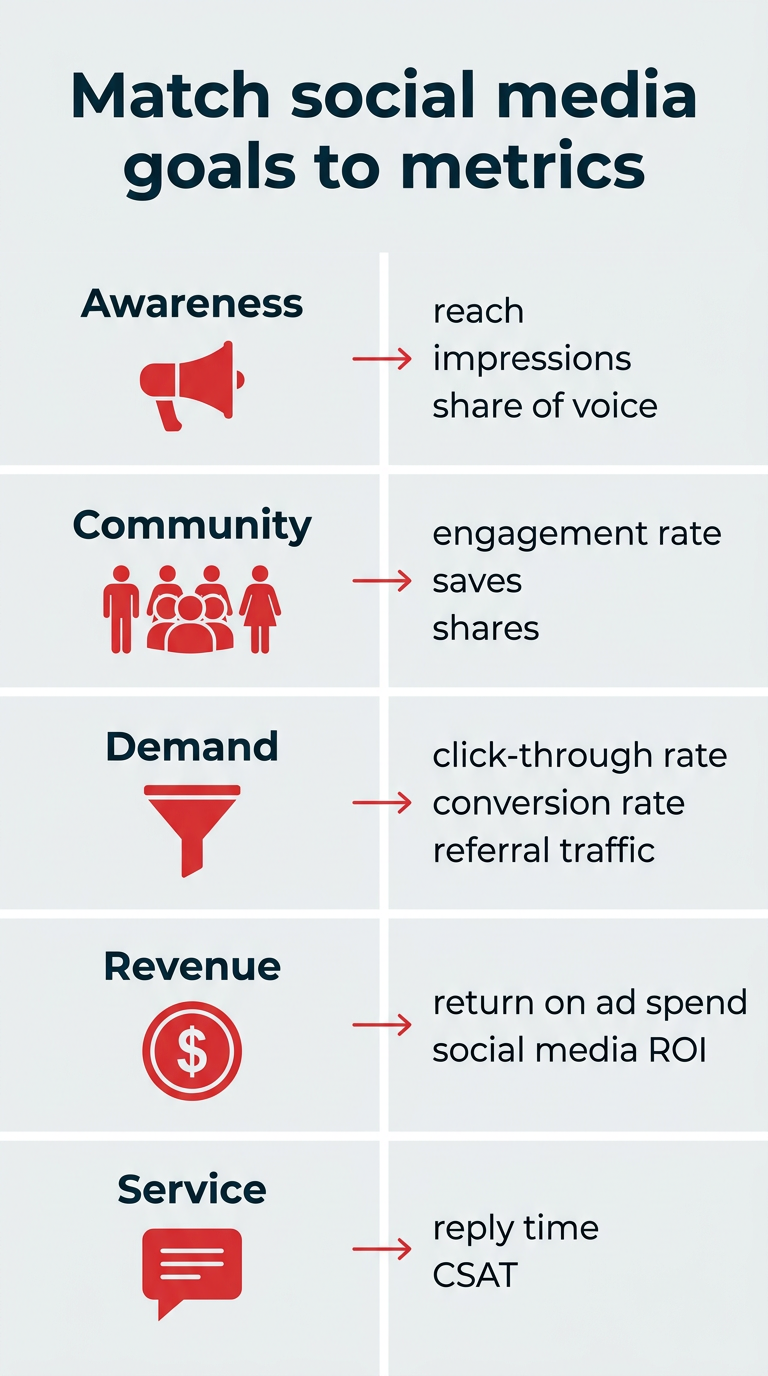
To transition from a "vanity" approach to a "value" approach, brands must utilize a framework that maps business goals to specific, trackable KPIs.
| Business Goal | Key Metrics to Track | Primary Data Source |
|---|---|---|
| Brand Awareness | Reach, Impressions, Share of Voice | Social OS, Platform Native |
| Engagement | Engagement Rate, Saves, Shares | Platform Native, Analytics Tools |
| Lead Generation | Conversion Rate, Click-Through Rate (CTR) | Google Analytics, CRM |
| Revenue/ROI | ROAS, CPC, Customer Acquisition Cost | Ad Platforms, CRM |
| Satisfaction | CSAT, NPS, Average Response Time | Social Inbox, CRM |
The Taxonomy of Metrics
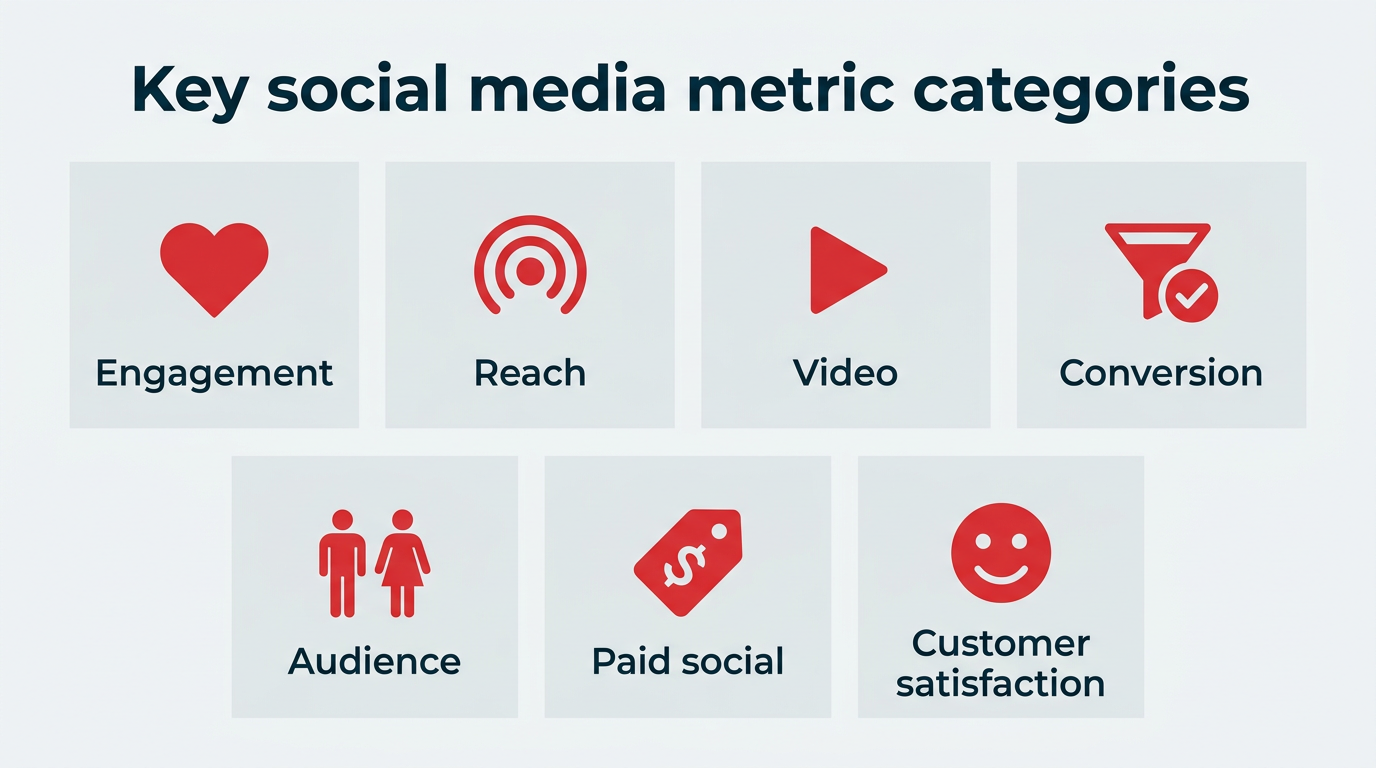
Understanding which metrics to track requires a nuanced view of the social ecosystem.
Engagement vs. Intent
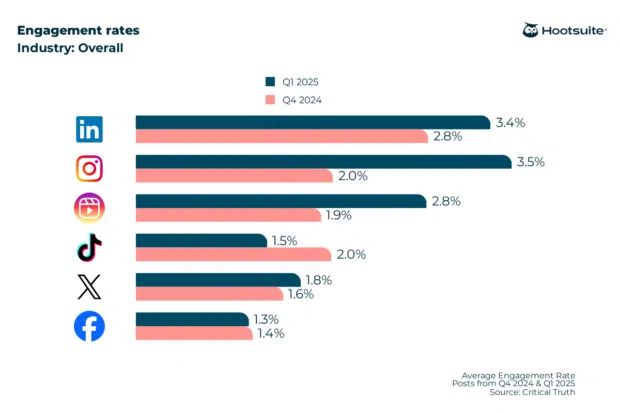
High engagement rates signal that content is resonating, but the type of engagement matters. A "Like" is a passive acknowledgment; a "Save" or "Share" indicates higher intent and algorithm-friendly quality signals. When measuring, prioritize metrics that demonstrate a user’s commitment to the content.
Reach and Awareness
Reach metrics quantify the size of your digital footprint. A critical, often overlooked indicator is the ratio of followers to non-followers reached. A high percentage of non-followers suggests your content is successfully breaking out of your immediate ecosystem—a key milestone for brand growth.
The Role of Video Performance
As video continues to dominate the digital landscape, standard reach metrics are insufficient. Advanced measurement now includes completion rates, average watch time, and "drop-off" points. Understanding where a viewer stops watching a video is just as important as knowing how many people started it.
Conversion and Attribution
The "holy grail" of measurement is tracking a user from a social click to a final purchase. Multi-touch attribution models are becoming the industry standard, as they distribute credit across the various touchpoints a customer engages with before converting. This prevents the bias of "last-click" attribution, which historically undervalued the role of top-of-funnel social content.
Implications for Organizational Success
The primary implication of rigorous measurement is the ability to move from a reactive to a proactive marketing posture.
Crisis Mitigation and Reputation Management
By tracking brand sentiment in real-time, teams can identify potential PR crises before they escalate. A spike in negative sentiment coupled with a decrease in volume often acts as an early warning system. Rapid response, informed by real-time data, is frequently the difference between a minor incident and a full-scale corporate crisis.
The ROI Conversation
One of the most significant hurdles for social media professionals is justifying budget to the C-suite. By integrating social measurement tools with CRM data, social media managers can shift the conversation. Instead of presenting "likes and follows," they can present "contribution to pipeline and closed-won revenue." This elevates the social team from a creative department to a revenue-generating partner.
Evolution of Content Strategy
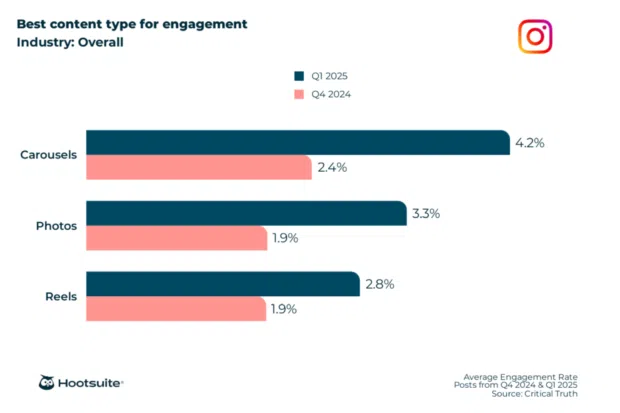
Data-driven insights allow for the systematic optimization of content. If your data shows that carousel posts on Instagram drive 30% more engagement than Reels, your strategic pivot becomes obvious and defensible. This empirical approach removes the "ego" from content creation and replaces it with audience-first decision-making.
Professional Recommendations for Modern Teams
To remain competitive in 2025 and beyond, organizations should adopt the following best practices:
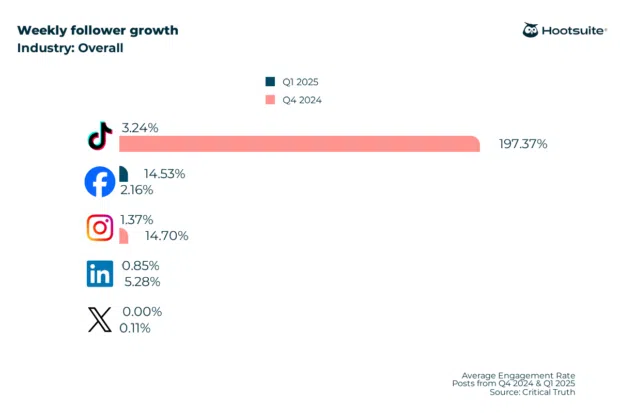
- Invest in Integrated Systems: Stop manually consolidating data from five different platforms. Use a unified dashboard that automates reporting to ensure accuracy and save time.
- Benchmark Against the Industry: Don’t measure in a vacuum. Use competitive intelligence tools to compare your engagement rates and share of voice against your direct peers.
- Prioritize Actionable Insights: If a metric doesn’t lead to a change in strategy or a validation of a current plan, remove it from your primary dashboard. Focus on the data that drives the business forward.
- Tailor Reports to the Audience: An executive does not need to know the CTR of a specific post; they need to know how social media is impacting revenue. A social manager, conversely, needs the granular detail to improve performance. Create distinct reporting tiers for these different stakeholders.
Conclusion: Data as a Strategic Asset
Social media measurement is not a secondary task—it is the foundation of digital strategy. As the global social media ad spend continues to climb toward the $300 billion mark, the stakes for accurate measurement have never been higher. By aligning business goals with specific KPIs, integrating technical measurement tools, and fostering a culture of continuous optimization, brands can transform their social channels into a verifiable, high-impact business engine. In the modern digital economy, the companies that measure best are the ones that grow fastest.
