
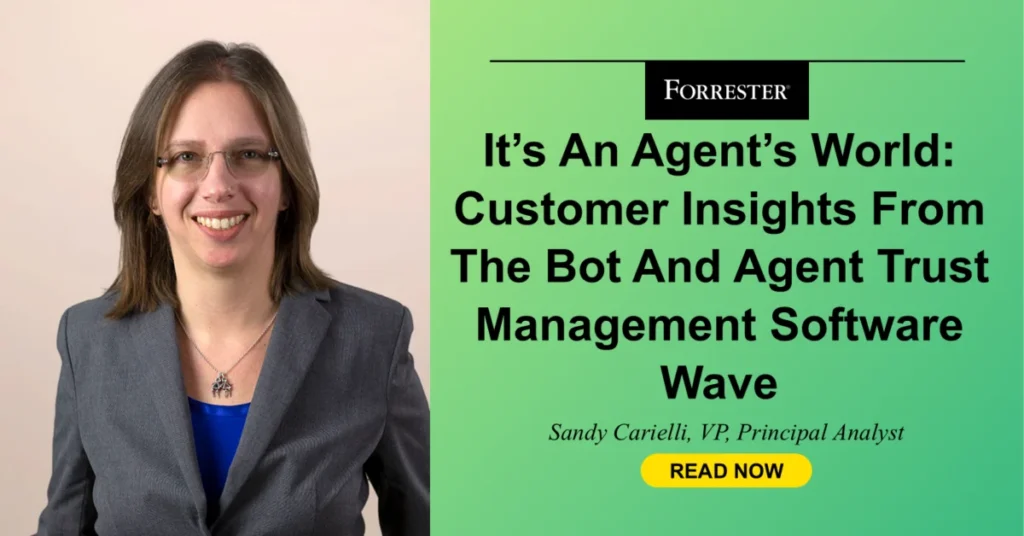
Navigating the Frontier of Automated Security: Insights from the Forrester Wave™ for Bot and Agent Trust Management Software (Q2 2026)
Main Facts
The rapid evolution of digital infrastructure has brought forth a paradigm shift in how organizations manage automated traffic, defend against sophisticated cyber threats, and govern autonomous software. At the epicenter of this transformation is the release of The Forrester Wave™: Bot and Agent Trust Management Software, Q2 2026. This landmark evaluation sheds light on a critical industry transition: the migration from legacy bot management—which primarily focused on blocking malicious scripts and scraping tools—to comprehensive "bot and agent trust management."
Behind the scenes of compiling a Forrester Wave™ lies a wealth of qualitative data gathered directly from the front lines of enterprise security. Analysts conducting these evaluations engage in extensive dialogue with verified customer references. While a significant portion of this feedback directly influences vendor scoring, criteria weighting, and placement within the Wave matrix, these conversations frequently uncover broader industry trends.
Key takeaways from the Q2 2026 evaluation highlight four monumental shifts in enterprise security:
- The Maturation of Key Use Cases: Enterprises are moving past rudimentary rate-limiting and CAPTCHA implementation toward nuanced, context-aware traffic analysis that distinguishes between benevolent automated workflows and malicious incursions.
- The Emergence of AI Agent Trust: As organizations increasingly deploy autonomous artificial intelligence agents to conduct business transactions, fetch data, and interact with APIs, securing and validating the identity of these agents has become paramount.
- Elevated Expectations for Service and Support: Buyers are no longer satisfied with static software deployment; they demand white-glove advisory services, proactive threat hunting, and dedicated customer success teams to keep pace with mutating threat vectors.
- The Indispensability of Threat Research: In an era where attackers leverage machine learning to bypass security controls, software vendors must possess world-class threat research capabilities to anticipate zero-day bot signatures and agent spoofing techniques.
To complement these findings, Forrester has published the Buyer’s Guide: Bot And Agent Trust Management Software, 2026, designed to help security and risk (S&R) professionals navigate vendor selection, assess technical readiness, and future-proof their application security architectures.
Chronology
To understand how the market arrived at the sophisticated trust management frameworks evaluated in the Q2 2026 Forrester Wave, it is essential to trace the historical trajectory of automated threat defense over the past two decades.
Phase 1: The Era of Simple Obfuscation (Early 2000s–2010s)
In the early days of web applications, automated threats were largely confined to primitive web scrapers, simple spam bots, and basic credential-stuffing scripts. Security measures were correspondingly rudimentary. Organizations relied heavily on static IP blocklists, user-agent string filtering, and the ubiquitous introduction of CAPTCHAs (Completely Automated Public Turing test to tell Computers and Humans Apart). During this period, the primary goal was friction: making it annoying enough for automated scripts to access a site that operators would look elsewhere. However, this approach severely degraded legitimate user experience and was easily bypassed by primitive proxy rotation and optical character recognition (OCR) solvers.
Phase 2: The Rise of Dedicated Bot Management (2015–2020)
As cybercrime industrialized, automated attacks evolved into sophisticated botnets capable of mimicking human browsing behavior, executing high-speed credential stuffing, and launching distributed denial-of-service (DDoS) attacks at the application layer. Legacy web application firewalls (WAFs) proved inadequate, paving the way for dedicated bot management solutions. Vendors introduced behavioral analysis, client-side telemetry collection, and machine learning models to differentiate between human users and automated scripts in real time. This era established the foundational playbook for identifying malicious traffic without disrupting genuine customers.
Phase 3: The API Explosion and Generative AI Disruption (2021–2025)
The widespread adoption of cloud-native architectures, microservices, and public APIs shifted the digital perimeter. Attackers pivoted away from targeting front-end web forms toward abusing business logic vulnerabilities via APIs. Concurrently, the explosion of generative artificial intelligence and autonomous software agents introduced a brand-new operational reality. Enterprises began deploying their own AI agents to interact with third-party services, while malicious actors weaponized AI to generate polymorphic attacks that could dynamically adapt to standard bot mitigation techniques.
Phase 4: The Convergence of Trust and Verification (2026 and Beyond)
This brings the industry to the current landscape captured by The Forrester Wave™: Bot and Agent Trust Management Software, Q2 2026. The market has recognized that a binary "block versus allow" paradigm is no longer sufficient. Security teams must now establish a framework of trust. They need systems capable of verifying not just whether a visitor is human or bot, but whether an authorized AI agent or automated workflow is operating within prescribed governance policies. This evolution has redefined the software category, expanding its mandate from mere threat mitigation to comprehensive digital identity and behavioral trust orchestration.
Supporting Data
The transition from basic bot management to holistic bot and agent trust management is underpinned by shifting enterprise priorities and escalating threat metrics. While individual vendor scores within the Q2 2026 Forrester Wave reflect technical capabilities, aggregated insights from customer reference calls reveal systemic patterns across industries.
The Expanding Attack Surface
Data compiled across the evaluation process indicates that more than 60% of enterprise web and API traffic is now non-human. This traffic is divided into two distinct categories:
- Authorized Automated Traffic: Includes search engine crawlers, partner APIs, automated monitoring tools, and internal or external enterprise AI agents designed to execute tasks on behalf of users.
- Unauthorized/Malicious Traffic: Comprises credential stuffing rings, inventory hoarding bots, carding attacks, scraping operations, and rogue AI agents attempting data exfiltration or unauthorized transactions.
Shifts in Buyer Criteria
When surveyed regarding what matters most in evaluating modern trust management software, customer references consistently emphasized three primary pillars:
| Evaluation Pillar | Percentage of Emphasis (Qualitative Consensus) | Core Enterprise Requirement |
|---|---|---|
| Contextual Accuracy | 35% | Low false-positive rates to ensure legitimate customer transactions and partner workflows are never blocked. |
| AI Agent Governance | 30% | Advanced telemetry capable of identifying, authenticating, and authorizing machine-to-machine transactions. |
| Threat Research Integration | 20% | Continuous, automated updates to detection engines driven by global telemetry and proactive threat intelligence. |
| Vendor Support & Advisory | 15% | Access to security engineers who can assist with custom rule tuning and incident response. |
These data points illustrate that modern buyers view trust management software not merely as a software-as-a-service (SaaS) subscription, but as a critical operational pillar of digital resilience.
Official Responses
As organizations navigate the complexities highlighted in the Q2 2026 Forrester Wave and its companion Buyer’s Guide, industry stakeholders, security leaders, and software vendors have shared their perspectives on the future of trust management.
The Analyst Perspective
In discussing the findings of the recent evaluation, leading analysts emphasize that security strategies must evolve alongside technological innovation.
"One of the best parts about authoring a Forrester Wave™ is getting to speak to customer references," notes the report’s lead author. "Every vendor in the Wave evaluation connects me with customers who talk about how they use the product, what they like, and what they wish was better. While a lot of that goes into evaluating vendors during the Wave process, those customer conversations are chock-full of additional insights that go well beyond their relationship with the vendor."
The author further stresses that the emergence of AI agent trust represents a fundamental philosophical shift for security architects:
"During the evaluation, I spoke with customer references who shared their thoughts on key use cases, the emergence of AI agent trust, expectations around service and support, and the importance of threat research. Security teams can no longer treat all automation as a threat to be eradicated. They must build frameworks that selectively verify, authorize, and trust legitimate software agents while aggressively neutralizing malicious ones."
Enterprise Security Leader Reactions
Chief Information Security Officers (CISOs) interviewed during the research phase noted that traditional perimeter defenses are buckling under the weight of generative AI tools. One CISO from a major global financial institution remarked:
"We used to worry about script kiddies running off-the-shelf botting software. Today, we are facing adaptive AI agents that can read our terms of service, solve complex workflows, and mimic user behavior with terrifying accuracy. Our partnership with trust management vendors has shifted from keeping out unwanted traffic to actively establishing a secure handshake with the myriad automated entities that want to do business with us."
Vendor Community Response
Leading software vendors featured in the Q2 2026 evaluation have welcomed the expanded definition of the market. Industry executives have pointed out that enterprises are increasingly demanding unified dashboards that can handle web bot mitigation, API security, and AI agent authentication under a single pane of glass. Vendors are investing heavily in telemetry collection networks and behavioral analytics to meet these expectations, signaling a maturing market ready to tackle the next generation of automated challenges.
Implications
The paradigm shift documented in The Forrester Wave™: Bot And Agent Trust Management Software, Q2 2026 carries profound implications for enterprise security strategies, application development lifecycles, and risk management frameworks.
1. Rewriting Application Threat Modeling Programs
For decades, application threat modeling has focused primarily on human users, standard input validation vulnerabilities (such as SQL injection and cross-site scripting), and basic session management. The mainstream adoption of AI agents and sophisticated bots requires security teams to fundamentally adapt their threat-modeling programs.
Security architects must now ask:
- How do we authenticate an AI agent acting on behalf of a verified user?
- What happens when an automated agent compromises business logic without triggering traditional anomaly thresholds?
- How can application programming interfaces (APIs) be hardened against automated scraping and unauthorized data harvesting by foreign AI crawlers?
These questions will take center stage at upcoming industry gatherings, such as Forrester’s Security & Risk Forum in November, where security leaders will convene to discuss actionable methodologies for integrating AI agent trust into existing application security lifecycles.
2. The Convergence of Fraud Prevention and Cybersecurity
Historically, bot management lived within the realm of web security or infrastructure defense, while credential abuse and fraud detection operated under separate risk management silos. The rise of sophisticated automated attacks—such as automated account takeover (ATO) and synthetic identity fraud—has dissolved these departmental boundaries. The Q2 2026 evaluation underscores that modern trust management software acts as a bridge between security operations centers (SOCs) and fraud prevention teams, requiring unified telemetry and shared governance policies.
3. Raising the Bar for Vendor Accountability
As enterprises become increasingly dependent on third-party trust management platforms, the criteria for choosing a vendor have grown stricter. Organizations can no longer rely on vanity metrics or static signature databases. Buyers must scrutinize a vendor’s commitment to continuous threat research, the transparency of their machine learning models, and the responsiveness of their customer support ecosystems. Companies that fail to provide proactive advisory services and rapid signature updates risk leaving their digital storefronts vulnerable to zero-day automated threats.
Conclusion
The Forrester Wave™: Bot And Agent Trust Management Software, Q2 2026 marks a turning point in how the digital economy handles automated interactions. By moving beyond simple exclusion to nuanced, policy-driven trust, organizations can safely harness the immense productivity gains of artificial intelligence and automated agents while safeguarding their digital assets against malicious exploitation. For security and risk professionals, digesting these insights—and putting them into practice through structured buyer’s guides and forward-looking threat modeling—will be essential to maintaining digital trust in an increasingly automated world.
