
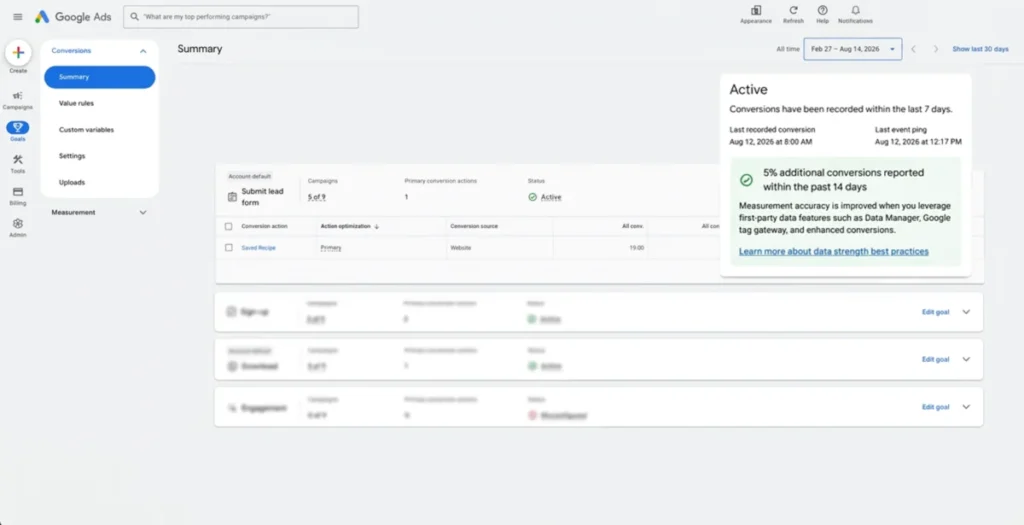
Google Expands First-Party Data Tools and Introduces ‘Data Strength Uplift’ Metric Ahead of Q4 Holiday Rush
SAN FRANCISCO — Just in time for the high-stakes Q4 holiday shopping season, Google has rolled out a sweeping suite of updates to its first-party data infrastructure. Designed to streamline how marketers connect, manage, and measure consumer data, the updates arrive as the digital advertising ecosystem continues its aggressive pivot away from third-party cookies toward privacy-compliant, consented user signals.
The announcements center on the broader integration of Google’s Data Manager, the adoption of a universal industry standard for its APIs, and the launch of a brand-new Data Strength Uplift Metric inside Google Ads. Together, these tools aim to solve two of the industry’s most persistent headaches: the immense technical overhead of managing cross-platform data pipelines and the difficulty of quantifying whether investments in measurement infrastructure are actually paying off.
1. Main Facts
Google’s latest product release introduces three primary pillars aimed at bolstering first-party data utilization for performance marketers:
- Data Manager Expansion: Google is directly integrating Data Manager—its centralized hub for connecting CRM, offline, and app data—into Google Analytics (GA) and Display & Video 360 (DV360). Enhanced conversions are also rolling out across both platforms.
- Universal API Adoption: The Data Manager API is shifting to a broader standard by adopting the IAB Tech Lab’s Event and Conversions API (ECAPI), creating a unified protocol for sending conversion and event data across diverse advertising networks. Furthermore, built-in diagnostics are being introduced to spot and resolve data formatting issues before they degrade campaign performance.
- The Data Strength Uplift Metric: A newly launched metric in Google Ads estimates the incremental number of conversions "recovered" through enhanced first-party data configurations, such as the Google Tag Gateway or enhanced conversions.
According to internal Google data, advertisers leveraging Data Manager to bridge offline and app data see an average 26% increase in incremental Return on Ad Spend (ROAS), while those utilizing the Google Tag Gateway report an average 14% conversion uplift.
2. Chronology of Events and Strategic Rollout
The evolution of Google’s measurement tooling did not happen overnight; it represents a multi-year transition precipitated by shifting privacy regulations (such as GDPR and CCPA) and browser restrictions on third-party cookies.
- The Post-Cookie Preparation Phase (2021–2023): As privacy frameworks tightened, Google introduced Enhanced Conversions and began heavily nudging advertisers toward first-party tagging solutions like the Google Tag and server-side tagging. However, fragmented data collection methods often left marketing teams struggling to unify web, app, and offline CRM data.
- Introduction of Data Manager (2024–2025): To combat fragmentation, Google initially launched Data Manager to give marketers a single interface to manage disparate data streams. Despite its utility, the tool remained siloed from several critical Google ecosystems, requiring manual, platform-specific workarounds.
- The Q4 2026 Push: Recognizing the immense pressure brands face during the Q4 holiday shopping rush—where every single conversion counts—Google accelerated its roadmap. By pushing Data Manager natively into Google Analytics and DV360, and aligning with the IAB Tech Lab’s ECAPI standard, Google is attempting to lower the technical barrier to entry for omnichannel data orchestration just as ad spend hits its annual peak.
3. Supporting Data and Technical Architecture
The underlying mechanics of these updates are designed to alleviate technical debt for digital marketing and engineering teams alike.
Cross-Platform Synergy via Data Manager
Historically, setting up offline conversion imports (OCIs) or app data feeds required bespoke developer resources for each individual advertising tool. By expanding Data Manager into Google Analytics and DV360, Google is unifying the control plane. Advertisers can now configure an offline data source once and syndicate those signals across multiple Google channels simultaneously.
Additionally, the introduction of automated Data Diagnostics acts as an early-warning system. By proactively scanning data streams for broken parameters, schema mismatches, or syntax errors, the system prevents corrupted first-party signals from polluting automated bidding algorithms.
Embracing the IAB Tech Lab’s ECAPI
Perhaps the most technically significant update for enterprise-level advertisers is the adoption of the IAB Tech Lab’s Event and Conversions API (ECAPI).
Large organizations frequently manage multiple advertising platforms—not just Google, but Meta, TikTok, Amazon, and others. Building and maintaining separate data pipelines for every single vendor consumes massive engineering bandwidth. By aligning its Data Manager API with ECAPI, Google is supporting a broader industry standard. Marketers can now utilize a single, universal pipeline standard to route conversion data to various supported endpoints, drastically reducing custom code maintenance.
Decoding the Data Strength Uplift Metric
Quantifying the ROI of invisible infrastructure—like server-side tagging or enhanced matching—has always been notoriously difficult. When a campaign’s performance improves after implementing better tracking, it is often impossible to tell whether the ad creative simply performed better or if the system is merely capturing conversions that previously slipped through the cracks.
The new Data Strength Uplift Metric aims to clear up this ambiguity. By analyzing match rates, signal quality, and historical trends, the metric calculates an estimated volume of recovered conversions directly attributable to improvements in the advertiser’s data setup.

4. Official Responses and Industry Context
Industry analysts and Google representatives alike have framed these updates as a necessary evolution in automated, AI-driven bidding.
In official release documentation, Google emphasized that modern automated bidding engines—which rely heavily on machine learning—are only as effective as the data fed into them. "As more data feeds Google’s bidding and optimization systems, advertisers need reliable ways to connect those signals and know whether their measurement setup is working," company representatives noted.
Early feedback from enterprise agencies has been cautiously optimistic. Media buyers point out that while platforms like Meta have long provided granular visibility into event match quality scores, Google’s ecosystem has occasionally felt like a "black box" regarding how backend data ingestion directly influences auction outcomes.
However, external data experts have also sounded notes of caution, reminding marketers that a higher reported conversion count does not automatically equate to a healthier business bottom line.
5. Strategic Implications for Advertisers
While the new tools offer undeniable technical and analytical advantages, media buyers and marketing directors must navigate several strategic nuances when implementing these updates ahead of Q4.
Quantifying Infrastructure Investments
For years, digital marketing leaders have struggled to secure executive buy-in for data engineering projects. Upgrading tags, configuring server-side tracking, and cleaning up CRM hygiene are unglamorous tasks that don’t immediately produce flashy ad creatives.
The Data Strength Uplift Metric provides a tangible reporting mechanism. Marketing teams can now present hard estimates of recovered conversion volume to leadership, justifying the time and budget spent on foundational data engineering.
The Danger of Metric Vanity
Despite the utility of the uplift metric, savvy advertisers must remember a critical caveat: Recovered volume does not equal business value.
A tracking improvement that captures an extra 15% of conversions tells an advertiser how many events were saved from unmeasured oblivion, but it says nothing about the quality of those conversions. If poor-quality leads or low-margin transactions are captured and fed into Google’s Smart Bidding algorithms without proper weighting, the automated system will simply optimize toward finding more low-value prospects.
To prevent algorithmic drift, advertisers must ensure that downstream business metrics—such as lifetime value (LTV), profit margins, verified lead status, and CRM-verified sales—are tightly integrated back into the conversion action settings.
Looking Ahead: The Autonomous Bidding Era
Google’s aggressive push toward first-party data is ultimately about feeding its machine learning models. As third-party identifiers fade into obsolescence, Google Ads relies almost entirely on first-party behavioral signals, enhanced conversions, and predictive modeling to win auctions and drive conversions.
By making Data Manager ubiquitous across its product suite and standardizing its API via the IAB Tech Lab, Google is systematically removing the friction points that prevent advertisers from sharing data. For brands heading into the Q4 holiday rush, adopting these tools is no longer optional—it is the foundational requirement for keeping automated bidding engines accurate, competitive, and profitable.
