
The New Newsroom: How LATAM Publishers are Navigating the Social Video Revolution
In the landscape of modern media, the traditional morning paper and the evening broadcast have been eclipsed by a scroll, a tap, and a swipe. Across Latin America (LATAM), the paradigm of information consumption has fundamentally shifted. News is no longer merely delivered; it is discovered, debated, and shared at scale through the digital ecosystems of YouTube, TikTok, and Instagram.
According to the Reuters Institute Digital News Report 2025, the transformation is near-total: between 58% and 64% of digital audiences in Argentina, Chile, Colombia, Mexico, and Peru now identify social media as their primary gateway to current events. For legacy media houses, this represents both an existential threat and a golden opportunity. As traditional viewership wanes, the competition for the digital "attention economy" is intensifying, with agile, social-first creators often outmaneuvering established institutions.
To remain relevant in 2026 and beyond, LATAM publishers must move beyond gut-instinct editorializing and embrace data-backed strategy. By analyzing cross-platform performance data from January 2025 through July 2025, we can decode the mechanics of audience engagement and identify the tactical shifts necessary for survival in the social-first era.

The Landscape of LATAM News: By the Numbers
The scale of social video consumption in Latin America is staggering. Data from Tubular Labs indicates that, across all video categories and platforms, regional content generated an eye-watering 4.05 trillion views in the first seven months of 2025.
Within this massive volume, the "News & Politics" category accounted for 27.1 billion views across 293,000 individual uploads. While these numbers seem robust, they represent a significant "whitespace" opportunity. Currently, News & Politics content makes up a mere 0.67% of total video uploads in the region. This indicates that the market is far from saturated; publishers who can effectively scale their production to meet demand are poised to capture a significantly larger share of the audience’s attention.
Chronology of a Shift: How YouTube Became a News Powerhouse
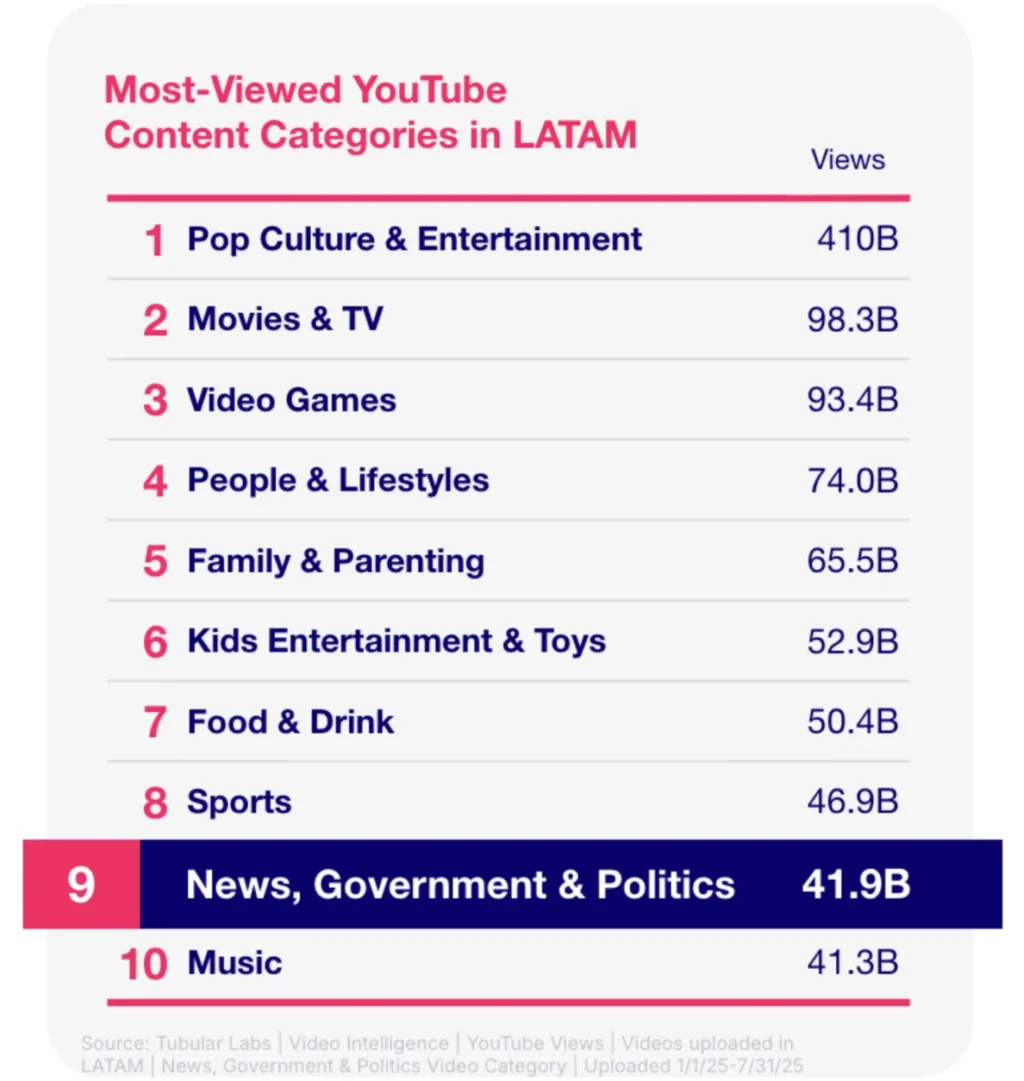
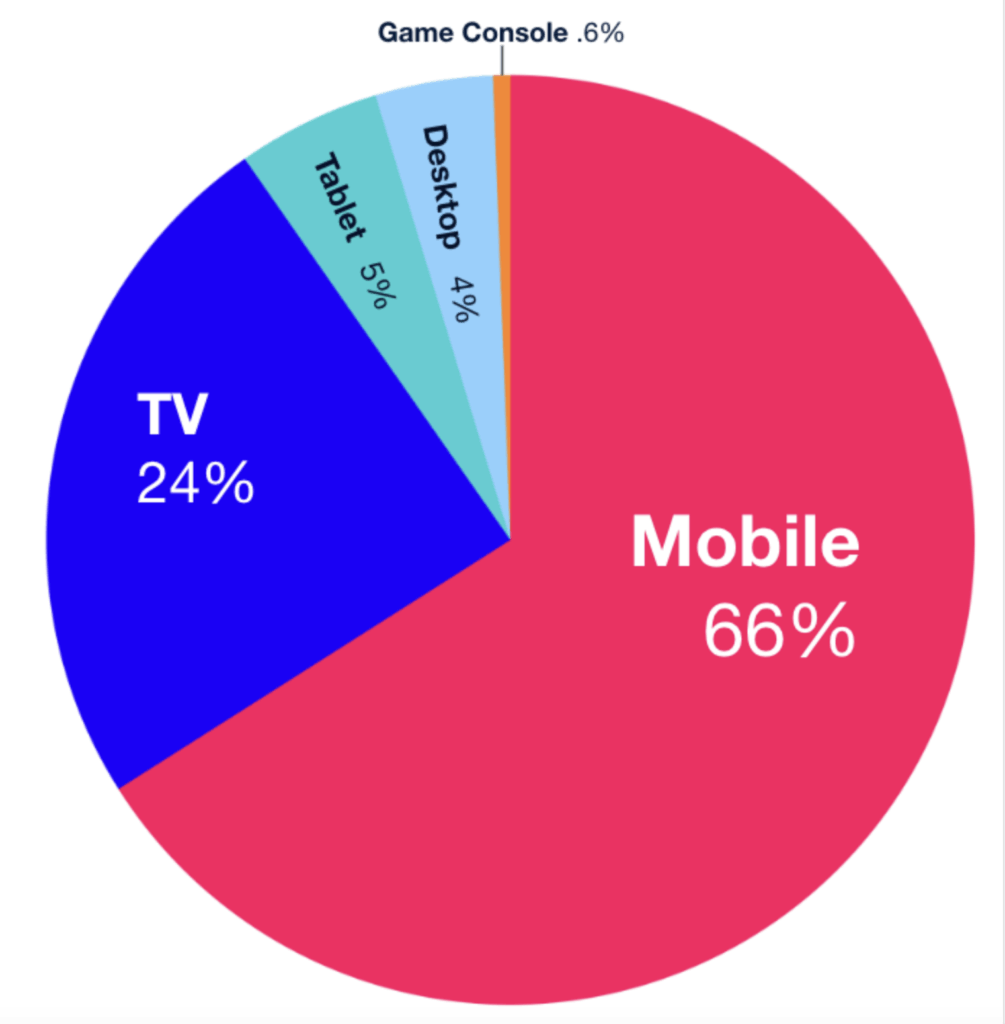
Historically, YouTube was perceived as a repository for music videos, gaming, and entertainment. However, 2025 marked a definitive turning point. News, Government & Politics climbed to become the 9th most-viewed category on the platform in LATAM, amassing 41.9 billion views. Notably, this growth occurred despite fewer total uploads compared to more traditional entertainment categories, suggesting that when publishers do post, the content is highly resonant.
The Duration Paradox
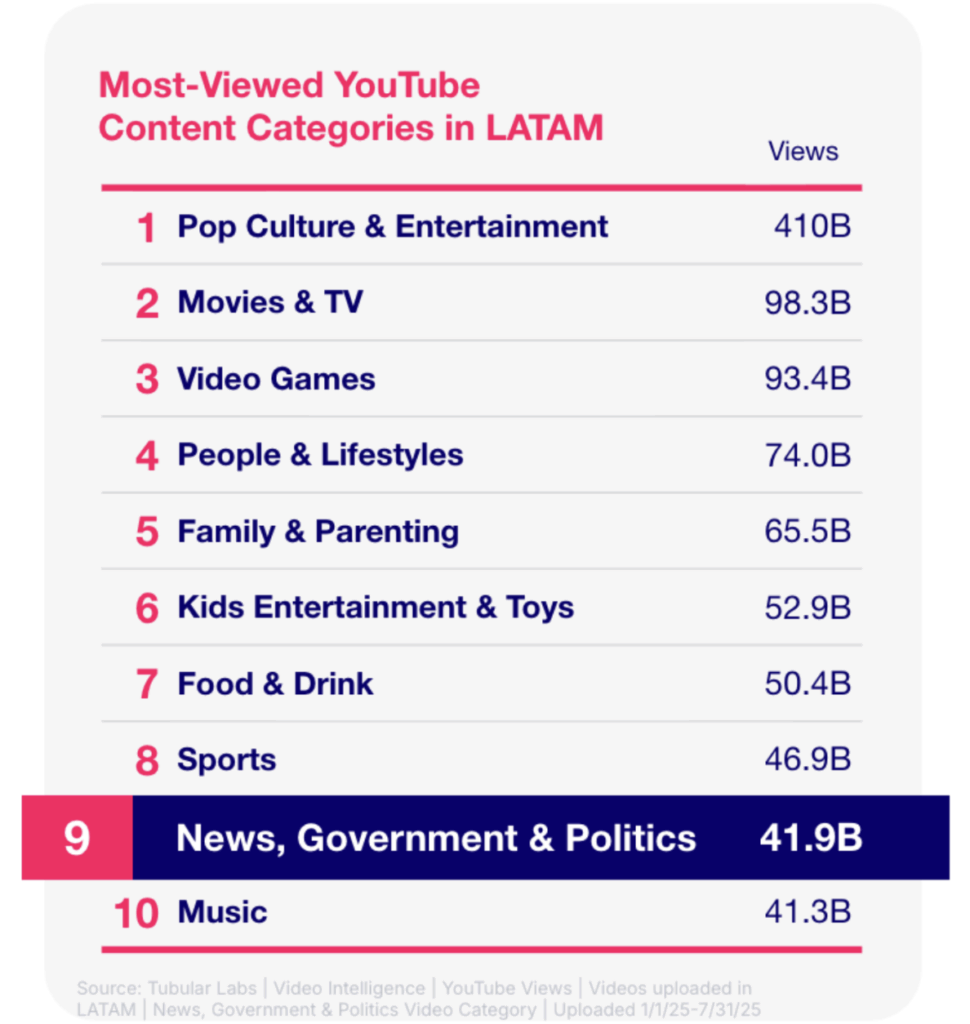
One of the most counterintuitive findings for media strategists is the inverse relationship between video length and engagement. Data analysis reveals that on YouTube, videos under 30 seconds deliver the highest engagement per video. Conversely, the industry standard—videos between one and five minutes—consistently yields the lowest engagement.
This suggests a "strategy gap." Many legacy publishers continue to repurpose long-form television segments for the web, ignoring the platform-specific preference for brevity. To capitalize on this, publishers must pivot toward "snackable" content. The data suggests that the 0-30 second window is currently the most under-utilized growth lever available to digital news teams.
The Sunday Effect and Mobile-First Consumption
Performance data also reveals specific behavioral patterns in how LATAM audiences interact with news. Counter to the traditional "news cycle" that prioritizes Monday-through-Friday morning blocks, videos published on Sundays consistently earned the highest engagement.
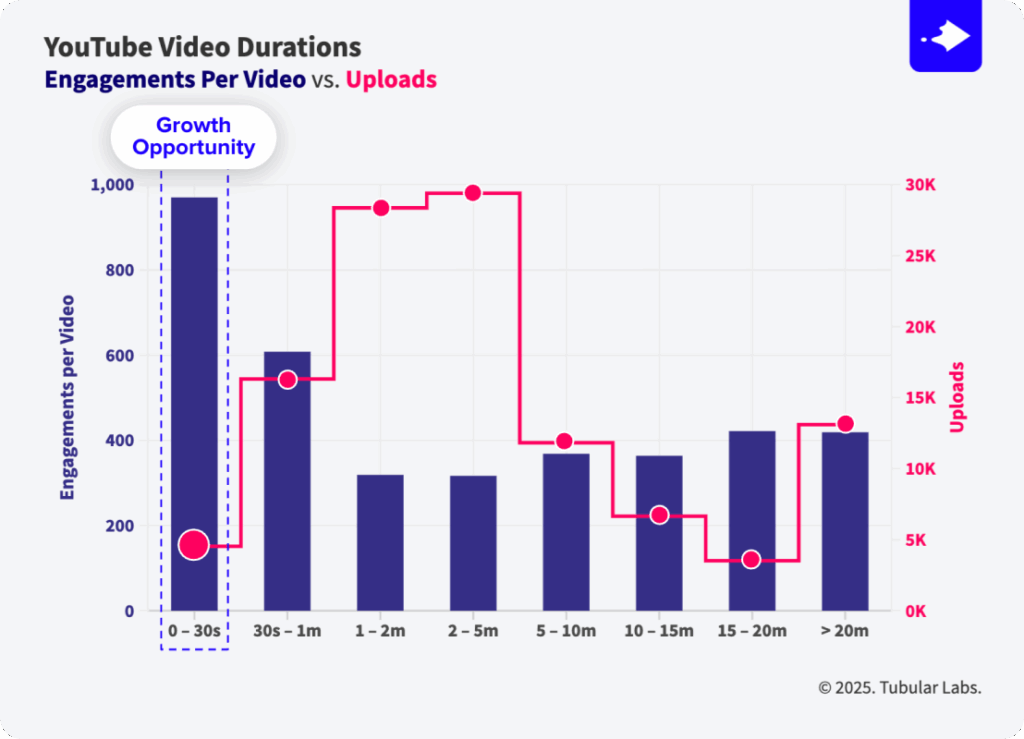
Furthermore, the device divide is stark. Mobile devices account for 66% of YouTube views for News & Politics, compared to just 24% for TV. This renders traditional landscape, long-form broadcasting increasingly obsolete for the mobile-native demographic. The implication is clear: if your content is not optimized for vertical, mobile-first, short-form consumption, you are effectively invisible to two-thirds of your potential audience.
Case Studies: The Shorts Revolution
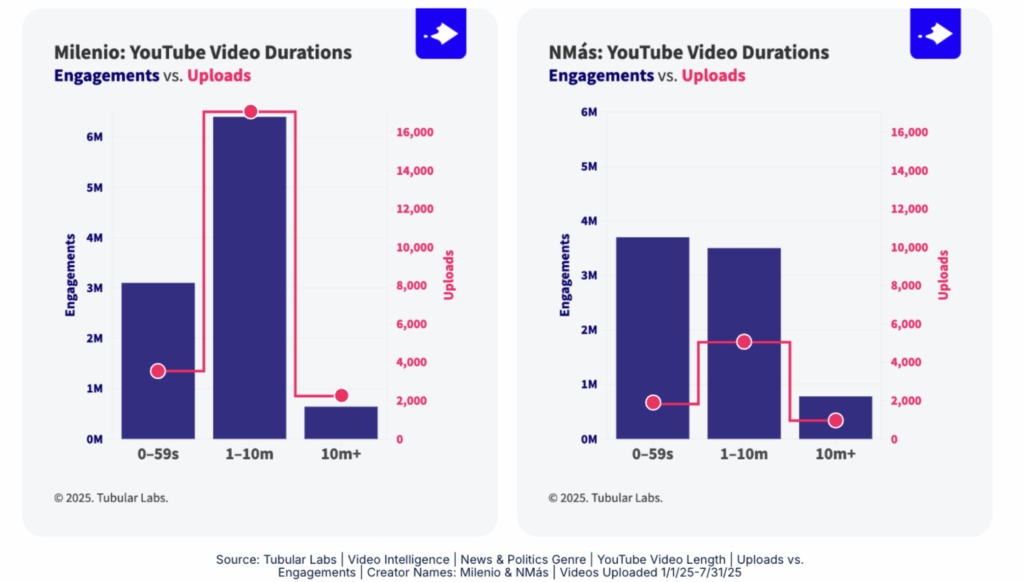
The efficacy of short-form video is best demonstrated by two regional giants: Milenio and N+ (NMás).
Milenio, by strategically integrating YouTube Shorts, managed to drive 31% of their total cross-platform engagements using only 15% of their total uploads. Similarly, N+ found that while they continued to produce a high volume of mid-length content, nearly half of their total engagement was being generated by their Shorts output.
The lesson for newsrooms is a simple, if labor-intensive, one: the "splice-and-dice" approach. By breaking down long-form investigations, interviews, and field reports into shorter, high-impact vertical segments, publishers can maximize the reach of every piece of produced content without exponentially increasing production costs.
The TikTok Dominance and Strategic Implications
While YouTube remains a pillar, TikTok has emerged as the true engine of interaction. Despite representing a smaller share of overall uploads, TikTok accounts for 71% of all cross-platform social interactions with LATAM news media.
The growth trajectory is equally impressive: the top 10 LATAM news publishers on TikTok saw a 55% year-over-year increase in viewership. For media organizations like C5N, the numbers are illustrative of a wider trend. C5N’s TikTok content accounted for only 25% of their total cross-platform uploads, yet it was responsible for 71% of their total engagement.
This creates a clear roadmap for 2026:
- Platform Segmentation: Understand that different audiences seek different content on different platforms.
- Thematic Mapping: Data suggests that sensitive topics, such as women’s rights or immigration, perform exceptionally well on TikTok and Instagram, while more procedural content like law enforcement reports may find a more loyal, attentive audience on Facebook.
- Hardware-Driven Consumption: Partnering with analytics firms like Chartbeat reveals that audiences on TVs, tablets, and gaming consoles prefer long-form content (20+ minutes), while mobile users demand brevity (under 1 minute). Publishers must tailor their distribution strategy not just by topic, but by the device on which the content is consumed.
Official Perspective: The Path Forward
The data provided by Tubular Labs and the behavioral shifts analyzed by Chartbeat paint a picture of a media industry at a crossroads. The transition to a "social-first" newsroom is no longer an experiment; it is a mandate.
"The most critical advantage for publishers today is not just content production, but content intelligence," notes a spokesperson for the analysis team. "Aligning strategy with real audience behavior—rather than inherited assumptions about how news ‘should’ be consumed—is the only way to lock in a legacy in this new era."

Summary of Key Strategic Takeaways for 2026:
- Embrace the "Whitespace": With News & Politics occupying only 0.67% of total uploads, there is significant room for growth. Aggressive but intelligent posting can capture market share from slower competitors.
- Prioritize Short-Form: Across all platforms, the 0-30 second video is the most efficient driver of engagement. This should be the primary focus for any digital-first news team.
- Leverage TikTok as an Engine: Do not treat TikTok as an afterthought. It is the primary driver of interaction in the region and requires a dedicated, platform-native content strategy.
- Optimize for Timing: Abandon the traditional 9-to-5 publishing schedule. Data proves that audience engagement peaks on days—such as Sundays—that legacy newsrooms historically under-utilize.
- Device-Specific Formatting: Never publish a one-size-fits-all video. Use long-form for TV-connected audiences and vertical, high-impact shorts for the mobile-first majority.
As we move deeper into 2026, the publishers who will thrive are those who stop viewing social media as a mere distribution channel and begin treating it as the primary home for their editorial identity. The era of the social-native newsroom has arrived; the only question remaining is which legacy institutions will adapt, and which will be left behind in the feed.
