
The AI-Decision Paradox: Why Your Marketing Funnel Is Broken and How to Fix It
The rules of consumer engagement have not just evolved; they have been rewritten. For decades, the marketing funnel was a predictable, linear path: awareness, interest, desire, and action. Today, that structure is collapsing under the weight of generative AI and fragmented digital discovery.
Market behavior is shifting, and while many brands are obsessed with how people discover products, they are missing the more critical evolution: AI is fundamentally reshaping how people decide.
Whether you capture attention is no longer the metric that matters. Whether that attention converts depends entirely on your ability to navigate the hidden, AI-driven decision-making layer that now sits between your brand and your customer.
The Core Shift: From Discovery to Delegation
The traditional consumer journey has been replaced by a "delegated decision" model. With over 60% of consumers now utilizing AI for product research and comparison, the power dynamic has shifted. Your brand is no longer just being seen by a human; it is being interpreted, summarized, and surfaced by algorithms—systems that prioritize relevance, speed, and efficiency over brand legacy.
Before a potential customer even lands on your website, your brand’s narrative has likely been curated by a large language model (LLM) or a social search engine. If your digital footprint isn’t optimized for this "AI layer," you are losing ground before the conversation begins.
Chronology of a Digital Transformation
To understand where we are, we must look at how the decision-making process has fragmented over the last decade:
- 2015–2018 (The Multi-Screen Era): The rise of the "second screen." As television viewing became a background activity, consumers began using smartphones to research products in real-time. The funnel was still somewhat linear but started to branch out.
- 2019–2022 (The Social Search Shift): Platforms like TikTok and Instagram evolved into search engines. Gen Z, in particular, began abandoning traditional search engines in favor of visual, short-form, and community-led discovery.
- 2023–2025 (The AI Integration): The introduction of generative AI into Google Search, Bing, and social platform discovery tools. The shift moved from "finding results" to "getting answers."
- 2026 and Beyond (The Era of Delegation): We have entered the era where consumers delegate the heavy lifting of decision-making—weighing pros and cons, reading reviews, and checking specs—to AI agents.
Generational Nuance: How AI Fits Into Decision-Making
While the technology is universal, the relationship each generation has with it is distinct.
Gen Z: The Social-First Delegators
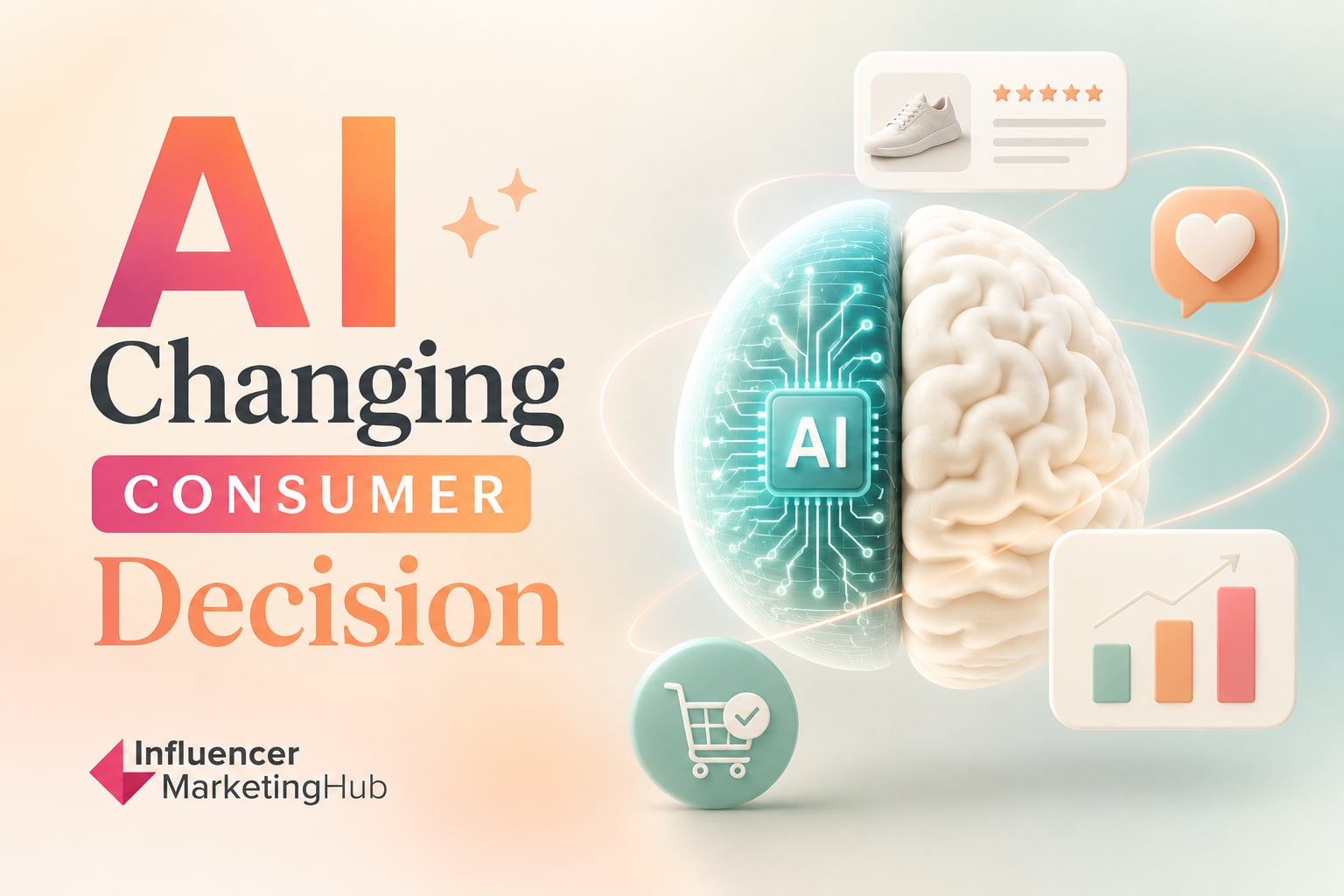
For Gen Z, the AI layer is invisible because it is native to their social apps. They rely on social proof (influencer recommendations) bolstered by AI-summarized insights. They are the most likely to bypass traditional brand websites, preferring to decide based on a TikTok-integrated AI response.
Millennials: The Efficiency Seekers
Millennials use AI as a productivity tool. They utilize LLMs to aggregate data, compare pricing, and filter through the noise of legacy e-commerce sites. They trust AI for logistical decisions but remain slightly more skeptical of AI-driven brand storytelling than their younger counterparts.
Gen X and Boomers: The Validation Layer
For older generations, AI is often used as a verification tool. They use AI to summarize complex product features or to validate a purchase decision by asking, "Is this brand reliable?" For these cohorts, the AI layer acts as a digital consultant, and if the brand doesn’t appear in the AI’s "recommendation," trust is rarely granted.
Supporting Data: The Fragmentation of the Funnel
The data paints a clear picture of why a "one-size-fits-all" marketing strategy is failing:
- The Search Disconnect: Recent studies indicate that 40% of Gen Z now prefers TikTok and Instagram for product searches over Google. This proves that search is no longer a centralized destination; it is a contextual behavior happening across every platform.
- The Second-Screen Reality: 87% of consumers now engage with a second screen while watching television. This multi-screen fragmentation means that brands must ensure that their message is not just consistent, but optimized for the device context in which it is being received.
- The Personalization Gap: 75% of consumers are significantly more likely to purchase from brands that offer hyper-personalized experiences. AI is the only engine capable of scaling this level of precision, yet many brands are still deploying generic, one-to-many marketing tactics.
Implications for Modern Brands
The shift to AI-assisted decision-making requires a total recalibration of marketing strategy.
1. Optimize for the "Answer," Not Just the "Link"
Traditional SEO is dead. In its place, we have "Answer Optimization." If your brand is not appearing in the synthesized, summarized answers provided by AI, you are invisible. Brands must ensure their content is structured in a way that AI models can ingest and verify as an authoritative source.
2. Embrace the Fragmentation
Stop trying to drive all traffic to your homepage. If your audience lives on Reddit, TikTok, or within an AI-powered browser, your strategy must meet them there. The goal is to be present in the "considered set" of the AI, regardless of where that AI is deployed.
3. Precision as the New Conversion Metric
Discounting is no longer the primary driver of conversion—relevance is. AI allows for micro-segmentation that was previously impossible. By utilizing predictive analytics, brands can serve the right offer to the right person at the exact moment their AI agent is weighing a purchase decision.
Expert Perspective: A Note from the Frontlines
Paula Bruno, founder and CEO of Intuition Media Group, notes that the brands winning today are those that bridge the gap between human emotion and algorithmic logic.
"AI is not replacing the need for experiential marketing or human connection," Bruno explains. "Instead, it is acting as the curator that determines which experiences reach which people. A brand that ignores the AI layer is effectively cutting off its own distribution channels."
Bruno’s work with global giants like Unilever and Hyundai highlights that even established brands must now treat "AI presence" as a core pillar of their media strategy, equal in importance to paid social or broadcast advertising.
Conclusion: The Path Forward
The question for CMOs today is no longer "what is our message?" but rather: "Who are we trying to reach, how do they make decisions, and what is the AI layer telling them about us before we even enter the conversation?"
Conversion in 2026 is an exercise in precision. The brands that will thrive in this new environment are those that stop viewing AI as a tool for content creation and start viewing it as the most important participant in the consumer’s decision-making process. By understanding the nuances of how different generations delegate their choices to machines, brands can ensure they are not just present in the conversation, but are the preferred answer when the decision is finally made.
The funnel hasn’t just changed; it has been atomized. The challenge for the modern marketer is to reassemble those pieces into a cohesive, intelligent, and human-centric narrative that holds up even when it’s being told by an algorithm.
