
The Post-Click Paradox: How Upstream Bias and Budget Pressures Are Derailing Paid Media ROI
In an era of rising customer acquisition costs (CAC) and heightened macroeconomic scrutiny, digital marketers find themselves caught in a high-stakes paradox. While an overwhelming majority of marketing professionals acknowledge that their budgets are being squeezed, they continue to funnel their remaining resources into the top of the funnel—overlooking the critical post-click experience where actual conversion occurs.
According to a comprehensive new study, "The State of Paid Media ROI 2026," conducted jointly by conversion intelligence platform Unbounce and research firm Ascend2, there is a stark disconnect between what marketers identify as effective ROI drivers and where they actually allocate their time, effort, and budgets.
While advertising platforms have made it easier than ever to target users and generate clicks, the research reveals that millions of ad dollars are being wasted the moment a user leaves the ad network and lands on an unoptimized, generic corporate website.
1. Main Facts: The Core Findings of the Disconnect
The study, which surveyed 304 paid media professionals across the United States, paints a clear picture of a marketing ecosystem out of balance.
At the heart of the report is a glaring contradiction: 40% of marketers identify destination page optimization as one of the most effective ways to maximize paid media spend, yet only 31% actually invested in their landing pages over the last six months.
Instead, budgets and operational focus continue to flow "upstream" toward audience research (40%), artificial intelligence tools (39%), and ad creative (38%).
Marketer Investment Priorities vs. Perceived ROI Drivers (Last 6 Months)

Optimizing Destination Pages:
[████████████████████] 40% (Identified as Highly Effective)
[███████████████] 31% (Actually Received Investment)

Audience Research & Targeting:
[████████████████████] 40% (Received Active Investment)

AI Tools & Automation:
[███████████████████] 39% (Received Active Investment)
This imbalance has created a highly inefficient digital marketing pipeline. Marketers are spending heavily to win the auction and secure the click, only to abandon the prospect once they arrive at the destination. The study’s key findings highlight several critical areas where this disconnect manifests:
- The Budget Squeeze: 90% of paid media professionals report that resource and budget constraints are actively limiting their programs, with testing and experimentation being the first areas to be cut.
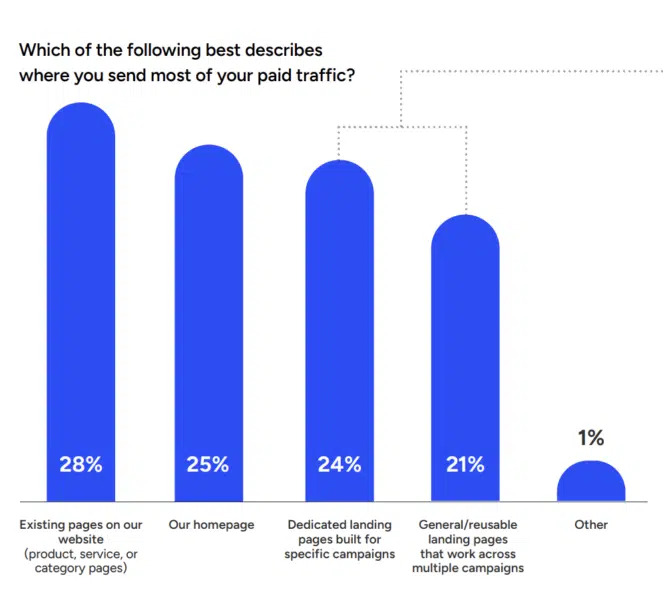
- The Homepage Penalty: More than half (53%) of all paid traffic is sent to general website pages rather than campaign-specific, dedicated landing pages. Specifically, 28% of traffic is directed to existing product or category pages, and 25% is sent directly to the corporate homepage.
- The AI Blind Spot: While 86% of marketers use AI within their paid media workflows, its application is almost entirely confined to upstream activities like reporting, audience targeting, and ad copy generation. Only 19% leverage AI to build or optimize post-click landing pages.
- The Performance Gap: Marketers who consistently exceed their ROI targets behave differently. They invest their resources evenly across the entire customer journey—balancing audience targeting and creative with robust post-click optimization, dedicated landing pages, and sophisticated attribution.
2. Chronology: How Budget Pressures Pushed Marketers Upstream
To understand how the digital marketing industry arrived at this post-click bottleneck, it is necessary to examine how budget constraints and ad-platform dynamics have evolved over the past several years.
CHRONOLOGY OF THE UPSTREAM SHIFT

   Past 3-5 Years                  Past 12-18 Months                  Current Cycle (2026)
┌────────────────────────┐      ┌─────────────────────────┐      ┌─────────────────────────┐
│ Rise of Black-Box AI   │      │ Macroeconomic Pressures │      │ The Post-Click Bottleneck│
│ Platforms              │      │ & Budget Reductions     │      │                         │
│                        │      │                         │      │                         │
│ • Google PMax & Meta   │      │ • Teams downsized       │      │ • 90% of budgets        │
│   Advantage+ automate  │ ───> │ • Focus shifts to       │ ───> │   squeezed              │
│   targeting & bidding. │      │   "fast, visible" ads   │      │ • CRO and landing pages │
│ • CRO sidelined.       │      │ • Dev resources cut     │      │   starved of resources  │
└────────────────────────┘      └─────────────────────────┘      └─────────────────────────┘
The Era of Platform Automation (Past 3–5 Years)
With the introduction and rapid adoption of automated, "black-box" advertising solutions—such as Google’s Performance Max and Meta’s Advantage+—the mechanics of buying ads became highly centralized within the ad networks themselves. These tools promised to optimize targeting, bidding, and creative distribution automatically.
As a result, marketing departments increasingly shifted their technical focus to match these platform requirements, prioritizing ad-platform integration over independent web conversion rate optimization (CRO).
The Macroeconomic Squeeze (Past 12–18 Months)
As interest rates rose and venture capital and corporate spending cooled, marketing departments were pressured to do more with less. When budgets were cut, organizations prioritised immediate, highly visible metrics—such as impressions, click-through rates (CTR), and ad impressions—to prove ongoing activity to executives.
Because building and maintaining custom landing pages requires cross-functional coordination with web developers, designers, and copywriters, post-click optimization was pushed aside in favor of quick, platform-native adjustments.
The Current Bottleneck (2026)
Today, this lopsided approach has reached a breaking point. The Unbounce/Ascend2 report confirms that 90% of marketers are operating under severe resource constraints.
When forced to choose where to cut, nearly half of the respondents admitted that landing page creation, copy variations, and message matching suffered first. Consequently, marketers are stuck in a cycle of paying premium prices for high-intent traffic, only to dump that traffic onto generic homepages because they lack the operational bandwidth to build dedicated destination experiences.
3. Supporting Data: Inside the Numbers of the Marketing Disconnect
The data compiled by Unbounce and Ascend2 reveals a massive execution gap between strategic knowledge and day-to-day execution.
Where the Money Flows vs. Where the Impact Lies
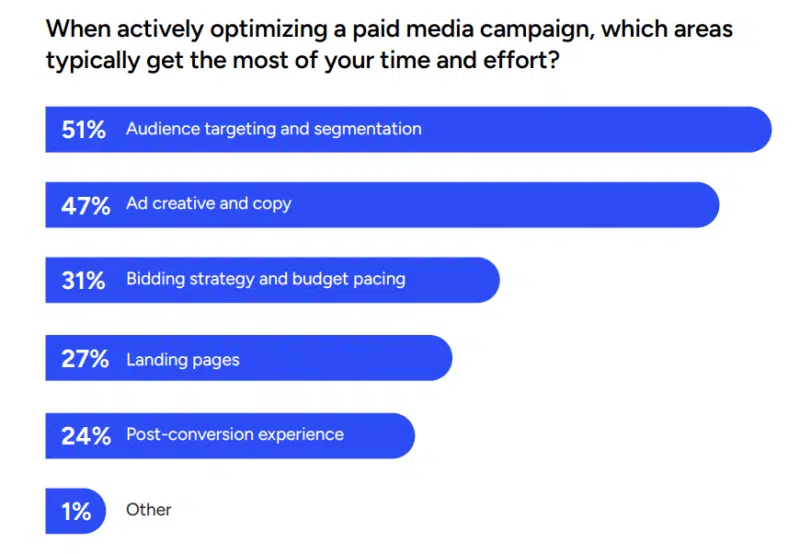
When asked where they invested their budgets and effort over the past six months, respondents highlighted a heavy preference for upstream channel management:
| Area of Investment | Percentage of Marketers Investing (Last 6 Months) |
|---|---|
| Audience Research & Targeting | 40% |
| AI Tools & Automation | 39% |
| Ad Creative | 38% |
| Attribution & Reporting | 35% |
| Testing & Experimentation | 34% |
| Landing Pages & Destination Pages | 31% |
This spending allocation stands in direct opposition to what marketers know actually works. When asked to identify the most effective tactics for maximizing paid media ROI, destination page optimization (40%) ranked second overall, trailing only audience targeting (46%), and placing well ahead of tactical moves like cutting underperforming channels (35%), shifting platforms (32%), or lowering bid caps (19%).
The Destination Breakdown: Where Does the Traffic Go?
The study shows that more than half of all paid media campaigns fail to guide users to a dedicated conversion pathway.

Distribution of Paid Traffic Destinations

[████████████████████████████] 28% - Product or Category Pages
[█████████████████████████] 25% - Corporate Homepage
[████████████████████████] 24% - Dedicated Campaign Landing Pages
[████████████████████] 20% - Reusable Landing Page Templates
[███] 3% - Other / Undefined
This lack of specificity directly harms campaign performance. For example:
- Direct Sales Campaigns: 40% of marketers running campaigns aimed at generating immediate sales send their traffic to general product or category pages rather than high-conversion, campaign-specific landing pages.
- Lead-Generation Campaigns: More than 25% of marketers running lead-generation campaigns direct their prospects to the corporate homepage—a page typically filled with competing links, generic messaging, and no clear call to action.
The financial penalty for this practice is severe. Nearly two-thirds (64%) of marketers who primarily direct paid traffic to their homepage reported that they are failing to meet or exceed their ROI goals.
The AI Adoption Gap
Artificial intelligence has seen near-universal adoption, with 86% of paid media professionals integrating AI into their workflows. However, the technology is being used almost exclusively to optimize the top of the funnel:
- Reporting & Analytics: 47%
- Audience Targeting: 45%
- Ad Copy Generation: 40%
- Landing Page Creation/Optimization: 19%
This data point represents a massive missed opportunity. The survey revealed that marketers who outperformed their ROI targets were twice as likely to use AI for landing page creation and optimization compared to their underperforming peers.
4. Official Responses and Expert Perspectives
The findings of "The State of Paid Media ROI 2026" point to an operational bottleneck rather than a lack of strategic alignment. Marketers do not need to be convinced that landing pages matter; rather, they are physically and organizationally unable to produce them.
In the report, researchers identified several key barriers preventing marketing teams from executing post-click optimization:
- Team Capacity and Bandwidth: Marketing teams have been downsized, leaving remaining staff with barely enough time to manage ad accounts, let alone build custom web pages.
- Design and Development Bottlenecks: In many organizations, changes to web infrastructure must go through centralized IT or web development teams. This introduces weeks of delay, rendering real-time campaign optimization impossible.
- Software and Tooling Budgets: While ad spend is viewed as an direct revenue driver, software tools (such as landing page builders and testing platforms) are often categorized as overhead costs, making them prime targets for procurement cuts.
The Illusion of Ad Platform Optimization
Industry analysts note that modern ad networks have built a "gilded cage" for marketers. Platforms like Google and Meta make it incredibly easy to launch campaigns, write copy, and adjust bids using their internal, AI-driven dashboards.
Because these actions can be taken with the click of a button, marketers spend their days tweaking settings inside the platform. However, once the user clicks the ad, they leave the platform’s ecosystem. At that point, the advertiser must take over the customer experience—a handoff that is failing more than half the time.
As Constantine von Hoffman, Senior Editor at MarTech, observes:
"The findings suggest that budget pressure isn’t simply forcing marketers to spend less. It’s pushing them toward faster, easier optimizations inside advertising platforms while leaving more resource-intensive post-click work behind."
5. Implications: Navigating the End-to-End Marketing Landscape
The Unbounce and Ascend2 report serves as a warning for brands relying on digital advertising. As ad networks become more automated, targeting and bidding strategies are becoming commoditized. If every competitor is using Google’s or Meta’s AI to target the same audience with similar ad creative, the only remaining point of competitive differentiation is what happens after the click.
The Leaky Bucket: Financial Impact of Post-Click Strategy

Scenario A: Homepage Destination (Unoptimized)
  $10,000 Spend  ──>  5,000 Clicks ($2 CPC)  ──>  1.0% Conv. Rate  ──>  50 Conversions ($200 CPA)

Scenario B: Dedicated Landing Page (Optimized)
  $10,000 Spend  ──>  5,000 Clicks ($2 CPC)  ──>  4.0% Conv. Rate  ──>  200 Conversions ($50 CPA)

RESULT: Optimized post-click experience yields 4x more conversions for the exact same ad spend.
The Competitive Advantage of "Outperformers"
The data shows that top-performing marketing organizations avoid the upstream trap by treating paid media as an end-to-end system. Rather than viewing the click as the end goal, they view it as the halfway point of the conversion journey.

Marketers who consistently exceed their ROI targets share three key operational habits:
- Balanced Resource Allocation: They distribute their budgets and time evenly across the entire funnel. They do not starve their web experiences to fund their ad budgets.
- Decentralized Page Creation: Outperforming teams bypass IT bottlenecks by using no-code or low-code landing page platforms, allowing non-technical marketers to build, launch, and test pages in minutes rather than weeks.
- Downstream AI Integration: They are early adopters of AI tools designed for dynamic page personalization, automated copywriting, and multivariate layout testing.
Actionable Strategies for Marketing Leaders
To correct the upstream bias and recover wasted ad spend, marketing executives should consider the following structural changes:
- Audit Traffic Destinations: Immediately review all active paid campaigns. If more than 20% of your budget is directing traffic to a homepage or a generic category page, pause those campaigns or redirect them to dedicated, single-purpose landing pages.
- Establish a "Post-Click Ratio" for Budgets: For every dollar spent on securing an ad click, allocate a set percentage (e.g., 10% to 15%) to optimizing the destination page. If you do not have the resources to optimize the destination, reduce your ad spend accordingly—it is better to send fewer, higher-converting visitors to a great page than to waste money on high bounce rates.
- Empower Teams with Self-Service Tools: Break the IT bottleneck by equipping marketing teams with dedicated landing page software. This allows campaign managers to maintain message match (ensuring the ad copy matches the landing page headline) without needing developer intervention.
Conclusion
In a tight budget environment, the temptation to focus on the easiest, most visible platform metrics is strong. However, the Unbounce and Ascend2 research proves that true ROI efficiency is found in the hard work of post-click optimization. By treating paid media as a complete, unified journey—from the initial search query to the final form submission—brands can stop paying the "homepage penalty" and ensure that every ad dollar spent actually has a chance to convert.
