
The Algorithmic Newsroom: Decoding Global Engagement Trends in the Age of Social Video
In the modern digital ecosystem, the newsroom is no longer just a place where stories are written—it is an algorithmic laboratory. News publishers today face a dual challenge: they must compete not only with one another for the fleeting attention of a global audience but also against the inscrutable, shifting logic of social media platforms. Whether it is YouTube’s recommendation engine, Instagram’s discovery feed, or TikTok’s viral-driven "For You" pages, success in the "News & Politics" genre is increasingly defined by data-driven precision.
According to a comprehensive analysis of video performance data from November 2025 through February 2026, the era of "one-size-fits-all" publishing is over. Insights derived from Tubular Intelligence reveal that audience behavior is highly nuanced, fragmented by geography, and sensitive to timing. For publishers, the path to relevance lies in aligning their editorial strategy with the specific, often counter-intuitive ways viewers consume content in their respective regions.
The Core Data: A Global Shift in Consumption
The analysis, which spanned APAC, LATAM, EMEA, and North America, highlights a critical trend: volume is no longer a proxy for value. Many publishers continue to churn out "mid-length" content—videos ranging from two to five minutes—because it is efficient to produce. However, the data suggests that this strategy may be failing to capture the full potential of audience engagement.
The APAC Duration Dilemma
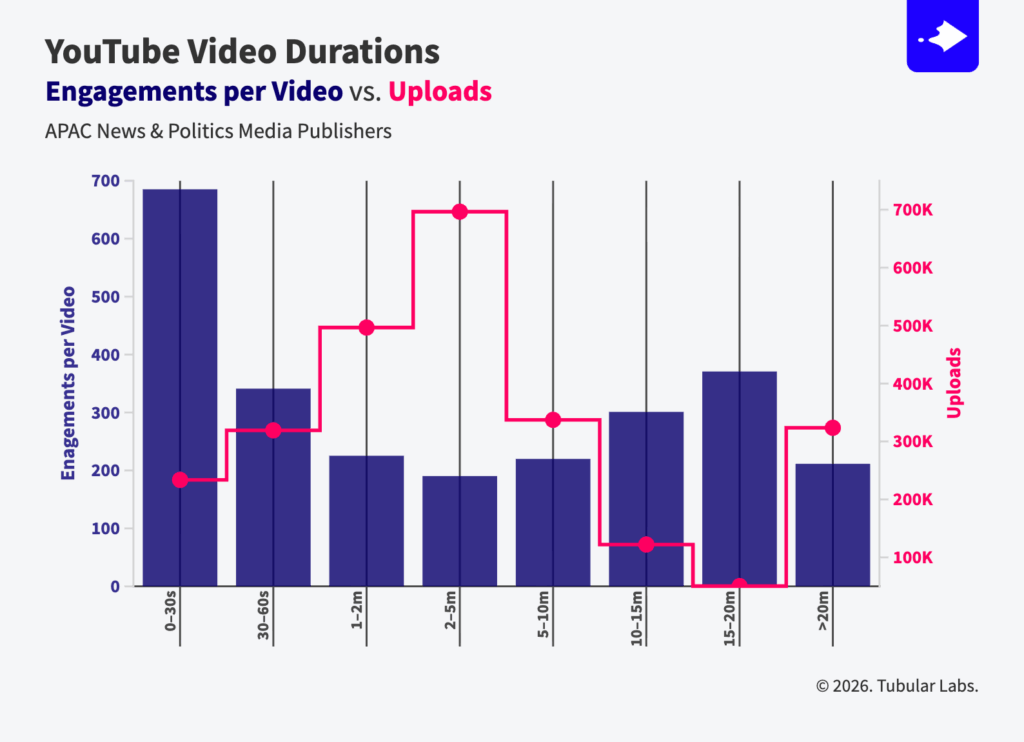
In the Asia-Pacific (APAC) region, viewer behavior exhibits a distinct "barbell" preference. Audiences are heavily polarized between ultra-short updates (under 30 seconds) and deep-dive, long-form explainers (15 to 20 minutes).
While mid-length videos account for the highest volume of uploads, they consistently underperform in terms of engagement per video. This indicates a significant disconnect between supply and demand. Publishers in this region who pivot toward shorter, high-impact clips for discovery and longer, authoritative deep-dives for loyalty are seeing significantly higher returns on their creative investments.

The LATAM Timing Paradox
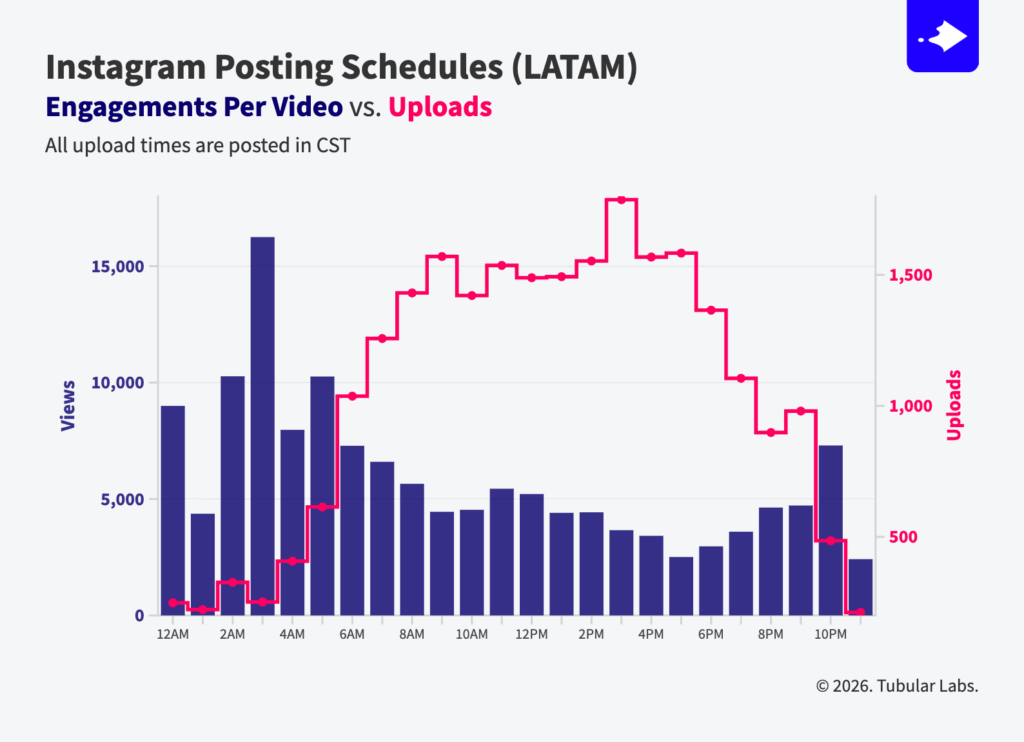
Perhaps the most striking inefficiency uncovered by the data exists in Latin America (LATAM). Publishers in this region predominantly post during the evening, between 3:00 PM and 3:59 PM CST, likely mirroring traditional broadcast news cycles. However, the data reveals that actual engagement peaks in the early morning, specifically between 3:00 AM and 3:59 AM.
This creates a "timing mismatch." By publishing during the saturated afternoon hours, newsrooms are fighting for space in a crowded feed. Shifting distribution to the early-morning window offers a twofold advantage: it captures an audience that is actively seeking information at the start of their day and faces drastically lower competition from other publishers.
Chronology of Content Evolution (Nov 2025 – Feb 2026)
To understand how these trends manifest, we must look at the progression of news cycles over the four-month window analyzed:
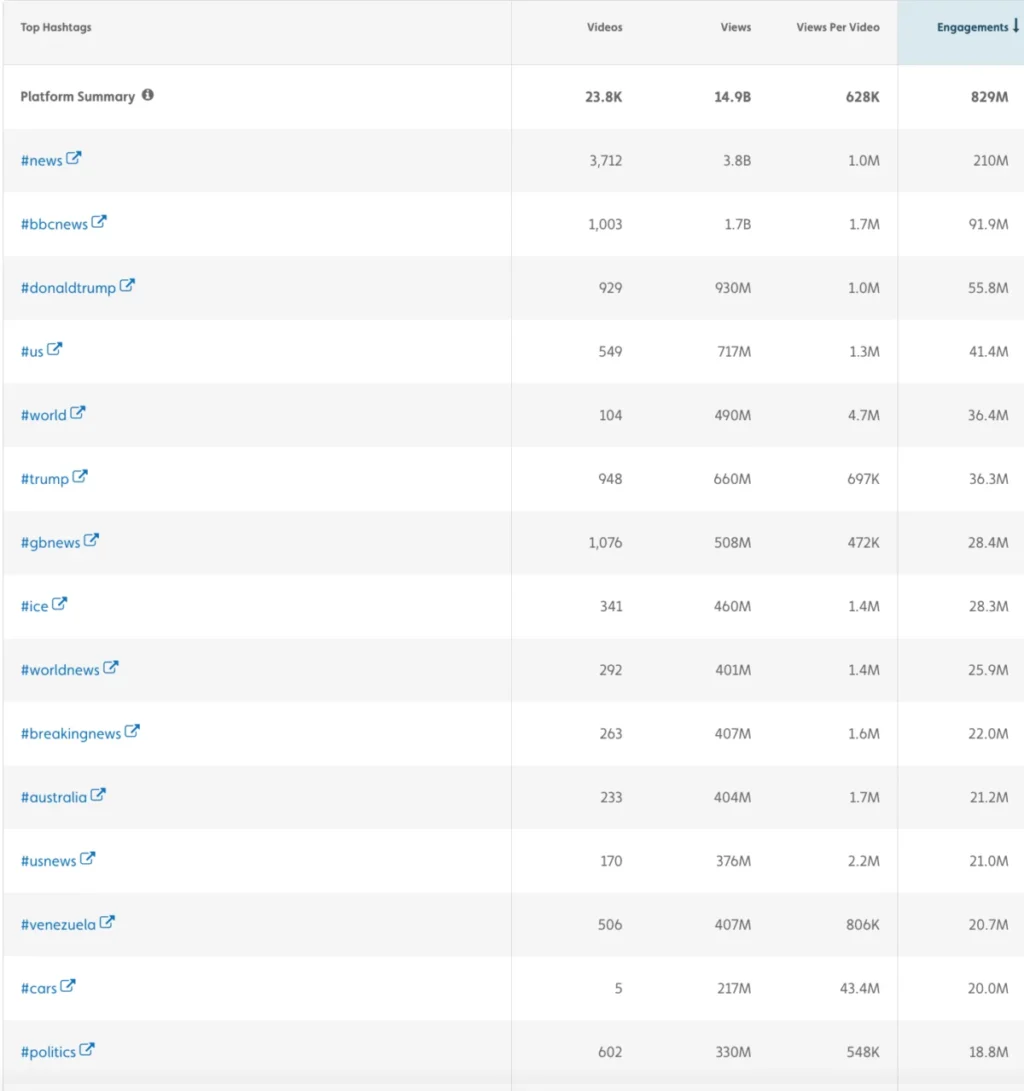
- November 2025 (The Search for Authority): As geopolitical tensions flared, EMEA publishers began leaning heavily into strategic hashtag usage. The trend showed a shift away from generic tagging toward a mix of global political flashpoints (#trump, #venezuela) and established, brand-led identifiers (#bbcnews). This signaled a maturation in social SEO, where publishers began treating hashtags as a bridge between breaking news and search-driven discoverability.
- December 2025 – January 2026 (The Rise of the "Human" Element): During the winter, US-based publishers saw a dramatic divergence in content performance. While hard news—such as the tragic car accident involving Anthony Joshua in Nigeria—drove massive, passive viewership (180 million views in 30 days), the highest engagement was reserved for content that allowed for audience commentary.
- February 2026 (The Engagement Pivot): By the end of the period, the "viral" trend shifted toward reactive content. A standout example was a video featuring an interview at an ICE protest. While the subject matter was serious, the audience response was defined by mockery and debate, resulting in 63.5 million engagements in a single week. This underscored a shift: audiences on platforms like TikTok are no longer just passive consumers of news; they are active participants in a cultural conversation.
Supporting Data: Understanding Platform Dynamics
The data reinforces a fundamental truth: different platforms demand different psychological contracts with the viewer.
On platforms like YouTube, viewers often commit to longer, narrative-driven content. In contrast, on TikTok, the "hard news" model is being disrupted by the "cultural reaction" model. The most successful publishers are those who recognize that while breaking news generates reach, it is the emotional resonance of a story—its ability to spark debate, humor, or shock—that drives the engagement metrics platforms use to determine which videos appear on the front page.
Furthermore, the strategic use of hashtags in EMEA proves that discoverability is a multi-layered game. By combining global tags with specific country identifiers, publishers are effectively building a global news wire that survives long after the initial broadcast, allowing their content to remain discoverable for international audiences months after the event.
Official Perspectives and Industry Implications
Industry analysts at Tubular Labs emphasize that the primary issue facing newsrooms is not a lack of content, but a lack of alignment. "The opportunity isn’t to publish more," note the researchers. "It’s to publish smarter."
The implications for the industry are profound:
- Editorial Workflow Restructuring: Newsrooms must shift from a "production-first" mindset to an "audience-first" workflow. If data shows that 3:00 AM is the peak engagement window in a specific market, the editorial calendar should be adjusted to facilitate live or scheduled posting during those hours, regardless of traditional news cycle norms.
- Format Flexibility: The "mid-length" trap is a significant drain on resources. Newsrooms should experiment with repurposing long-form content into "micro-moments" for short-form platforms, rather than treating each format as a distinct, labor-intensive silo.
- Algorithmic Literacy: Publishers must view platforms as partners in distribution. Understanding the difference between a "view" (which signals awareness) and an "engagement" (which signals loyalty) is essential. The data suggests that hard news is the fuel for awareness, but the commentary around that news is the fuel for platform growth.
Implications for the Future of Journalism
As we move deeper into 2026, the competitive landscape for news publishers will continue to tighten. The platforms themselves are evolving; they are increasingly prioritizing content that keeps users within their ecosystem, fostering community and discussion.
For legacy news organizations, the transition to this new reality is existential. The data suggests that those who rely solely on their brand name or the "weight" of their news will continue to lose ground to, or be forced to compete with, independent creators who instinctively understand how to package news as social currency.
The path forward is clear: success in the News & Politics space requires a synthesis of journalistic integrity and data-driven agility. By mastering the nuances of regional consumption, optimizing for the correct duration, and leveraging search-optimized tagging, publishers can move beyond the "mid-length" stagnation that currently plagues the industry.
The newsroom of tomorrow is one that listens as much as it speaks. It is a newsroom that watches the clock in LATAM, respects the attention spans of APAC, and understands the cultural, often humorous, undercurrents of the American social feed. In an era of infinite content, the most valuable commodity remains the ability to be found, to be understood, and—above all—to be part of the conversation.
For publishers looking to refine their strategy, the integration of real-time intelligence is no longer optional. As audience behaviors continue to fluctuate, the ability to pivot based on actionable, platform-specific data will define the winners of the next decade in digital media.
