
The 2026 Social Media Image Size Guide: A Strategic Blueprint for Digital Success
In the rapidly evolving landscape of digital marketing, one truth remains constant: visual content is the primary driver of engagement. However, the technical specifications for that content are in a state of perpetual flux. As platforms like Instagram, X, Facebook, LinkedIn, and TikTok continue to refine their algorithms and user interfaces, maintaining brand consistency across these diverse environments has become a significant challenge for social media managers and creative directors alike.
Using the incorrect image dimensions is more than a minor technical oversight; it is a strategic liability. Images that are improperly sized are subject to aggressive compression, awkward cropping, and a loss of visual integrity, all of which directly undermine brand professionalism and audience trust. This comprehensive guide provides the essential 2026 specifications to ensure your brand remains visually sharp and strategically positioned across every major social network.
![Social media image sizes for all networks [July 2026]](https://blog.hootsuite.com/wp-content/uploads/2023/01/Social-Media-Image-Sizes-2023.png)
The Strategic Importance of Precision
Why should a business prioritize pixel-perfect images? The answer lies in the psychology of the "scroll." Users decide within milliseconds whether to engage with a post or bypass it. When an image is blurry due to poor resolution or cut off because it ignores aspect ratio requirements, it signals a lack of attention to detail.
Beyond aesthetics, technical compliance affects platform performance. Algorithms often deprioritize content that does not meet native resolution standards, potentially limiting your organic reach. By aligning your creative assets with platform-specific requirements, you ensure that your brand’s visual story is told exactly as intended, regardless of the device—mobile or desktop—your audience uses.
![Social media image sizes for all networks [July 2026]](https://blog.hootsuite.com/wp-content/uploads/2025/12/Social-media-image-sizes-for-all-networks-December-2025-556x556.png)
The 2026 Landscape: Key Platform Specifications
Instagram: The Visual Standard
Instagram remains the cornerstone of visual social media. With its mix of permanent grid posts, fleeting Stories, and high-engagement Reels, it requires a multifaceted approach to image management.
- Profile Pictures: 320 x 320 pixels. While displayed as a circle, uploading a square file ensures no vital elements are lost.
- Feed Posts: 1080 x 1080 (Square), 1080 x 1350 (Portrait), and 1080 x 566 (Landscape).
- Stories and Reels: 1080 x 1920 pixels. Crucially, creators should avoid placing critical text or logos within the top 14% and bottom 35% of the frame to avoid the interface overlay.
X (formerly Twitter): The Multimedia Pivot
X has shifted toward a more multimedia-heavy feed, integrating a robust video tab and prioritizing visual impact to break through the text-heavy environment.
![Social media image sizes for all networks [July 2026]](https://blog.hootsuite.com/wp-content/uploads/2025/12/Social-media-image-sizes-for-all-networks-January-2026-1-620x465.png)
- Profile Photos: 400 x 400 pixels.
- Header Photos: 1500 x 500 pixels.
- In-Stream Images: 1600 x 900 pixels is the gold standard for landscape, maintaining a 16:9 aspect ratio for optimal viewing on both mobile and desktop.
Facebook: The Cross-Platform Balancing Act
Facebook continues to be a hybrid platform, serving both desktop power users and mobile-first consumers. Consistency here requires designing for the smallest screen while maintaining quality for the largest.
- Page Cover Photos: 851 x 315 pixels.
- Timeline Posts: 1200 x 630 pixels remains the most versatile size for link previews and standard posts, ensuring no truncation in the feed.
- Stories: 1080 x 1920 pixels.
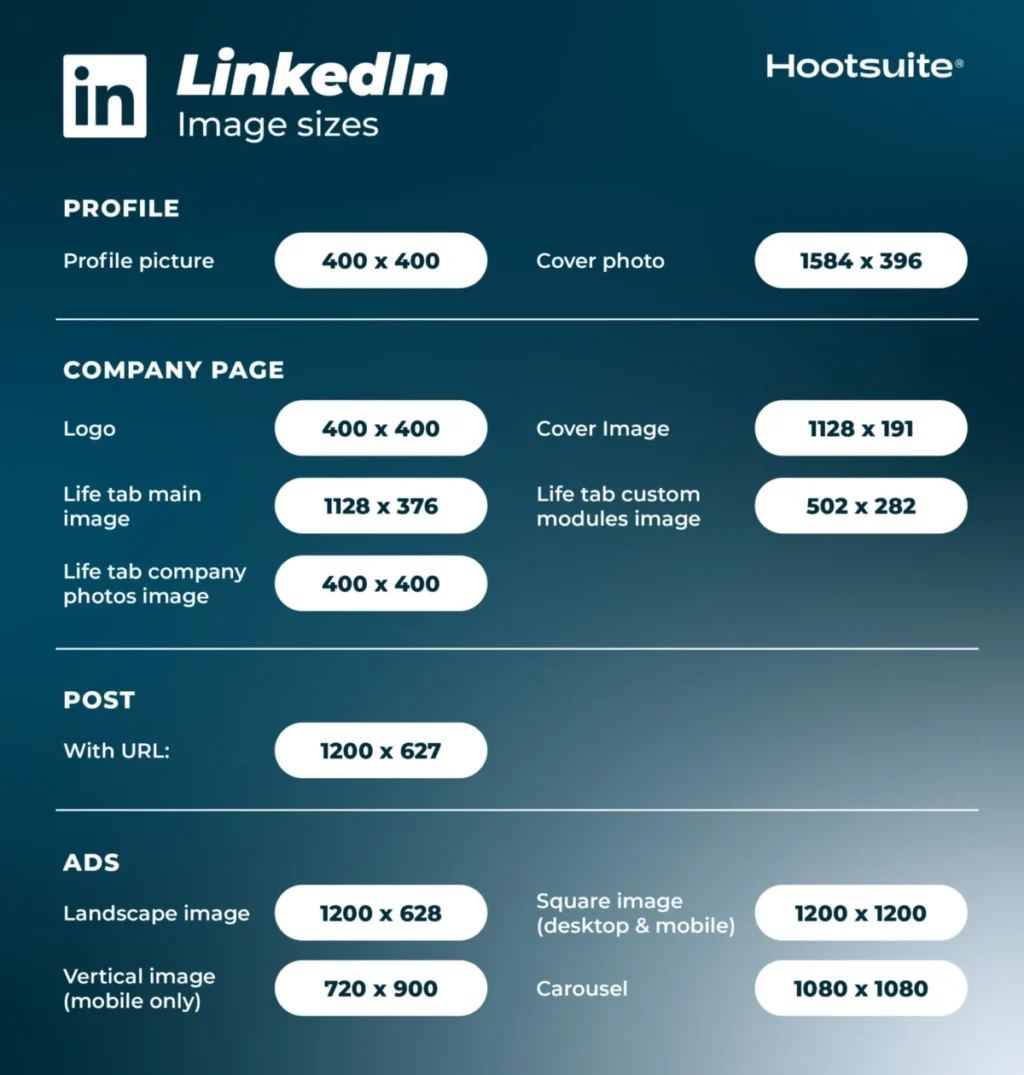
LinkedIn: Professionalism in Every Pixel
On LinkedIn, your visual identity is an extension of your brand’s corporate reputation. Professionalism is non-negotiable.
![Social media image sizes for all networks [July 2026]](https://blog.hootsuite.com/wp-content/uploads/2025/04/Social-media-image-sizes-Instagram-620x558.jpg)
- Company Logo: 300 x 300 pixels.
- Cover Images: 1128 x 191 pixels.
- Standard Feed Posts: 1200 x 627 pixels for link shares and 1200 x 1200 pixels for static imagery.
TikTok: The Vertical Frontier
TikTok demands high-energy, vertical-first creative. Since the platform is almost exclusively consumed on mobile, the 9:16 aspect ratio is the only one that guarantees a full-screen, immersive experience.
- Profile Photo: 200 x 200 pixels.
- Video Content: 1080 x 1920 pixels.
Chronology of Platform Changes
The evolution of image sizes is rarely sudden; it is a gradual adaptation to changing hardware. As smartphones have transitioned to taller, narrower screens, social platforms have shifted their default aspect ratios from the traditional 16:9 landscape to the 9:16 portrait format.
![Social media image sizes for all networks [July 2026]](https://blog.hootsuite.com/wp-content/uploads/2025/12/Social-media-image-sizes-for-all-networks-January-2026-1-1-620x629.png)
In early 2025, we saw a massive push toward "full-screen" experiences across all platforms, including LinkedIn and X, which previously favored horizontal content. By 2026, the industry has standardized around the "mobile-first" philosophy, where the 1080px width is the ubiquitous anchor for almost all high-quality digital assets.
Supporting Data: Why "Standardization" Matters
Industry research indicates that posts utilizing native, platform-optimized aspect ratios see a 20% to 30% increase in engagement compared to posts that are simply repurposed without resizing. Compression artifacts—the "blurriness" seen on images that are too small or poorly exported—are often detected by automated platform systems, which may then re-compress the file, further degrading quality. By adhering to the recommended dimensions, brands avoid these automated penalties.
![Social media image sizes for all networks [July 2026]](https://blog.hootsuite.com/wp-content/uploads/2025/12/Social-media-image-sizes-for-all-networks-January-2026-3-620x753.png)
Official Responses and Platform Guidelines
Major platforms have been explicit in their documentation: while they possess sophisticated AI to crop and scale images, they consistently advise against relying on these tools. Instagram, for instance, notes that "manual optimization is the only way to guarantee a brand’s aesthetic integrity." Meta’s advertising guidelines similarly urge marketers to design for the specific placement—whether it be a Story or a Feed post—rather than attempting to use a "one size fits all" asset.
Implications for Modern Marketing Teams
For marketing enterprises, the challenge of managing these variables at scale is significant. The modern workflow must integrate these technical requirements directly into the creative process.
![Social media image sizes for all networks [July 2026]](https://blog.hootsuite.com/wp-content/uploads/2025/04/Social-media-image-sizes-LinkedIn-620x651.jpg)
- Template Creation: Design teams should maintain a master library of templates for every common format (e.g., "LinkedIn Feed," "Instagram Story," "X Header") to prevent the need for manual resizing.
- Workflow Integration: Utilizing platforms like Perch by Hootsuite allows for real-time adjustments. By building images within an environment that provides network-optimized templates, teams can bypass the trial-and-error phase of posting.
- Governance: Large organizations should implement a brand style guide that includes specific "safe zones" for text and logos, ensuring that even when a platform crops an image, the core brand message remains visible.
Navigating the Future of Digital Visuals
As we look toward the remainder of 2026, we anticipate that the distinction between "image" and "video" content will continue to blur, with static images incorporating more motion-graphic elements. This will require marketers to be even more precise with their resolution settings, as high-resolution assets will be necessary to support these lightweight animations without pixelation.
Ultimately, the goal is to reduce the "friction" between your brand and your audience. When your visual content is perfectly sized, your audience focuses on your message, your product, and your value proposition, rather than the technical shortcomings of the display. In a crowded digital marketplace, this clarity is not just a best practice—it is a competitive advantage.
![Social media image sizes for all networks [July 2026]](https://blog.hootsuite.com/wp-content/uploads/2025/04/Social-media-image-sizes-Pinterest-620x517.jpg)
By standardizing your image production process and keeping these 2026 specifications as your North Star, you empower your brand to maintain a consistent, professional, and highly engaging presence across every corner of the social web.
