
The Accelerated Evolution: Mapping Generative AI’s Chaotic Journey Through the MarTech Hype Cycle
In the fast-evolving landscape of marketing technology, few analytical frameworks are as polarizing—or as essential—as the Gartner Hype Cycle. It is a model that is simultaneously revered for its diagnostic clarity and reviled for its perceived reductionism. Yet, as generative AI (GenAI) reshapes the foundational tools of the modern marketer, the Hype Cycle has become the primary lens through which we attempt to make sense of an unprecedented technological deluge.
The reality of 2025 is that GenAI is not a monolith. It is not a single point on a curve; rather, it is an entire ecosystem of applications, each moving at its own velocity across the graph of inflated expectations, disillusionment, and enlightenment. As a new report from SAS, Marketers and AI: Navigating New Depths, suggests, the speed at which these technologies are maturing is rendering traditional adoption timelines obsolete.
The Core Thesis: Understanding the "Multi-Generational" Hype Cycle
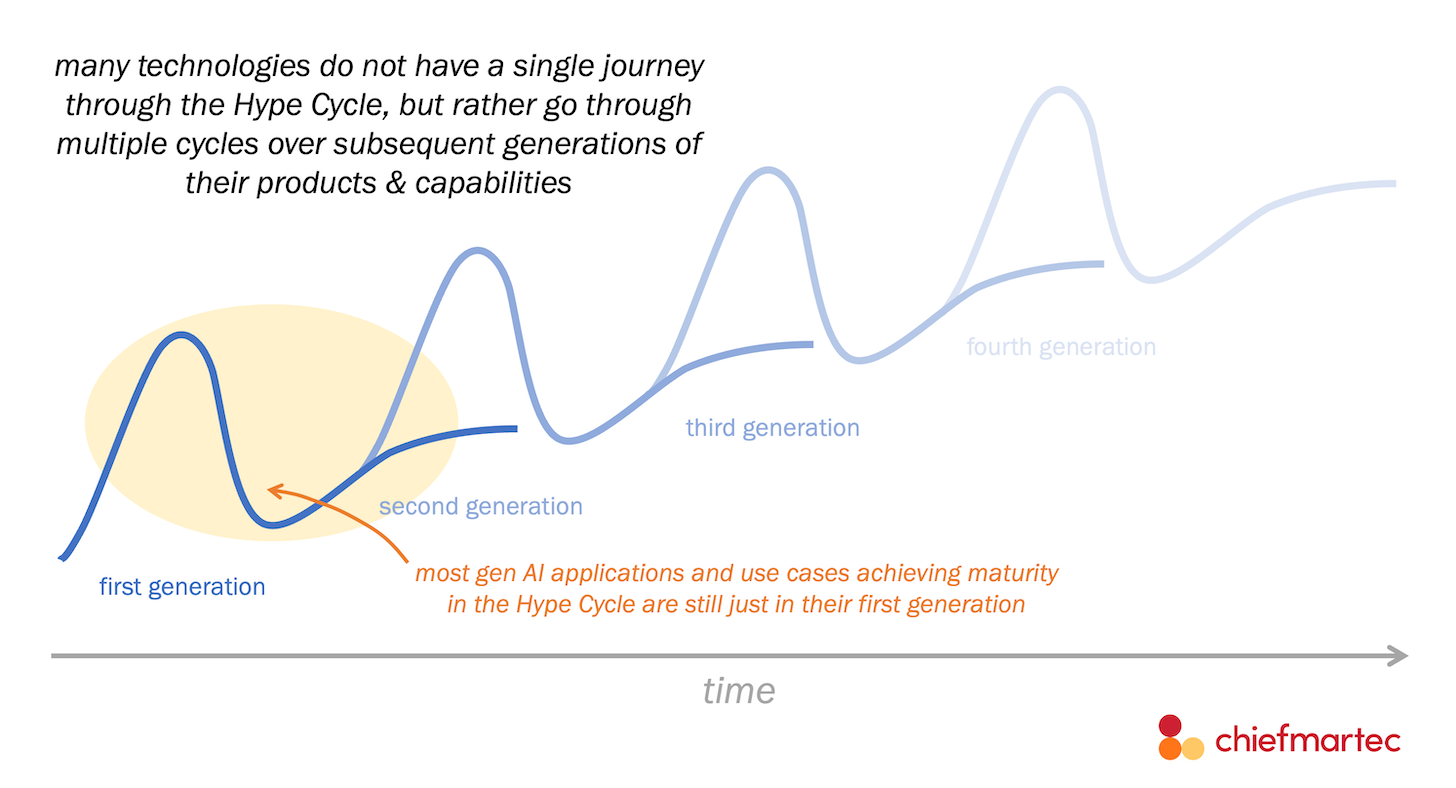
To understand the current state of martech, we must first dispel the notion that GenAI follows a linear progression. When we look at any specific AI application—such as a customer service chatbot—we are looking at a "first-generation" iteration.
Today’s chatbots are capable of handling basic, query-response tasks with relative accuracy. However, in two, five, or ten years, these agents will likely possess the agency to execute complex, autonomous cross-selling motions and take decisive actions on behalf of the customer. Crucially, each of these "generations" will trigger its own, unique Hype Cycle.
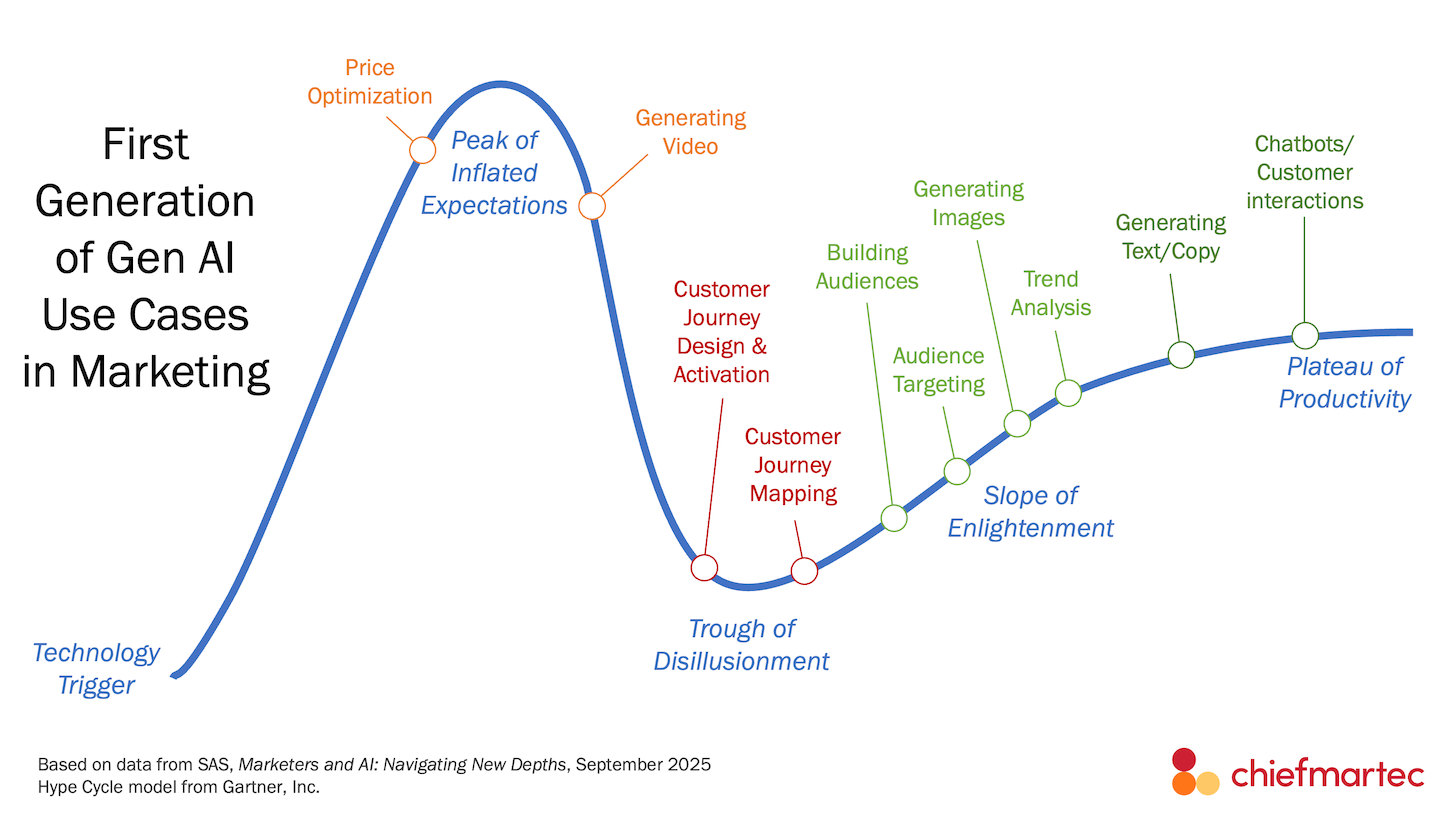
We are currently witnessing a phenomenon where a technology can exist in the "Plateau of Productivity" for its first-generation capabilities while simultaneously entering the "Peak of Inflated Expectations" for its second-generation promise. This intellectual elasticity—the ability to hold two opposing truths about the same technology—is the hallmark of the modern marketing technologist.
Chronology of Adoption: A 12-Month Snapshot
The pace of adoption has shifted from a crawl to a sprint. Where it once took a decade for a technology to travel from its initial trigger to the plateau of productivity, we are now seeing this transition compressed into 24 months.
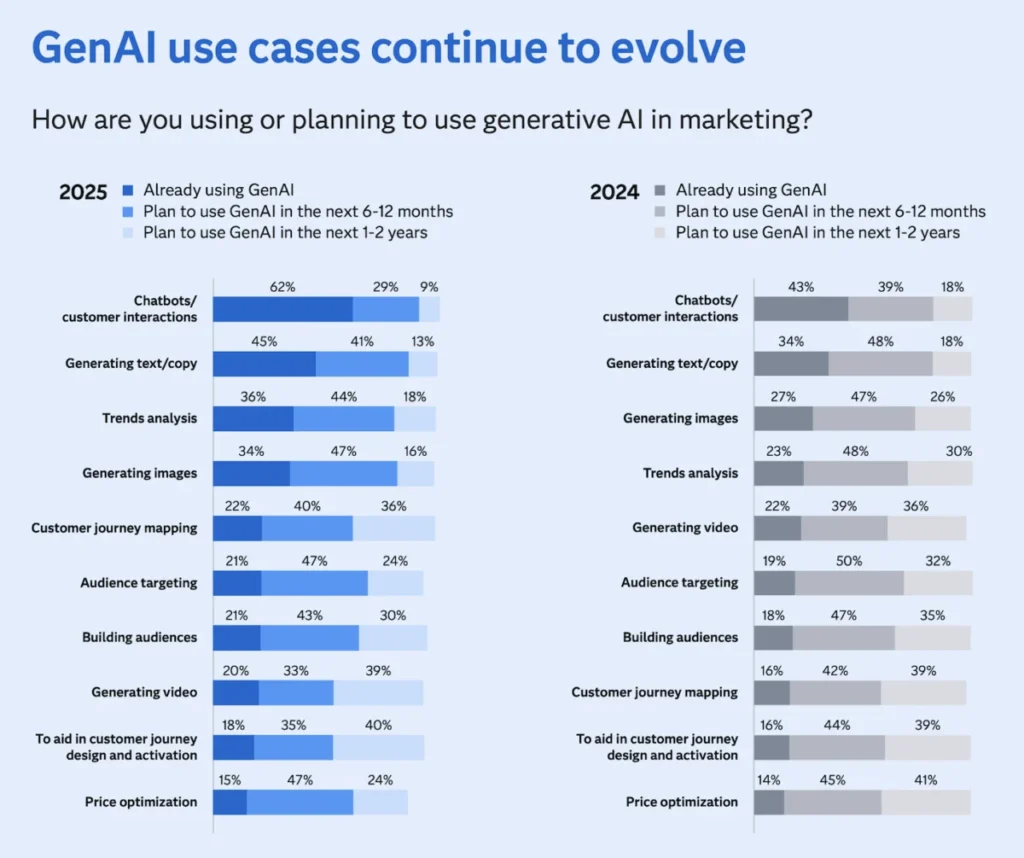
Data from the 2025 SAS report provides empirical evidence of this compression. By comparing the adoption rates of 10 distinct marketing AI use cases between 2024 and 2025, we can see a clear maturation trend. The most significant acceleration has been seen in:
- Content Personalization: The transition from experimental to operational has been rapid as marketers move past generic messaging to hyper-targeted, AI-driven creative.
- Customer Experience Optimization: Utilizing AI to map and refine user journeys in real-time has moved from a "nice-to-have" to a core competitive requirement.
- Creative Asset Generation: While initially viewed as a novelty, the integration of generative visual and copy assets into daily workflows has reached a new level of professional maturity.
Conversely, the data reveals a "reversal of fortune" for certain use cases. Some technologies that enjoyed immense fanfare in 2024 have seen a contraction in adoption. This is not necessarily a failure of the technology, but a classic indicator of the "Trough of Disillusionment." Organizations that rushed into implementation without clear ROI metrics have retreated to reassess their strategies, effectively clearing the deck for more robust, sustainable integrations.
Supporting Data: The Maturation of AI Use Cases
The SAS report surveyed 300 professionals, providing a robust sample size that captures the sentiment of the industry. When mapping these findings to the Hype Cycle, we find a direct correlation between adoption velocity and placement on the curve.
The most highly adopted use cases—primarily those focused on productivity and efficiency—have firmly established themselves on the "Plateau of Productivity." These include automated email optimization and basic data synthesis. In these areas, the "hype" has dissipated, replaced by the mundane, high-value reality of increased throughput.
However, the "Trough of Disillusionment" is currently occupied by early-stage, "black box" predictive tools that failed to deliver on the lofty promises of absolute accuracy. For the marketer, this creates a bifurcated landscape: on one hand, tools that work and are being scaled; on the other, tools that are undergoing a necessary "re-education" phase to align with enterprise expectations.
Official Perspectives and Industry Implications
The implications of this rapid cycle are profound for leadership. The traditional "wait and see" approach is no longer a viable strategy in a market where the gap between the innovators and the laggards is widening every quarter.
Industry analysts and researchers, including those at SAS, emphasize that the current phase of the cycle is defined by "utility over novelty." The era of "AI for AI’s sake" is rapidly ending. CMOs are now demanding clear, quantifiable business impacts, leading to a shift in investment toward applications that integrate seamlessly with existing martech stacks rather than those that act as siloed, shiny objects.
Furthermore, the conversation is already shifting toward the horizon. The SAS report notes early considerations regarding the role of quantum computing in marketing. While this may seem like science fiction, the history of the last 24 months serves as a warning: the timeline for "disruptive" to "operational" is only getting shorter.
The Strategic Path Forward
So, how does the modern organization navigate this? The answer lies in managing a portfolio of AI initiatives at different stages of the Hype Cycle.
- Exploit the Plateau: Double down on technologies that have reached the Plateau of Productivity. These are your "known quantities" that drive current revenue and efficiency.
- Mitigate the Trough: For technologies in the Trough of Disillusionment, do not discard them. Instead, audit them. Are they failing because of the technology, or because of the implementation? Often, a second-generation approach—focused on specific, narrow use cases—can pull a technology out of the trough.
- Monitor the Peak: Keep a close eye on the Peak of Inflated Expectations. This is where your competitive advantage for the next 18 months will be forged. However, manage expectations internally to ensure that the inevitable "trough" does not result in the abandonment of promising long-term assets.
Conclusion: An Exhilarating (and Exhausting) Time
We are living in an era of unprecedented technological turnover. The exhaustion felt by many in the martech community is a rational response to the sheer velocity of change. However, this exhaustion should not be mistaken for stagnation.
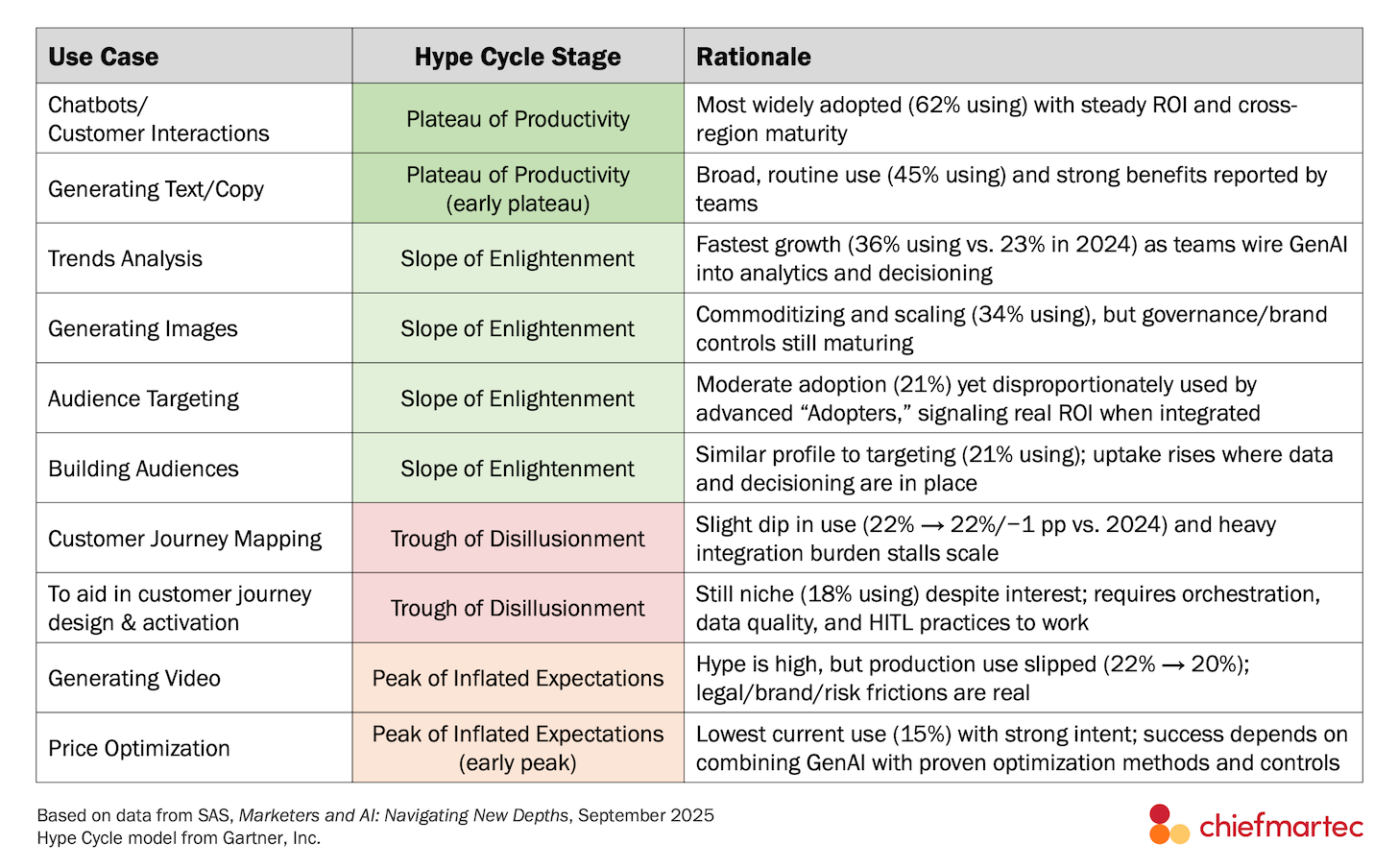
The fact that we are already debating the merits of second-generation AI agents while still perfecting first-generation chatbots is a testament to the vibrancy of our industry. As we move through these multiple, overlapping Hype Cycles, the most successful marketers will not be those who adopt the most technology, but those who best understand the timing of that adoption.
We are no longer just marketers; we are now curators of a complex, evolving machine-learning infrastructure. It is a challenging role, but as the data suggests, it is also one of the most intellectually stimulating times to be in the business of growth. Whether we are climbing a peak, sliding into a trough, or steadying ourselves on a plateau, the journey is just beginning. With quantum computing and more advanced autonomous agents on the horizon, the only certainty is that the cycle will continue to accelerate. The question is no longer if you will use AI, but when you will decide which generation of it is worth your time.
